Engineering Review: Single Pulse MIG/MAG Welding Robot – Curitiba, Brazil
In this article
- Field Engineering Report: Implementation of Single Pulse MIG/MAG Welding Robot for Structural…
- Site Overview: Curitiba Industrial Sector
- The Technical Synergism: MIG/MAG Welding Robot and Arc Welding Solutions
- Deep Dive: Galvanized Pipe Welding Challenges
- Operational Parameter Adjustments
- Lessons Learned from the Field
- Economic and Quality Impact
- Technical Conclusion
Field Engineering Report: Implementation of Single Pulse MIG/MAG Welding Robot for Structural Components
Site Overview: Curitiba Industrial Sector
This report details the commissioning and optimization phase of a robotic welding cell in Curitiba, Brazil. The facility focuses on the mass production of structural frameworks, specifically utilizing galvanized pipe welding for outdoor infrastructure. Given the high humidity levels typical of the Curitiba plateau and the volatile nature of zinc coatings, the integration of a MIG/MAG Welding Robot was paired with customized Arc Welding Solutions to ensure metallurgical integrity and aesthetic consistency.
The Technical Synergism: MIG/MAG Welding Robot and Arc Welding Solutions
In a high-throughput environment, a MIG/MAG Welding Robot is often viewed as a standalone hardware purchase. However, the success of this project relied on the synergy between the hardware and the overarching Arc Welding Solutions. In Curitiba, we encountered a specific challenge: the local supply of shielding gas and wire electrodes often fluctuates in chemical consistency. To counter this, the “solution” aspect involved the implementation of an adaptive pulse-control algorithm and a high-accuracy wire feeding system.
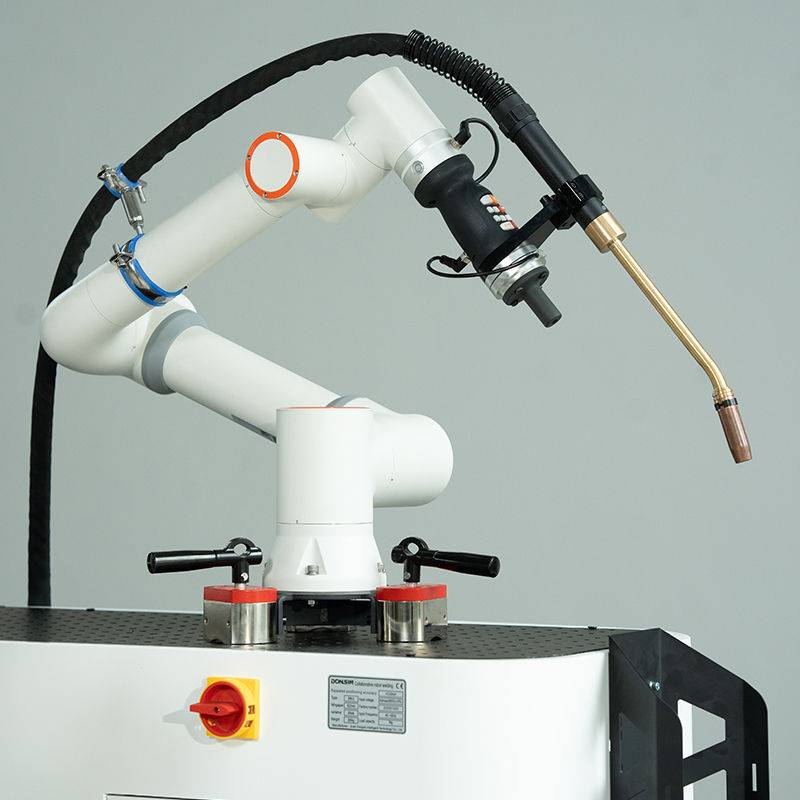
The MIG/MAG Welding Robot provides the mechanical repeatability required for complex circular paths on pipe joints. But without the integrated Arc Welding Solutions—which include the power source’s waveform management and the torch’s high-duty cycle cooling—the robot would merely be repeating a defective process. We synchronized the robot’s motion controller with the power source’s “Pulse-on-Pulse” capabilities to manage the thermal input, which is critical when dealing with the thin-walled galvanized materials common in the Brazilian structural market.
Deep Dive: Galvanized Pipe Welding Challenges
Galvanized Pipe welding is notoriously difficult due to the low boiling point of zinc (approximately 906°C) compared to the melting point of the steel substrate (approx. 1535°C). When the arc strikes, the zinc coating vaporizes instantly. If the weld pool solidifies too quickly, the zinc vapor becomes trapped, leading to subcutaneous porosity or “wormholes.”
Managing Zinc Vaporization
In our Curitiba field tests, we observed that standard short-circuit transfer resulted in excessive spatter, as the exploding zinc vapor disrupted the molten globule transfer. By switching the MIG/MAG Welding Robot to a single pulse mode, we achieved a “one drop per pulse” metal transfer. This stabilized the arc significantly. The pulse peak current serves to punch through the surface tension of the molten pool, allowing the zinc gas to escape before the background current allows the pool to freeze.
Shielding Gas Selection in the Brazilian Context
Local gas blends in Paraná often vary. For this Galvanized Pipe welding application, we moved away from the standard 80/20 Argon/CO2 mix. We implemented an Arc Welding Solutions package that utilized a 92% Argon / 8% CO2 blend. The lower CO2 content reduced the overall heat of the arc, which minimized the width of the Heat Affected Zone (HAZ) where the protective zinc coating is burnt off, thereby preserving the pipe’s corrosion resistance near the bead.
Operational Parameter Adjustments
During the second week of implementation, we focused on fine-tuning the MIG/MAG Welding Robot travel speeds and torch angles. For Galvanized Pipe welding, a “push” technique (forehand welding) was employed at a 15-degree angle. This technique directs the arc force ahead of the weld pool, effectively pre-heating the zinc coating and allowing it to vaporize before the main molten pool arrives. This is a critical lesson learned: dragging the torch (backhand) tends to trap more gas under the bead.
Waveform Optimization
The Arc Welding Solutions software allowed us to modify the “tail” of the pulse. By slightly increasing the burn-back time and adjusting the crater fill parameters, we eliminated the common “cold start” issues associated with robotic pipe welding. In Curitiba’s winter mornings, the ambient temperature in the shop can drop significantly, affecting the initial arc strike. We programmed a “hot start” routine into the MIG/MAG Welding Robot to compensate for the initial thermal sink of the cold galvanized pipe.
Lessons Learned from the Field
1. Grounding Integrity
One of the most overlooked aspects of Arc Welding Solutions is the work-piece lead (grounding). In this Curitiba plant, we found that inconsistent grounding was causing “arc blow,” which the robot’s sensors were incorrectly identifying as a wire-feed error. Given the high-frequency pulses used in modern MIG/MAG Welding Robot units, a dedicated, low-impedance ground for the rotating pipe fixture was mandatory to prevent interference with the robot’s encoder signals.
2. Nozzle Maintenance
Zinc spatter is more “tenacious” than steel spatter. It adheres to the gas nozzle and creates turbulence in the shielding gas flow. We integrated an automatic reamer station into the robotic cell. Every five cycles, the MIG/MAG Welding Robot performs a cleaning routine and applies an anti-spatter injection. This reduced downtime by 14% compared to manual cleaning intervals.
3. Fume Extraction Strategy
The health hazards of zinc oxide fumes cannot be overstated. A key part of the Arc Welding Solutions deployed in Brazil was the integration of a high-vacuum extraction system mounted directly on the robot’s 6th axis. Because the MIG/MAG Welding Robot moves in a predictable path, the extraction hood could be positioned much closer to the source than a manual welder would tolerate, ensuring 98% capture of the hazardous white smoke typical of Galvanized Pipe welding.
Economic and Quality Impact
The transition to a robotic system in Curitiba has yielded measurable results. The rework rate, which stood at 12% with manual Galvanized Pipe welding due to porosity, has dropped to less than 1.5%. This is largely attributed to the consistency of the pulse parameters provided by the Arc Welding Solutions. Furthermore, the MIG/MAG Welding Robot has increased the linear meters welded per hour by 40%, as the machine does not need to pause for the operator to reposition around the pipe’s circumference.
Technical Conclusion
The implementation of a MIG/MAG Welding Robot for Galvanized Pipe welding requires more than just high-end hardware; it requires a tailored set of Arc Welding Solutions that account for the physics of zinc vaporization and local environmental variables. In Curitiba, our focus on pulse-waveform modulation, gas chemistry, and automated nozzle maintenance has created a robust production loop. The key takeaway for senior engineering management is that the robot provides the motion, but the “Solutions” package provides the metallurgy. Future installations should prioritize the integration of these two elements from the design phase to avoid the common pitfalls of zinc-induced porosity and arc instability.
Engineer’s Recommendation for Next Phase
For the next expansion of the Curitiba line, I recommend investigating “Copper-Silicon” (CuSi3) brazing wires within the same MIG/MAG Welding Robot framework. While traditional welding is effective, MIG brazing operates at lower temperatures, which could further preserve the galvanized layer and virtually eliminate the need for post-weld cold-galvanizing sprays.
Report Authored By: Senior Welding Engineer, Site Lead (Paraná District)
Date: May 22, 2024
Status: Finalized – Commissioning Complete







