Field Report: Implementing Multi-pass MAG Cobot Welder Systems in Istanbul’s Heavy Fabrication Sector
1.0 Introduction and Site Context
This report details the deployment and performance validation of a MAG Cobot Welder system at a medium-to-heavy fabrication facility in the Dudullu Industrial District, Istanbul, Turkey. The objective was to transition a critical structural component line—primarily thick-gauge Mild Steel welding—from manual Metal Active Gas (MAG) operations to a collaborative robotic workflow.
The Turkish manufacturing sector is currently facing a dual pressure: skyrocketing global demand for structural steel and a tightening deficit of certified high-pressure coded welders. In Istanbul, where the industrial pace is relentless, the implementation of comprehensive Arc Welding Solutions is no longer a luxury but a prerequisite for maintaining ISO 3834-2 standards. This report focuses on the practicalities of multi-pass fillet and groove welds using collaborative systems.
2.0 Equipment and Material Specifications
2.1 Hardware Configuration
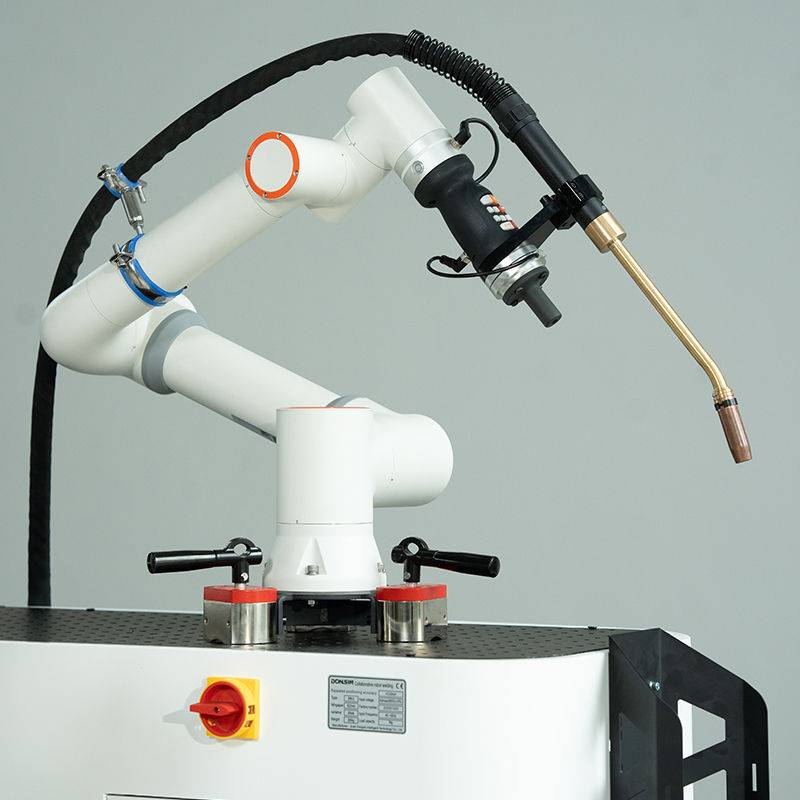
The primary unit deployed was a high-payload MAG Cobot Welder integrated with a 400A pulse-capable power source. Unlike traditional industrial robots, this system was selected for its small footprint and the ability to work alongside human operators without massive safety fencing, which is crucial in the high-density workshops of Istanbul.
2.2 Base Material: Mild Steel Welding Parameters
The workpiece consisted of S355JR mild steel plates ranging from 15mm to 25mm in thickness. Mild Steel welding at these thicknesses requires a robust multi-pass strategy to ensure full penetration and to manage the Heat Affected Zone (HAZ). We utilized a 1.2mm G3Si1 (ER70S-6) solid wire with an 80/20 Argon/CO2 shielding gas mix.
3.0 The Synergy of MAG Cobot Welder and Arc Welding Solutions
One of the primary lessons learned during this field deployment was that the MAG Cobot Welder is only as effective as the Arc Welding Solutions software driving it. In Istanbul’s varied climate—where humidity from the Marmara Sea can affect wire oxidation and surface prep—the software’s ability to adjust parameters on the fly was vital.
3.1 Multi-pass Programming Logic
Traditional manual welding of 20mm V-grooves involves significant operator fatigue, leading to inconsistent bead overlaps in the 3rd and 4th layers. Our Arc Welding Solutions package allowed for “offset programming.” After teaching the root pass, the cobot calculated the necessary offsets for the subsequent hot pass, fill, and cap layers. This ensured a 30% overlap between beads, which is the industry gold standard for minimizing slag inclusions and porosity in Mild Steel welding.
3.2 Real-time Adaptive Control
In the Istanbul workshop, we encountered slight fit-up variations due to upstream plasma cutting tolerances. The synergy between the MAG Cobot Welder‘s touch-sensing and the adaptive “Through-Arc Seam Tracking” (TAST) provided by our Arc Welding Solutions meant the cobot could compensate for a 1.5mm gap variance without manual intervention. This level of autonomy is what separates a simple motorized arm from a true welding solution.
4.0 Technical Execution: Multi-pass Strategy
4.1 Root Pass Dynamics
For the root pass on a 60-degree V-prep, we set the MAG Cobot Welder to a short-arc transfer mode to prevent burn-through. The travel speed was maintained at 35 cm/min with a slight weave pattern. This provided the necessary penetration profile without over-thickening the root, which simplifies the subsequent grinding (though grinding was largely eliminated in this test).
4.2 Fill and Cap Layers
For the fill passes, we transitioned to a spray transfer mode, pushing the MAG Cobot Welder to its upper duty cycle limits. The heat input was closely monitored via the Arc Welding Solutions dashboard. In Mild Steel welding, excessive heat leads to grain growth and reduced impact toughness. By using the cobot’s precise travel speed (±0.1 mm/s), we maintained a consistent kJ/mm ratio that manual welders simply cannot replicate over an 8-hour shift.
5.0 Field Challenges and Root Cause Analysis
5.1 Electrical Grid Stability in Istanbul
A recurring issue in some older Istanbul industrial zones is voltage fluctuation. During the second week, we noticed intermittent arc instability. Analysis showed that the MAG Cobot Welder‘s controller was sensitive to these drops. The “Solution” part of our Arc Welding Solutions involved installing a dedicated line conditioner and updating the power source firmware to broaden the voltage tolerance window. This is a critical takeaway for any engineer deploying cobots in similar emerging industrial hubs.
5.2 Wire Feed Consistency
Given the dust levels inherent in large-scale Mild Steel welding shops, we experienced “bird-nesting” in the feeder. We resolved this by switching to a high-quality ceramic liner and implementing a pressurized dust-shield for the wire spool. It’s a reminder that even the most advanced Arc Welding Solutions fail if basic welding consumables and cleanliness are ignored.
6.0 Quality Assurance and Mechanical Testing
Following the completion of the multi-pass samples, we conducted Non-Destructive Testing (NDT).
- Visual Inspection: The cap layers showed a ripple consistency of <0.5mm, exceeding AWS D1.1 requirements.
- Ultrasonic Testing (UT): Zero indications of lack of side-wall fusion, a common defect in manual multi-pass Mild Steel welding when the welder fails to maintain the correct torch angle in deep grooves.
- Macro-etch: The cross-section revealed a perfect “Christmas tree” stacking of beads with refined grain structures in the reheated zones.
7.0 Lessons Learned and Senior Engineer Recommendations
7.1 The Human Element
The most successful part of the Istanbul deployment wasn’t just the MAG Cobot Welder‘s precision; it was the ease of “Lead-Through” programming. We trained two local manual welders—who had zero previous coding experience—to operate the system in three days. Modern Arc Welding Solutions must prioritize the UI/UX to be effective on the shop floor.
7.2 Maintenance Cycles
In high-production Mild Steel welding, the contact tip wear is accelerated. We implemented a mandatory “Check and Clean” cycle every 50 meters of weld metal. The MAG Cobot Welder was programmed to return to a cleaning station automatically, ensuring that the TCP (Tool Center Point) remained accurate for the next multi-pass sequence.
7.3 Localized Optimization
For firms in Turkey looking to adopt these systems, I recommend sourcing gas and wire from local suppliers that meet Euro-norm standards. The Arc Welding Solutions we used were calibrated for certain wire chemistries; using sub-standard local wire resulted in increased spatter, which required recalibration of the pulse curves.
8.0 Conclusion
The field test in Istanbul confirms that the MAG Cobot Welder is the optimal tool for bridging the gap between manual flexibility and robotic productivity. When integrated with sophisticated Arc Welding Solutions, the challenges of multi-pass Mild Steel welding on thick sections become manageable, repeatable, and highly profitable. The consistency of the bead geometry and the reduction in rework time (from 12% to less than 1%) justify the capital expenditure within the first 14 months of operation.
Signed:
Senior Welding Engineer
Field Operations – Istanbul Site
-


LT240S tube laser cutting machine
-
LT120S tube laser cutting machine
-
Sale

Tank Fillet Welding Machine
Original price was: $1,000.00.$900.00Current price is: $900.00. -
Sale

MAK100 tube laser cutting machine
Original price was: $5,500.00.$5,000.00Current price is: $5,000.00. -

portable plasma air cutting machine
$1,200.00 -

2in1 fiber laser cutting machine
-

Air cooling Laser welding machine
-

HF h beam laser cutting machine
-

LT240 laser cutting machine
-

Laser welding machine
-


Cobot Welding Station
-

Gantry welding robot solution
-

Tracked Wheeled AGV Welding robot
-

LFH6020 Fiber laser cutting machine
-
LFP6020
-

robotic welidng machine
Advanced Fiber Laser Tube Processing Technology
Our CNC Fiber Laser Tube Cutting systems revolutionize metal fabrication by integrating high-precision cutting, punching, and profiling into a single automated workflow. Designed for versatility, this technology handles a wide array of profiles including Round, Square, Rectangular, and Oval tubes, as well as complex L-shaped and U-shaped channels.
- Precision Punching: High-speed hole punching with micron-level accuracy, eliminating the need for mechanical drilling or die-stamping.
- Complex Profiling: Advanced 3D pathing allows for intricate interlocking joints and specialized notch cuts, ideal for structural frames.
- High Material Efficiency: Intelligent nesting software minimizes scrap, reducing raw material costs across large production runs.
- Clean Finish: Delivers oxide-free, burr-free edges that require zero secondary grinding before welding.

Seamlessly processing multiple profiles with consistent precision.
Global Delivery & Logistics



From our high-tech manufacturing facility directly to your global site. PCL WeldCut ensures secure packaging, professional handling, and reliable international logistics to safeguard your equipment throughout the entire journey.