Engineering Review: Robotic MIG Robotic Arm Welder – Georgia, USA
In this article
- Field Engineering Report: Implementation of Robotic MIG Systems in Aluminum Fabrication
- 1.0 Project Overview and Site Conditions
- 2.0 Technical Integration: The Robotic Arm Welder and Industrial Automation Synergy
- 3.0 Advanced Aluminum Alloy Welding Parameters
- 4.0 Lessons Learned: Field Observations from the Georgia Site
- 5.0 Metallurgical Integrity and Testing
- 6.0 Conclusion: The Future of GA Manufacturing
Field Engineering Report: Implementation of Robotic MIG Systems in Aluminum Fabrication
1.0 Project Overview and Site Conditions
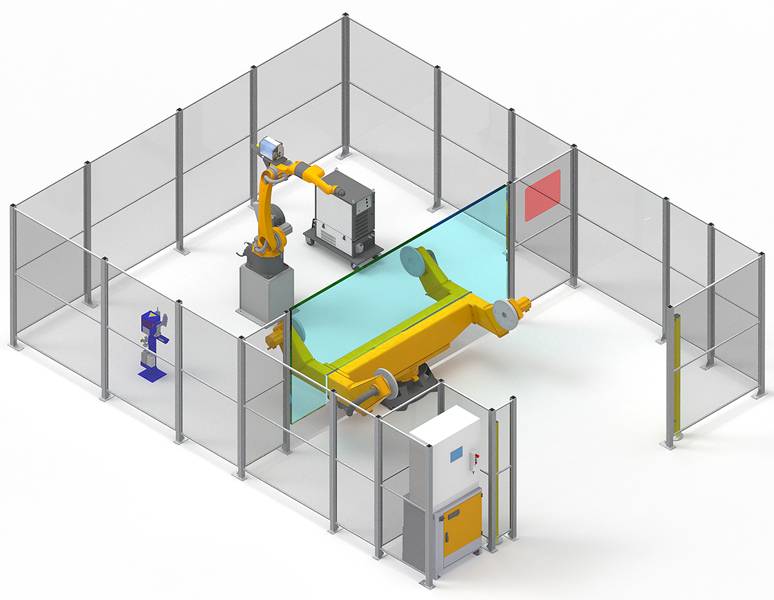
This report summarizes the technical deployment and optimization of a high-speed 6-axis Robotic Arm Welder at a Tier 1 automotive structural components facility in Gainesville, Georgia. The project focus involved transitioning a manual Aluminum Alloy welding line to a fully integrated Industrial Automation cell. The primary objective was the fabrication of 6061-T6 aluminum chassis sub-frames, requiring high-deposition MIG (GMAW-P) with stringent requirements for penetration depth and aesthetic bead uniformity.
Operating in the Georgia environment presents specific atmospheric challenges. The high ambient humidity common to the region necessitates rigorous control over gas delivery systems and filler metal storage. During the initial week of deployment, we identified significant porosity issues traced back to moisture condensation on the chilled aluminum extrusions. This necessitated the installation of a localized pre-heat station and an upgraded desiccant air drying system for the pneumatic components of the Industrial Automation suite.
2.0 Technical Integration: The Robotic Arm Welder and Industrial Automation Synergy
The true value of a Robotic Arm Welder is not found in its movement speed alone, but in its seamless integration into the broader Industrial Automation ecosystem. In this GA facility, the robotic cell was interfaced with a central PLC (Programmable Logic Controller) via EtherNet/IP. This allowed for real-time telemetry of weld parameters, including current, voltage, and wire feed speed.
2.1 Synchronized Motion Control
In Aluminum Alloy welding, heat management is the primary hurdle. By utilizing a dual-station headstock-tailstock positioner integrated into the robot’s external axis control, we achieved “coordinated motion.” This allows the Robotic Arm Welder to maintain a consistent gravity-position (1F/2F) regardless of the part’s geometry. When the robot and the positioner move in perfect synchronicity, we can increase travel speeds by 30% compared to static jigging, while maintaining a stable weld pool.
2.2 The “Smart” Interface
Industrial Automation in this context also refers to the automated cleaning stations. Aluminum MIG welding is notoriously “dirty” regarding silica buildup and spatter on the gas nozzle. We programmed a mandatory “reamer” cycle every five parts. The robot exits the workspace, engages a pneumatic nozzle cleaner, applies anti-spatter compound, and performs a wire-cut to ensure a crisp arc start for the next cycle. This level of automation removes human error and ensures that the contact-to-work distance (CTWD) remains calibrated to within ±0.5mm.
3.0 Advanced Aluminum Alloy Welding Parameters
Welding 6000-series aluminum requires a nuanced understanding of thermal conductivity and the “crater crack” phenomenon. Aluminum dissipates heat approximately four times faster than steel. Consequently, the Robotic Arm Welder was programmed with a specific “Hot Start” and “Crater Fill” routine.
3.1 Waveform Manipulation
We utilized a pulsed MIG (GMAW-P) waveform tailored specifically for 4043 filler wire. The Industrial Automation software allowed us to modify the pulse frequency. By increasing the frequency to 250Hz, we achieved a narrower, more focused arc cone. This is critical when welding 5mm to 8mm Aluminum Alloy welding joints where over-penetration can lead to burn-through on the back-side of the extrusion.
3.2 Managing the Oxide Layer
The Georgia site faced issues with the tenacious aluminum oxide layer (Al2O3). While the DCEP (Direct Current Electrode Positive) arc provides a “cleaning action,” it is not a substitute for proper prep. Our field adjustment included a mechanized stainless-steel brushing station integrated into the pre-weld Industrial Automation sequence. We found that if the part was cleaned more than 4 hours prior to welding, the oxide layer would reform sufficiently to cause arc wandering. The robot’s “Touch Sensing” feature was also used to find the part’s edge, accounting for any thermal expansion/distortion from previous welds.
4.0 Lessons Learned: Field Observations from the Georgia Site
As a senior engineer, the “theory” often hits a wall when faced with floor reality. Below are the critical technical takeaways from this deployment.
4.1 The Push-Pull Feeding Dilemma
Standard “push” feeders are inadequate for Aluminum Alloy welding over the 3-meter reach of a Robotic Arm Welder. We experienced immediate “birdnesting” at the drive rolls. The solution was the implementation of a synchronized push-pull torch. The robot’s internal motor works in tandem with the wire feeder motor to maintain constant tension on the soft aluminum wire. Lesson: Never attempt high-volume aluminum automation with a standard torch lead; the downtime for wire jams will negate all productivity gains.
4.2 Shielding Gas Consistency
We initially utilized a 100% Argon shield. However, we observed a “cold-lap” at the toes of the weld on the thicker 10mm base plates. We switched to an Argon-Helium blend (75/25). The Helium addition increases the ionization potential, providing a hotter arc and better wetting of the Aluminum Alloy welding pool. Due to the cost of Helium, we programmed the Industrial Automation system to only trigger the Helium blend during the high-amperage passes, reverting to pure Argon for the thinner gauge tacks.
4.3 Grounding and High-Frequency Interference
In a heavy industrial Georgia plant, “dirty power” is a reality. The Robotic Arm Welder experienced intermittent E-stop triggers. We traced this back to improper grounding of the Industrial Automation cabinet. Aluminum welding requires high-frequency arc starts or high-energy pulses that can create EMI (Electromagnetic Interference). We solved this by installing a dedicated copper grounding rod specifically for the robot cell, isolated from the rest of the factory’s grid.
5.0 Metallurgical Integrity and Testing
Post-weld inspection focused on Liquation Cracking in the Heat Affected Zone (HAZ). Using the Robotic Arm Welder allowed us to maintain a precise interpass temperature. We installed infrared sensors that communicate with the Industrial Automation controller; if the part temperature exceeds 150°F (65°C), the robot enters a dwell state. This is vital for 6061-series alloys to prevent over-aging and loss of mechanical properties in the joint.
Macro-etch samples taken mid-project showed excellent grain structure. The consistency of the robotic travel speed ensured that the “teardrop” shaped weld pool—indicative of potential centerline cracking—was avoided in favor of a healthy “elliptical” pool.
6.0 Conclusion: The Future of GA Manufacturing
The integration of the Robotic Arm Welder at this Georgia facility has resulted in a 40% increase in throughput and a 15% reduction in filler metal waste. However, the success of Industrial Automation is entirely dependent on the engineer’s ability to respect the specific metallurgical quirks of Aluminum Alloy welding. Automation is not a “set and forget” solution; it is a high-precision tool that requires constant calibration of the wire-drive tension, gas flow dynamics, and thermal management protocols.
Moving forward, we recommend the implementation of “Through-Arc Seam Tracking” (TAST) to further enhance the robot’s ability to compensate for the slight warping inherent in large-scale aluminum fabrication. As the Georgia manufacturing sector continues to expand, the synergy between skilled welding engineering and robotic precision will remain the gold standard for structural integrity.
End of Report.
Prepared by: Senior Welding Engineer, Field Operations Division.







