Field Engineering Report: Implementation of Low-Spatter MAG Cobot Welding in Mumbai
1.0 Introduction and Site Conditions
This report details the field commissioning and performance evaluation of a low-spatter MAG Cobot Welding Machine deployed at a medium-scale heavy fabrication unit in Rabale, Navi Mumbai. The facility specializes in the production of structural components using IS 2062 Mild Steel welding protocols. The primary objective was to replace manual metal active gas (MAG) stations with Collaborative Robotics to address two critical pain points: inconsistent bead quality across long runs and excessive post-weld cleaning due to spatter.
Operating in Mumbai presents unique environmental challenges. The high ambient humidity (often exceeding 80%) and the salinity of the air near the coast significantly impact the storage of consumables and the stability of the arc. Furthermore, the local power grid is prone to voltage fluctuations, requiring the power source integrated with the cobot to have robust internal regulation. Our trial focused on 6mm to 12mm thickness mild steel plates, utilizing an ER70S-6 solid wire with an 80/20 Argon-CO2 shielding gas mix.
2.0 Synergy of the Cobot Welding Machine and Collaborative Robotics
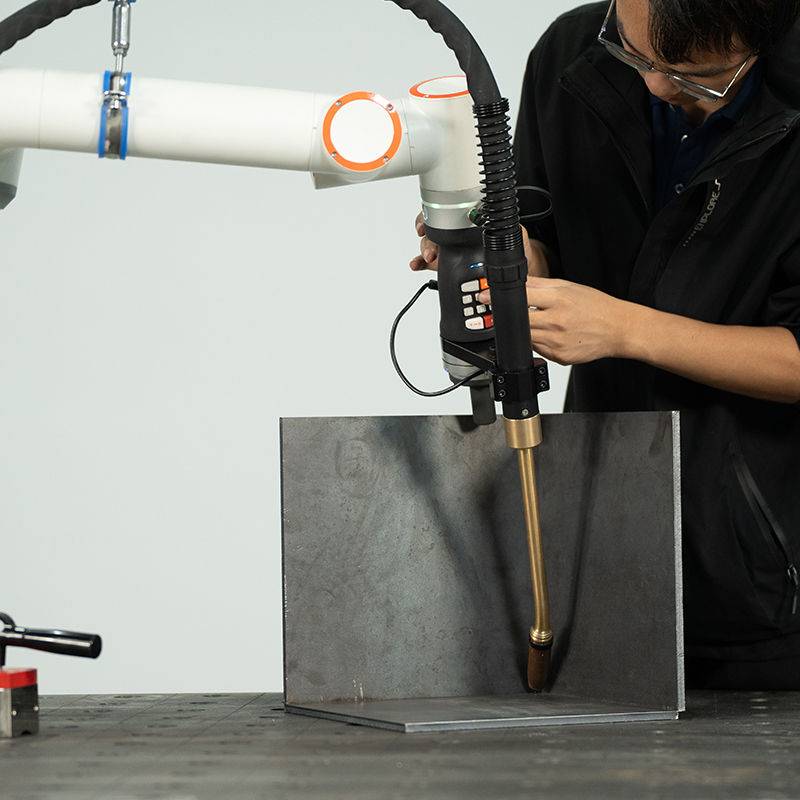
The term Cobot Welding Machine is often used interchangeably with collaborative robotics, but in a field context, they represent two distinct layers of the solution. The “Cobot” is the mechanical delivery system—the 6-axis arm that provides the repeatability and torch angle precision. “Collaborative Robotics” refers to the operational philosophy we implemented on the shop floor: allowing a skilled welder to stand alongside the machine, performing real-time jig adjustments and tacking while the arm executes the primary weld path.
2.1 Physical Footprint and Integration
In the cramped confines of a Mumbai workshop, a traditional industrial robot cage is a luxury we could not afford. The Cobot Welding Machine was mounted on a mobile pedestal with a footprint of only 800mm x 800mm. This allowed us to wheel the unit between different workstations. The collaborative nature of the sensors (force-torque feedback) meant we could operate without light curtains or physical barriers, provided the risk assessment accounted for the hot torch and arc radiation.
2.2 The Human-Machine Interface (HMI)
We observed that the synergy works best when the lead welder “teaches” the path using lead-through programming. Instead of coding coordinates, the welder physically moves the torch to the start, middle, and end points of the mild steel joint. This bridges the gap between traditional craftsmanship and digital precision. In our Mumbai trials, we found that a senior welder could program a new Mild Steel welding sequence for a junction box bracket in under 10 minutes—a task that would take a robotics engineer hours on a traditional PLC-based system.
3.0 Technical Analysis: Mild Steel Welding Performance
The core of this deployment was the low-spatter waveform control. Mild Steel welding, particularly when using CO2-heavy gas mixes, is notorious for globular transfer that creates “shot” or spatter. This not only wastes filler material but adds significant man-hours in grinding and surface preparation.
3.1 Low-Spatter Waveform Control
The Cobot Welding Machine was paired with an inverter-based power source capable of high-speed digital communication with the cobot’s controller. We utilized a modified short-circuit transfer mode. By monitoring the electrical resistance of the short circuit hundreds of times per second, the power source “clears” the droplet by dropping the current right before the bridge breaks. This prevents the explosive “snap” that causes spatter.
3.2 Weld Quality on IS 2062
During the 1200mm longitudinal seams on 10mm mild steel plates, the Cobot Welding Machine maintained a consistent travel speed of 350mm/min. Manual welders in the same shop typically fluctuate between 280mm/min and 400mm/min due to fatigue, leading to uneven penetration. The collaborative robotics system ensured a constant 15-degree push angle, resulting in a stack-of-dimes aesthetic that passed 100% Visual Testing (VT) and Dye Penetrant Testing (DPT) without any intermediate grinding.
3.3 Heat Input and Distortion Management
Distortion is a major issue in Mumbai’s heat, as the ambient temperature starts at 35°C. By using the pulsed-MAG settings enabled by the cobot’s software, we reduced the overall heat input by 18% compared to traditional constant-voltage MAG. This allowed us to maintain the flatness tolerances on thin-gauge mild steel skins (3mm) without the need for extensive water-cooling or complex clamping jigs.
4.0 Lessons Learned: Field Realities in Mumbai
Implementing collaborative robotics in a brownfield site taught us several lessons that aren’t found in the technical manuals. These insights are critical for any senior engineer looking to scale this technology in the Indian subcontinent.
4.1 Consumable Management and Humidity
The low-spatter benefits of the Cobot Welding Machine are negated if the wire is contaminated. We found that the high humidity in Rabale caused microscopic surface oxidation on the mild steel wire spools left out overnight. This led to arc instability and increased spatter.
Lesson: Use heated wire dispensers or enclosed wire feeders. Do not leave wire spools on the cobot overnight; return them to a climate-controlled dry room.
4.2 Grounding and Electrical Noise
The sensitive electronics in the collaborative robotics arm are susceptible to “noise” from older, high-frequency TIG machines operating on the same shop floor. We experienced two instances of the cobot “ghosting” or stopping mid-cycle due to electromagnetic interference (EMI).
Lesson: Ensure the Cobot Welding Machine has a dedicated, clean earth ground. Do not rely on the factory’s common grounding bus if it is shared with old-school heavy transformers.
4.3 The “Cobot-Ready” Joint Gap
While collaborative robotics is precise, it is not sentient. We learned that the upstream cutting processes (shearing and plasma cutting) in our Mumbai facility had a tolerance of +/- 2mm. A Cobot Welding Machine programmed for a zero-gap butt joint will fail if it encounters a 2mm gap.
Lesson: We implemented a simple “weaving” parameter in the cobot software. By adding a 1.5mm sine-wave weave to the Mild Steel welding path, the cobot could bridge varying gaps effectively, compensating for the lack of precision in the manual fit-up stage.
5.0 Productivity and ROI Summary
Over a 30-day period, the integration of the Cobot Welding Machine resulted in a 40% increase in arc-on time. In a traditional Mild Steel welding setup, the welder spends about 30% of their time welding and 70% on setup, slag removal, and positioning. With collaborative robotics, the human operator prepares the next jig while the cobot is welding the current one.
5.1 Reduction in Post-Weld Processing
The most significant cost saving came from the “Low-Spatter” feature. We reduced the use of anti-spatter sprays by 90% and eliminated the “chipping and grinding” shift entirely for these specific components. For the Mumbai facility, this meant a reduction in noise pollution and a decrease in the consumption of grinding discs, which is a hidden but substantial overhead.
5.2 Upskilling Local Talent
Initial resistance from the workforce was mitigated by positioning the Cobot Welding Machine not as a replacement, but as a “Power Tool.” We identified three “Grade B” welders and trained them as cobot operators. Within a week, they were producing “Grade A” welds. This transition is vital for the Mumbai manufacturing sector, which faces a chronic shortage of highly certified 6G welders.
6.0 Conclusion
The deployment of collaborative robotics for Mild Steel welding in Mumbai is a viable and necessary evolution for the local industry. The Cobot Welding Machine proves that high-end automation can thrive in challenging environments if the engineer accounts for local variables like humidity, electrical stability, and upstream fit-up tolerances. The synergy between the low-spatter MAG process and the ease of cobot programming provides a pragmatic path toward “Industry 4.0” without the need for massive capital expenditure or specialized robotics departments. Our next phase will involve integrating seam-tracking sensors to further automate the compensation for fit-up variations.
-


LT240S tube laser cutting machine
-
LT120S tube laser cutting machine
-
Sale

Tank Fillet Welding Machine
Original price was: $1,000.00.$900.00Current price is: $900.00. -
Sale

MAK100 tube laser cutting machine
Original price was: $5,500.00.$5,000.00Current price is: $5,000.00. -

portable plasma air cutting machine
$1,200.00 -

2in1 fiber laser cutting machine
-

Air cooling Laser welding machine
-

HF h beam laser cutting machine
-

LT240 laser cutting machine
-

Laser welding machine
-


Cobotic Welding Station
-

Gantry welding robot solution
-

Tracked Wheeled AGV Welding robot
-

LFH6020 Fiber laser cutting machine
-
LFP6020
-

robotic welidng machine
