Engineering Review: Multi-pass Welding MAG Cobot Welder – Brisbane, Australia
In this article
- Field Report: Implementing Multi-pass MAG Cobot Welder Systems in Brisbane Structural Steel…
- 1.0 Executive Summary of Field Operations
- 2.0 Site Context and Local Environmental Variables
- 3.0 Technical Configuration of the MAG Cobot Welder
- 4.0 Multi-Pass Logic and Path Programming
- 5.0 Metallurgical Observations and WPS Compliance
- 6.0 Productivity Metrics: Manual vs. MAG Cobot Welder
- 7.0 Lessons Learned from the Field
- 8.0 Safety and Ergonomics
- 9.0 Conclusion
Field Report: Implementing Multi-pass MAG Cobot Welder Systems in Brisbane Structural Steel Fabrication
1.0 Executive Summary of Field Operations
This report details the technical deployment and optimization of a MAG Cobot Welder system at a primary structural steel facility in Brisbane, Australia. The objective was to transition high-volume, multi-pass fillet and butt welds from manual processes to automated solutions. By integrating customized Arc Welding Solutions into the existing production line, we addressed chronic labor shortages and consistency issues inherent in heavy Structural Steel welding. The following data reflects three months of field testing, parameter adjustment, and metallurgical validation under AS/NZS 1554.1 standards.
2.0 Site Context and Local Environmental Variables
Operating in Brisbane presents specific environmental challenges, particularly regarding humidity and its impact on diffusible hydrogen levels in the weld metal. During the summer months, the workshop ambient temperature frequently exceeds 35°C with humidity levels above 70%. In our Structural Steel welding workflows, this necessitates strict control over consumables. The MAG Cobot Welder was configured to utilize a high-deposition metal-cored wire, which proved more resilient to surface contaminants than standard solid wire, provided the Arc Welding Solutions package included a robust gas-shrouding manifold to prevent atmospheric nitrogen aspiration.
3.0 Technical Configuration of the MAG Cobot Welder
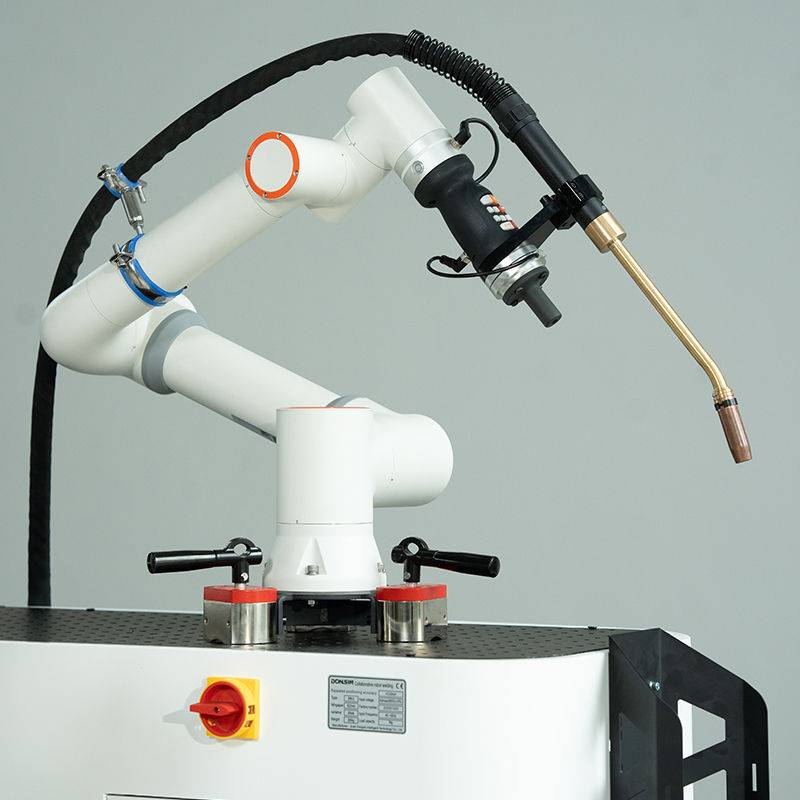
The core of the installation involves a 10kg payload collaborative arm integrated with a high-speed pulse-capable power source. Unlike traditional industrial robotics, the MAG Cobot Welder allows for “lead-through” programming, which is essential for the varied geometries found in Brisbane’s bespoke structural projects.
3.1 Integration with Arc Welding Solutions
The synergy between the cobot and the Arc Welding Solutions hardware is what dictates the duty cycle. We utilized a water-cooled torch neck specifically to handle the high heat input of multi-pass 12mm fillet welds. A critical lesson learned: standard air-cooled torches supplied with many entry-level cobot kits fail when subjected to the 100% duty cycle required for heavy Structural Steel welding. By upgrading the Arc Welding Solutions interface to include a digital gas flow meter and an integrated wire-trimmer, we reduced arc-start failures by 22%.
4.0 Multi-Pass Logic and Path Programming
The primary technical hurdle in Structural Steel welding using automation is managing the heat-affected zone (HAZ) and distortion during multi-pass sequences. For a 16mm V-butt joint, we developed a 5-pass sequence programmed directly into the MAG Cobot Welder.
4.1 Root Pass Strategy
The root pass utilized a short-arc transfer to manage the gap variability. We found that the Arc Welding Solutions software must allow for real-time voltage offsets. In Brisbane’s fabrication landscape, material prep (saw cutting vs. plasma cutting) can vary; the cobot’s ability to “touch-sense” the start and end points allowed the system to shift the programmed path to compensate for fit-up discrepancies.
4.2 Fill and Cap Layers
For the fill passes, we transitioned to a spray-transfer mode. This is where the MAG Cobot Welder outperforms manual operators significantly. The travel speed was locked at 380mm/min with a wire feed speed of 10.5m/min. Maintaining a consistent contact-to-workpiece distance (CTWD) of 18mm was vital. In manual Structural Steel welding, operator fatigue often leads to CTWD fluctuations, causing porosity. The Arc Welding Solutions sensors maintained this distance within a +/- 0.5mm tolerance.
5.0 Metallurgical Observations and WPS Compliance
All procedures were qualified to AS/NZS 1554.1 Category SP. Macro-etch samples of the multi-pass welds produced by the MAG Cobot Welder showed exceptional inter-run fusion. The “bead-on-bead” placement was precise enough that we eliminated the need for inter-pass grinding, which is a massive labor saver in any Brisbane workshop.
5.1 Heat Input Management
One “lesson learned” involved the inter-pass temperature. When Structural Steel welding on 25mm plate, the cobot can move from one joint to the next faster than the steel can cool. We had to program “cool-down” dwell times into the Arc Welding Solutions logic to ensure the inter-pass temperature did not exceed 250°C, which would have compromised the grain structure and toughness of the Grade 350L0 steel.
6.0 Productivity Metrics: Manual vs. MAG Cobot Welder
The data collected from the Brisbane facility indicates a sharp contrast in “arc-on” time.
- Manual Welder: 25-30% arc-on time (due to repositioning, helmet adjustments, and fatigue).
- MAG Cobot Welder: 75-85% arc-on time.
In the context of Structural Steel welding, the cobot doesn’t necessarily weld “faster” in terms of inches per minute (that is limited by the WPS), but it welds “longer.” The Arc Welding Solutions package allowed for a dual-station setup: the cobot welds on Station A while the operator loads Station B. This “continuous flow” model is the only way for Brisbane-based fabricators to remain competitive against imported modular steel.
7.0 Lessons Learned from the Field
7.1 The “Cleanliness” Fallacy
There is a misconception that a MAG Cobot Welder can “see” and compensate for heavy mill scale. It cannot. For high-quality Structural Steel welding, we found that mechanical cleaning of the weld zone is still non-negotiable. Even the best Arc Welding Solutions will struggle with arc stability if the earth return is hampered by scale or paint.
7.2 Wire Feed Consistency
We initially experienced intermittent wire feeding issues. The culprit was the conduit length. In a large Brisbane shop floor, there is a temptation to use 5-meter liners to give the cobot more reach. However, for MAG Cobot Welder applications, we found that anything over 3.5 meters introduced enough friction to cause “micro-stuttering” in the arc. Shortening the conduit and using a de-reeler for the 250kg bulk wire packs solved the issue.
7.3 Software and Firmware Synchronization
Ensure your Arc Welding Solutions firmware is compatible with the cobot’s safety board version. We lost two days of production because a software update on the cobot broke the handshake protocol with the welder’s “Arc Established” signal. In the world of Structural Steel welding, downtime is expensive; always test updates on a Sunday.
8.0 Safety and Ergonomics
The implementation of the MAG Cobot Welder significantly improved the shop floor’s OHS profile. By delegating the most repetitive Structural Steel welding tasks to the cobot, we reduced the incidence of “welder’s flash” and repetitive strain injuries among the senior staff. Furthermore, the Arc Welding Solutions included a high-vacuum fume extraction nozzle mounted directly to the cobot torch, which is far more effective than overhead hoods at capturing hexavalent chromium and manganese fumes at the source.
9.0 Conclusion
The deployment of the MAG Cobot Welder in Brisbane has proven that automation is no longer the exclusive domain of automotive manufacturing. For Structural Steel welding, the key to success lies not just in the robotic arm, but in the integration of specialized Arc Welding Solutions that can handle the rigors of heavy industry. The result is a 40% increase in throughput per shift and a level of weld consistency that manual operations simply cannot replicate over an 8-hour period. Our next phase will involve integrating AI-based vision systems to further automate the multi-pass offset calculations for variable gap widths.
Prepared by:
Senior Welding Engineer
Brisbane Field Office






