Precision Engineering for Heavy Infrastructure: Scaling Large Diameter Tube Laser Processing
Heavy construction demands structural integrity and dimensional precision that traditional mechanical cutting methods struggle to deliver at scale. The transition to large-diameter fiber laser cutting systems, specifically those equipped with a 3-chuck stability architecture, addresses the bottlenecks of manual layout, secondary deburring, and material waste. By integrating a direct CAD-to-CAM workflow, manufacturers can move from raw structural steel to assembly-ready components with zero manual intervention between processes.
Mechanical Stability: The 3-Chuck Synchronized System
In large-diameter processing—often involving tubes exceeding 400mm and weights surpassing 100kg per meter—material whip and sagging are the primary causes of dimensional inaccuracy. A standard 2-chuck system leaves the leading or trailing end of the tube unsupported during the final segments of the cut. This results in significant vibration, reducing the quality of the kerf width and potentially damaging the laser head.
The 3-chuck system introduces a middle chuck that provides continuous support and material indexing. This configuration allows for “zero-tailing” cutting. The three chucks work in tandem: the rear chuck feeds the material, the middle chuck maintains axial alignment, and the front chuck secures the part as it is severed. This kinematic synchronization ensures that even as the tube is depleted, the center of rotation remains fixed. This level of mechanical control eliminates the need for oversized tolerances, allowing for complex geometries such as miter joints and saddle cuts to fit perfectly during the welding phase.
Workflow Efficiency: ERP Integration and CAD-to-CAM
The primary cost driver in heavy steel fabrication is not the cutting speed, but the handling and preparation time. Conventional workflows require a technician to interpret 2D drawings, mark the tube, saw to length, and then mill or drill holes. Each movement of the heavy workpiece introduces a risk of cumulative error.
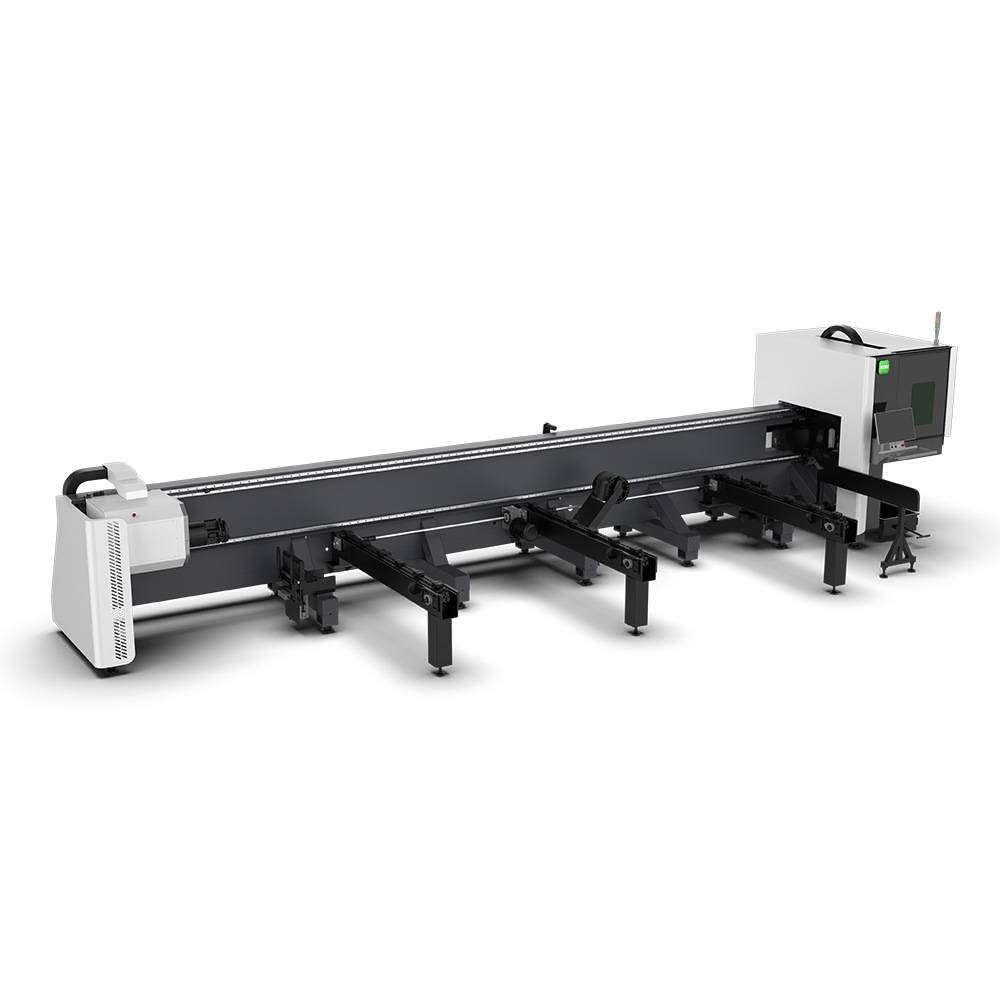
Modern laser systems utilize a streamlined digital thread. Design files from BIM or CAD software, such as Tekla or SolidWorks, are imported directly into the CAM environment. Here, nesting algorithms optimize the placement of parts along the raw stock to minimize scrap. This digital workflow integrates with the facility’s ERP system, providing real-time data on material consumption and part completion. Because the laser produces a clean, burr-free edge, the heat-affected zone is localized, and no secondary grinding or finishing is required. Parts move directly from the laser bed to the welding cell, reducing the total production cycle by up to 70%.
Technical Comparison: Traditional vs. 3-Chuck Laser System
| Feature | Traditional (Sawing/Drilling) | 3-Chuck Fiber Laser |
|---|---|---|
| Material Waste (Tailing) | 300mm – 500mm per tube | Near Zero (under 50mm) |
| Secondary Processing | Required (Deburring/Grinding) | None (Ready for Assembly) |
| Positional Accuracy | +/- 1.5mm | +/- 0.05mm |
| Labor Requirement | High (Multiple skilled operators) | Low (1 trained operator) |
EHS & Compliance: Mitigating Industrial Hazards
The heavy construction industry faces mounting pressure to improve the working environment and attract younger talent. Traditional plasma or mechanical cutting generates high levels of decibel noise and airborne particulate matter. A fully enclosed fiber laser system inherently contains these hazards. Integrated high-volume dust extraction systems capture metal fumes and particulates at the point of origin, ensuring compliance with OSHA and international air quality standards.
Furthermore, the complexity of modern machinery often acts as a barrier to entry for new labor. However, the software-driven nature of the 3-chuck laser allows for a simplified training curve. Operators do not need to master the manual physics of the machine; instead, they manage the interface. Most systems now feature a simplified UI that allows a new operator to reach production proficiency within two days. This reduces the reliance on a shrinking pool of highly specialized manual fabricators.
Risk Mitigation: Fiber Source Stability and Precision
Operating high-power lasers in a heavy construction environment introduces risks related to dust infiltration and power fluctuations. To mitigate these, the fiber laser source is typically housed in an IP65-rated, climate-controlled cabinet. This prevents airborne metallic dust from contaminating the optical path, which could lead to beam divergence or catastrophic fiber failure.
Precision is further protected through the use of self-centering chucks with kinematic redundancy. In large-diameter tube processing, material is rarely perfectly round or straight. The system’s sensors detect the actual center of the tube in real-time, adjusting the laser head’s focal point to compensate for deviations. This ensures that even on a “banana-shaped” tube, the wall thickness and hole placement remain consistent throughout the length of the workpiece. This automated compensation is critical for heavy construction components where bolt-hole alignment across 12-meter spans is mandatory for site assembly.
Conclusion: The ROI of Integrated Fabrication
For firms engaged in heavy infrastructure, the investment in a large-diameter 3-chuck laser system is justified through three vectors: material yield, labor reduction, and the elimination of downstream assembly errors. By moving to a CAM-driven workflow, the machine becomes a predictable node in the production chain rather than a source of variability. The reduction in secondary processing alone often facilitates a return on investment within the first 18 months of operation, while simultaneously providing a safer, cleaner environment for the next generation of industrial operators.
-


LT240S tube laser cutting machine
-
LT120S tube laser cutting machine
-
Sale

Tank Fillet Welding Machine
Original price was: $1,000.00.$900.00Current price is: $900.00. -
Sale

MAK100 tube laser cutting machine
Original price was: $5,500.00.$5,000.00Current price is: $5,000.00. -

portable plasma air cutting machine
$1,200.00 -

2in1 fiber laser cutting machine
-

Air cooling Laser welding machine
-

HF h beam laser cutting machine
-

LT240 laser cutting machine
-

Laser welding machine
-


Cobot Welding Station
-

Gantry welding robot solution
-

Tracked Wheeled AGV Welding robot
-

LFH6020 Fiber laser cutting machine
-
LFP6020
-

robotic welidng machine
Advanced Fiber Laser Tube Processing Technology
Our CNC Fiber Laser Tube Cutting systems revolutionize metal fabrication by integrating high-precision cutting, punching, and profiling into a single automated workflow. Designed for versatility, this technology handles a wide array of profiles including Round, Square, Rectangular, and Oval tubes, as well as complex L-shaped and U-shaped channels.
- Precision Punching: High-speed hole punching with micron-level accuracy, eliminating the need for mechanical drilling or die-stamping.
- Complex Profiling: Advanced 3D pathing allows for intricate interlocking joints and specialized notch cuts, ideal for structural frames.
- High Material Efficiency: Intelligent nesting software minimizes scrap, reducing raw material costs across large production runs.
- Clean Finish: Delivers oxide-free, burr-free edges that require zero secondary grinding before welding.

Seamlessly processing multiple profiles with consistent precision.
Global Delivery & Logistics



From our high-tech manufacturing facility directly to your global site. PCL WeldCut ensures secure packaging, professional handling, and reliable international logistics to safeguard your equipment throughout the entire journey.