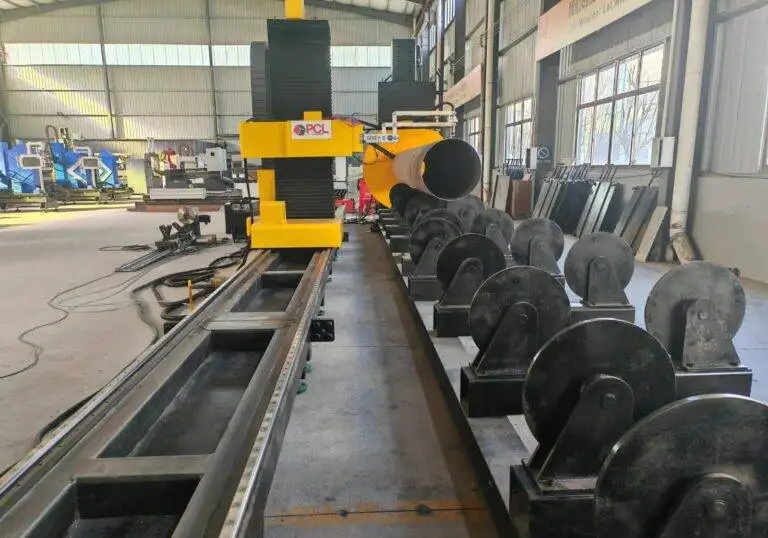
Beam Processing Center with Narrow Gap welding for for Wind Tower fabrication
In this article
Optimizing Structural Frameworks in Wind Tower Production
The fabrication of wind turbine towers extends beyond the rolling and welding of massive cylindrical cans. The internal structural integrity depends heavily on complex platforms, secondary steelwork, and internal frames that support high-voltage equipment, ladders, and lift systems. To meet the rigorous demands of global energy markets, industrial engineers are increasingly deploying automated Beam Processing Efficiency strategies. These centers are designed to handle heavy-duty H-beams and I-beams with a focus on high-speed thermal separation and edge preparation.
Unlike standard structural steel applications, wind tower internals must withstand harmonic vibrations and extreme fatigue cycles. This necessitates a move away from manual layout and traditional sawing toward unified plasma processing centers. The goal is to eliminate human error during the layout phase and move directly from CAD data to finished component, ensuring every structural member fits perfectly within the tapered geometry of the tower shell.
Advanced Plasma Cutting for Heavy Structural Sections
Plasma technology remains the primary choice for heavy H-beam processing in wind tower fabrication due to its ability to penetrate thick-walled carbon steel with high thermal intensity. In a modern Beam Processing Center, the plasma torch is often mounted on a multi-axis robotic arm or a high-precision gantry system. This allows the system to reach all four sides of an H-beam—flanges and web—without the need to flip the workpiece.
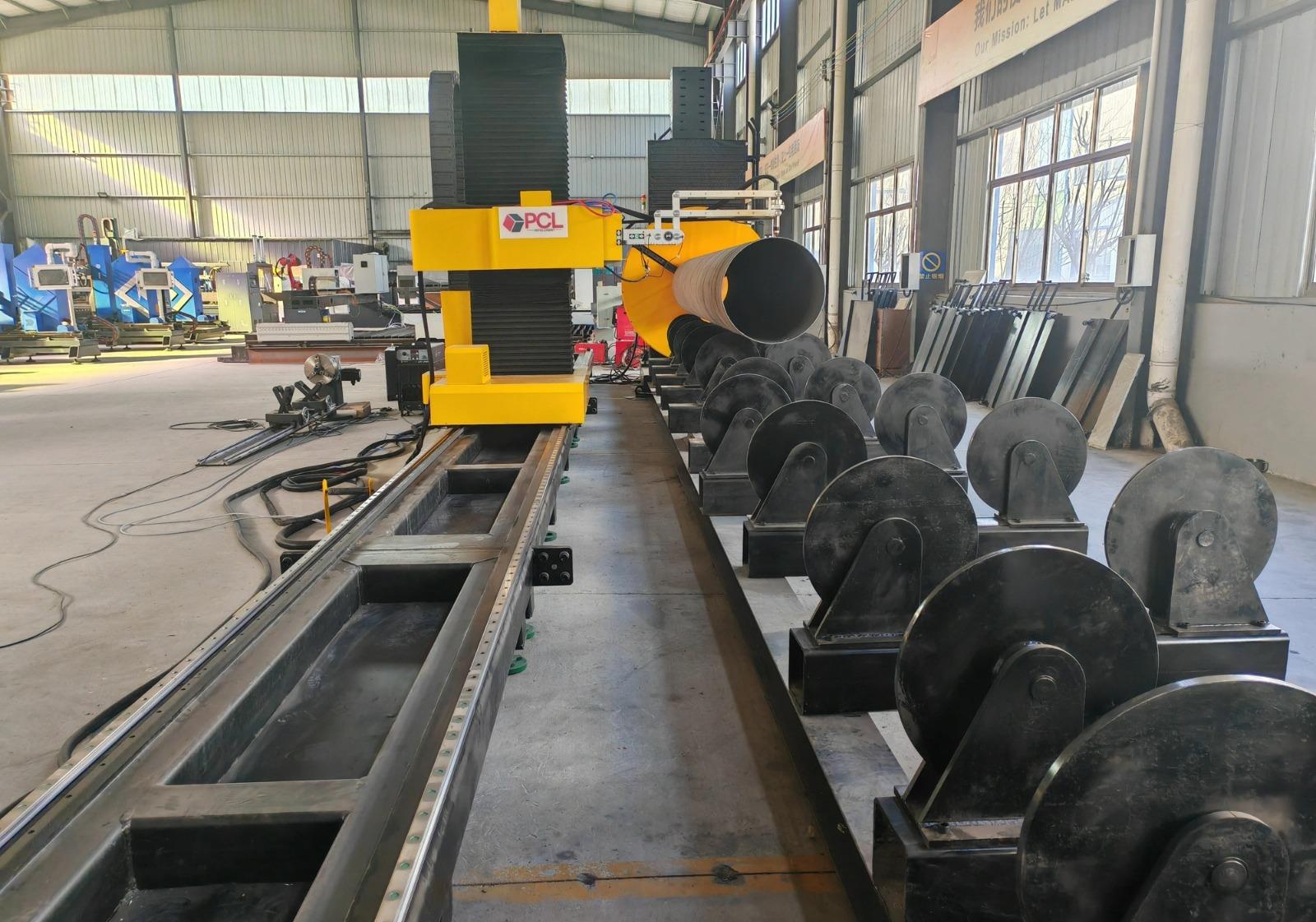
The use of high-definition plasma power sources ensures that the heat-affected zone (HAZ) is kept to a minimum. For engineers, this is critical because excessive heat can alter the metallurgical properties of the S355 or higher-grade steels commonly used in wind infrastructure. By maintaining a narrow, focused arc, the system achieves a dross-free cut that requires little to no secondary grinding, directly impacting the throughput of the fabrication line.
Intersection Accuracy and Fit-Up Precision
One of the most complex challenges in fabricating internal platforms for wind towers is the intersection of structural members. Beams often meet at non-orthogonal angles to accommodate the conical shape of the tower. Plasma Cutting Accuracy is the determining factor in whether these joints can be successfully welded without excessive gap-bridging or rework.
Automated beam centers utilize laser scanning and mechanical probing to locate the exact position of the beam in 3D space. This compensates for mill tolerances, such as flange out-of-squareness or web deviation. When the plasma torch executes an intersection cut, it accounts for these deviations in real-time. The result is a “lock-and-key” fit where the web of one beam seats perfectly against the radius of another. This precision is not merely for aesthetics; it ensures that the structural load is transferred correctly across the joint, which is vital for the 25-year service life of a wind turbine.
Beveling for Narrow Gap Weld Preparation
The shift toward Narrow Gap Weld Preparation in the wind industry is driven by the need to reduce the volume of filler metal and the total arc time. Standard V-groove preparations require large amounts of weld consumables and multiple passes, which increases the risk of distortion. Narrow gap configurations, characterized by steep bevel angles (often between 3 and 7 degrees), require absolute edge precision that only an automated plasma system can consistently provide.
The beam processing center’s multi-axis capability allows for the creation of complex bevel geometries, including K, Y, and X cuts. For wind tower internals, these bevels must be uniform across the entire length of the flange. If the bevel angle fluctuates by even a degree, the narrow gap welding process—which often utilizes automated submerged arc or gas-shielded systems—can suffer from lack of fusion or slag inclusions. Plasma cutting provides the necessary repeatability to ensure that the root face and the groove angle meet the strict tolerances required for deep-penetration narrow gap welds.
H-Beam Maintenance and Operational Uptime
In a high-output industrial environment, machine downtime is a significant bottleneck. Beam processing centers utilizing plasma technology offer distinct maintenance advantages over mechanical cutting methods. In a plasma-based system, there are no saw blades to dull, break, or replace. The primary wear items are limited to the electrode and nozzle, which can be swapped out in minutes by the operator.
Furthermore, the material handling systems for H-beams in these centers are designed for low-maintenance longevity. Heavy-duty conveyor rollers and drag-chain systems move the beams through the cutting cell with minimal mechanical wear. Because plasma is a non-contact cutting process, there is no lateral force exerted on the machine structure or the beam itself during the cut. This absence of mechanical stress extends the lifespan of the gantry’s motion components, such as linear rails and rack-and-pinion drives, ensuring long-term Structural Wind Tower Fabrication consistency.
Integrating Data for Lean Manufacturing
Modern beam processing is inherently tied to the digital thread. Industrial engineers leverage BIM (Building Information Modeling) and Tekla data to feed the plasma center’s control system. This integration eliminates the “silo” between design and production. By utilizing nested files, the plasma system can optimize the layout of parts on a standard 12-meter H-beam, significantly reducing scrap rates.
The accuracy of the plasma cut also facilitates the downstream assembly. When components are delivered to the welding station with accurate bevels and perfect intersection notches, the assembly jigging time is reduced. The fabricators can rely on the dimensions of the cut pieces, treating the structural steel more like precision-machined parts than traditional heavy metalwork. This shift in mindset is what allows for the rapid scaling of wind tower production required for offshore and large-scale onshore projects.
Technical Conclusion on Thermal Processing
The reliance on plasma cutting within a dedicated beam processing center is a strategic choice for wind tower manufacturers. The combination of high-definition cutting, sophisticated beveling for narrow gap preparation, and the inherent reliability of the equipment provides a robust foundation for structural fabrication. By prioritizing intersection accuracy and minimizing maintenance through thermal processing, facilities can achieve the high-quality outputs necessitated by the renewable energy sector’s stringent standards.