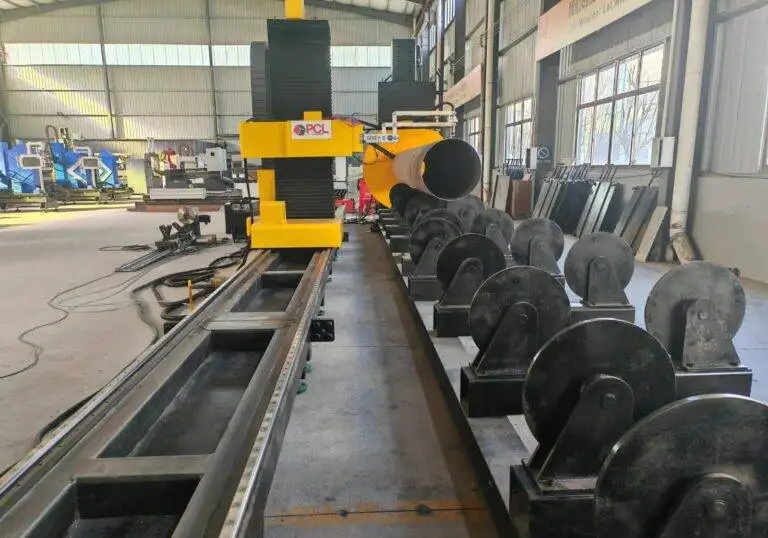
Beam Processing Center with Narrow Gap welding for for Wind Tower fabrication

In this article
Optimizing Wind Tower Structural Integrity via Advanced Plasma Beam Processing
In the current landscape of renewable energy infrastructure, the fabrication of wind towers demands a convergence of high-volume output and extreme structural precision. The transition toward taller hub heights and larger turbine capacities necessitates structural components that can withstand significant dynamic loads and fatigue cycles. Central to this manufacturing evolution is the Beam Processing Center, a multi-functional automated system designed to handle heavy-duty structural profiles with surgical accuracy. For wind tower internals and primary support structures, the integration of high-definition Plasma Cutting technology is the primary driver of efficiency, particularly when preparing components for Narrow Gap Welding (NGW).
The Criticality of Intersection Accuracy in Heavy-Duty Fabrications
Intersection accuracy refers to the geometric fidelity of the cut where one structural member meets another. In wind tower fabrication, internal platforms, nacelle supports, and base reinforcements often involve complex 3D intersections of H-beams, I-beams, and thick-walled tubes. Traditional mechanical cutting methods often fall short of the required tolerances, leading to significant gaps that must be bridged during the welding phase.
Modern plasma-based beam processors utilize multi-axis robotic arms or CNC-controlled gantries to execute complex geometries with a high degree of repeatability. By employing sophisticated algorithms for kerf compensation and real-time torch height control (THC), these systems ensure that the cut profile matches the digital twin precisely. For plasma cutting efficiency, this means achieving a fit-up tolerance often within +/- 0.5mm. Such precision is not merely a matter of aesthetics; it is a prerequisite for narrow gap welding applications. When the root opening is inconsistent due to poor intersection cutting, the stability of the welding arc is compromised, leading to potential lack of fusion or slag inclusions. A high-accuracy plasma cut eliminates the need for manual grinding or “buttering” of the joints, directly reducing man-hours per ton of steel processed.
Maintenance Advantages of Plasma Systems in H-Beam Processing
From an industrial engineering perspective, the Total Cost of Ownership (TCO) of a processing center is heavily weighted by maintenance downtime. H-beam processing environments are inherently harsh, characterized by heavy vibration, metallic dust, and intense thermal cycles. High-definition plasma systems have evolved to become the “workhorse” of this environment due to their mechanical robustness and simplified consumable management.
Unlike other thermal cutting technologies that require sensitive optical alignments or ultra-clean environments, plasma systems are built for the grit of a heavy structural shop. The H-beam transport systems—consisting of robust roller conveyors and cross-transfers—are synchronized with the plasma torch movements. Because plasma cutting is a non-contact process, there is no mechanical force exerted on the beam during the cut, which reduces wear on the clamping and positioning sub-systems. Furthermore, the modern plasma power supply is designed with modular components that allow for rapid troubleshooting. The primary maintenance cycle involves the replacement of electrodes and nozzles, which can be performed in minutes, ensuring the structural integrity of the workflow remains uninterrupted. This high duty cycle is essential for wind tower projects that operate on tight delivery schedules where equipment failure can result in cascading delays in the assembly hall.
Advanced Beveling Techniques for Narrow Gap Welding Preparation
Narrow Gap Welding (NGW) is the preferred joinery method for thick-section wind tower components because it significantly reduces the volume of filler metal required and minimizes the total heat input into the base material. However, NGW is exceptionally sensitive to joint preparation. The bevel angles must be steep—often between 1 and 7 degrees—with a high degree of uniformity across the entire length of the joint.
The implementation of a 5-axis or 6-axis plasma beveling head allows the Beam Processing Center to produce V, Y, K, and X-cuts in a single pass. This automated beveling capability is critical for preparing the heavy-gauge flanges of H-beams used in tower foundations and nacelle frames. By utilizing high-current density plasma arcs, the system can maintain a consistent bevel angle even when cutting through variable material thicknesses. The software driving the plasma head compensates for the natural taper of the plasma arc, ensuring that the resulting face is square where needed and precisely angled for the weld prep. This level of control allows for a reduced “included angle” in the weld joint, which directly translates to fewer welding passes and a smaller Heat Affected Zone (HAZ), preserving the mechanical properties of the high-strength low-alloy (HSLA) steels typically used in wind energy.
Throughput Synergy and Process Flow Integration
Integrating a plasma-based Beam Processing Center into the wider wind tower fabrication flow creates a lean manufacturing environment. The process begins with raw H-beam stock being loaded onto the input conveyor. Sensors detect the lead edge and the cross-sectional dimensions, compensating for any mill tolerances or slight deviations in the beam’s straightness. As the beam moves through the plasma station, all bolt holes, cope cuts, and bevels are executed according to the CAD data.
This “all-in-one” processing approach eliminates the logistical bottleneck of moving heavy beams between different stations for sawing, drilling, and manual beveling. By consolidating these steps into the plasma center, the industrial engineer can optimize the floor layout and reduce the risk of material handling accidents. The output of the center is a component that is “weld-ready.” For narrow gap welding, this means the component can be moved directly to the robotic welding cell. The consistency of the plasma-cut bevel ensures that the automated welding parameters can remain constant, reducing the need for real-time sensor-based path correction during the welding process.
Data-Driven Optimization and SEO of Operations
In the digital manufacturing era, the plasma Beam Processing Center acts as a data node. Every cut, every pierces, and every consumable change is logged. This data allows for predictive maintenance and precise cost-per-part analysis. By analyzing the gas consumption (typically Oxygen, Nitrogen, or H35) against the linear meters cut, facilities can fine-tune their parameters to achieve the lowest possible cost while maintaining the high intersection accuracy required for wind tower standards.
The synergy between high-definition plasma cutting and narrow gap welding represents the pinnacle of heavy structural fabrication. By focusing on the mechanical advantages of plasma—namely its resilience in H-beam handling and its precision in complex beveling—manufacturers can produce wind tower components that meet the most stringent international standards for weld quality and structural longevity. This strategic focus on the cutting phase of production ensures that the subsequent assembly and welding phases are as efficient as possible, driving down the overall Levelized Cost of Energy (LCOE) for wind power generation.
In conclusion, the Beam Processing Center is not merely a cutting machine; it is the foundation of a high-performance fabrication strategy. Through the application of precision plasma technology, the industry can achieve the intersection accuracy and bevel consistency required to make Narrow Gap Welding a viable, high-efficiency reality for the next generation of wind energy infrastructure.