Beam Processing Center with Narrow Gap welding for for Pressure Vessels
In this article
Engineering Precision: The Role of Plasma Cutting in Heavy-Duty Beam Processing
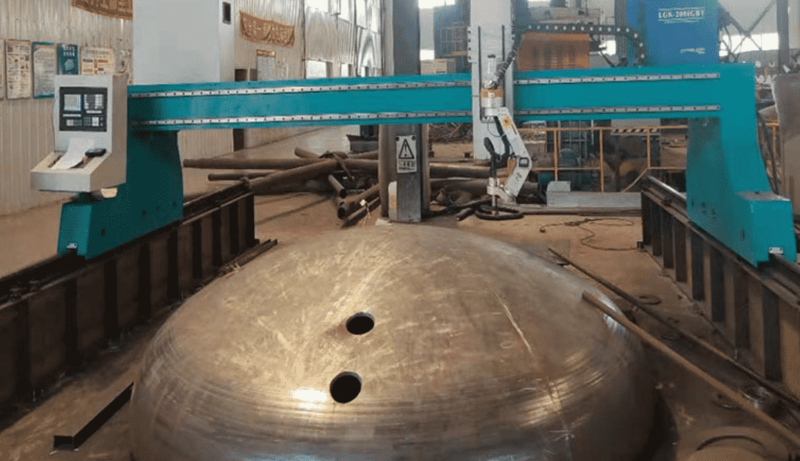
In the specialized field of pressure vessel fabrication, the structural integrity of support frames and internal reinforcements is as critical as the vessel shell itself. An automated Beam Processing Center equipped with high-definition plasma technology serves as the primary gateway for preparing these components. Unlike standard construction-grade fabrication, pressure vessel support structures—such as saddles, skirts, and ring stiffeners—require a higher degree of thermal cutting precision to accommodate Narrow Gap Welding (NGW) protocols.
The transition from traditional wide-groove welding to NGW demands a radical shift in edge preparation. The fundamental advantage of utilizing Plasma Cutting in this context lies in its ability to deliver consistent, repeatable geometries on heavy H-beams and structural profiles. By automating the thermal cutting process, engineers can eliminate the variables associated with manual layout and grinding, ensuring that the structural interface meets the tight fit-up tolerances required for high-integrity fusion.
Achieving Superior Intersection Accuracy for Complex Geometries
Pressure vessel assemblies often involve complex intersections where structural H-beams must contour perfectly to the radius of a cylindrical shell. Intersection Accuracy is the metric that determines the success of these connections. In a modern beam processing center, sophisticated 6-axis robotic arms or multi-axis gantry systems utilize plasma torches to execute complex copes and miter cuts.

From an industrial engineering perspective, the accuracy of these intersections is governed by the synchronization between the motion control system and the plasma arc voltage. Advanced software calculates the precise tool path required to compensate for the beam’s dimensional variances, such as web off-center or flange tilt. When a structural beam is cut to match the curvature of a pressure vessel, the resulting gap must be uniform to prevent burn-through or lack of penetration during the subsequent narrow gap welding phase. This precision reduces the volume of weld metal required and minimizes the total heat input into the parent material.
The 3D Plasma Beveling Advantage for Narrow Gap Welding
The hallmark of narrow gap welding is a groove angle that is significantly reduced—often less than 10 degrees total included angle. Preparing such a profile on thick-walled H-beams or plate-based reinforcements requires highly specialized 3D beveling capabilities. High-definition plasma systems are uniquely suited for this task due to their ability to maintain arc stability at varying torch inclinations.
A Beam Processing Center capable of 3D beveling allows for the creation of “J” or “U” prep profiles directly on the structural member. This eliminates the need for secondary machining operations. By controlling the plasma gas flow and current density, the system produces a clean, dross-free surface with a minimal heat-affected zone (HAZ). This is particularly important for Pressure Vessels operating under high fatigue or cryogenic conditions, where the metallurgical properties of the cut edge must remain within strict ASME or PED code requirements.
Low Maintenance and Operational Reliability of H-Beam Plasma Systems
In heavy industrial environments, equipment uptime is a primary KPI. Plasma cutting systems are favored in beam processing centers for their robust, low-maintenance characteristics. Unlike mechanical cutting methods that suffer from tool wear or sensitive optical systems that require clean-room conditions, plasma torches are designed for the “dirty” reality of a fabrication shop.
The maintenance cycle for a plasma-based H-beam line is largely focused on consumable replacement (nozzles and electrodes), which can be performed in minutes. This reliability ensures that the workflow for pressure vessel components remains fluid. Furthermore, modern plasma power sources feature self-diagnostic capabilities that monitor coolant flow, gas pressure, and arc consistency, allowing for predictive maintenance that prevents mid-cut failures—a critical factor when processing expensive, high-alloy structural sections.
Optimizing Fit-Up Tolerances for NGW Integration
The synergy between precision plasma cutting and narrow gap welding is rooted in the “fit-up” phase. In NGW, the tolerance for gap variation is extremely narrow—often within +/- 0.5mm. If the beam processing center fails to deliver this level of accuracy, the automated welding system cannot maintain the stable arc or consistent side-wall fusion necessary for X-ray quality welds.
By leveraging the Intersection Accuracy provided by high-definition plasma, fabricators can ensure that the root face and groove geometry are perfectly aligned across the entire length of the joint. This level of control allows for the use of tandem-wire or oscillating-wire NGW techniques, which drastically increase deposition rates while reducing the number of weld passes. The result is a significant reduction in fabrication cycle time and a decrease in the residual stresses that often plague large-scale pressure vessel structural assemblies.
Conclusion: Efficiency through Thermal Precision
Integrating a Beam Processing Center into the pressure vessel production workflow is not merely about speed; it is about achieving the geometric precision required by modern welding technologies. By focusing on the strengths of Plasma Cutting—specifically its ability to handle 3D beveling and complex intersections with minimal maintenance—industrial engineers can create a seamless transition from raw H-beam processing to final Narrow Gap Welding.
This approach optimizes material utilization, reduces labor-intensive secondary processes, and ensures that every structural component meets the rigorous safety and performance standards of the pressure vessel industry. As global standards move toward more efficient, low-heat welding processes, the role of high-precision thermal cutting in structural preparation will only become more vital to the bottom line of heavy fabrication facilities.







