Optimizing Heavy Construction Fabrication via 5-Axis Plasma Systems
In the production of heavy-duty construction machinery, such as excavator chassis, crane booms, and specialized mining equipment, the structural integrity of the base components is non-negotiable. The industry has increasingly transitioned toward Plasma Cutting technology to handle the heavy-gauge carbon steel and alloy plates required for these high-stress applications. Unlike traditional mechanical methods, modern plasma systems integrated with 5-axis kinematics offer a decisive advantage in throughput and geometric precision.
The primary challenge in heavy fabrication is the transition from raw structural steel to a weld-ready component. Construction machinery relies on thick sections where edge preparation—specifically beveling—is essential for full-penetration welds. A 5-axis plasma system addresses this by providing a dynamic range of motion that allows for complex edge geometries in a single pass, significantly reducing the secondary handling of massive workpieces.
The Mechanics of the 5-Axis Beveling Head
The core of this technology lies in the 5-axis beveling head, which utilizes two additional rotational axes (typically A and B) on top of the standard X, Y, and Z Cartesian coordinates. This allows the torch to tilt and rotate simultaneously while traversing the cut path. For an industrial engineer, this means the ability to execute V, X, Y, and K-cuts on plates ranging from 12mm to over 50mm in thickness without relocating the material to a separate milling or grinding station.
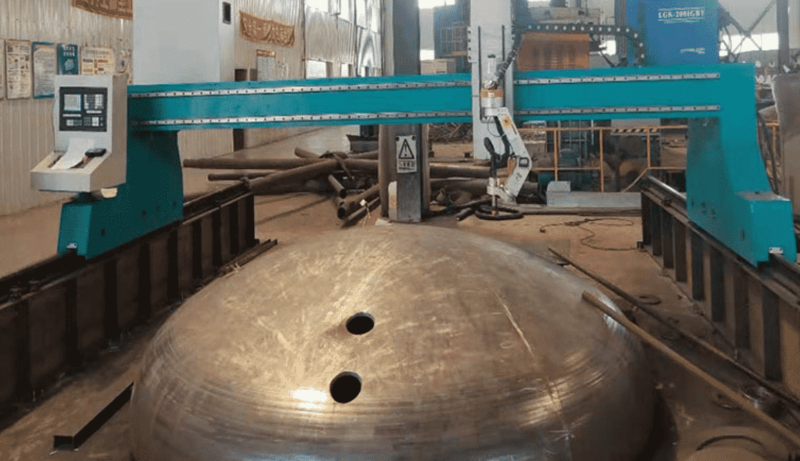
In construction machinery, many parts feature non-linear contours that require varying bevel angles along a single edge. The 5-axis head uses advanced CNC algorithms to adjust the torch angle in real-time, compensating for the kerf width and the arc’s natural deviation. This ensure that the root face and the bevel angle remain consistent throughout the entire geometry, which is critical for the subsequent automated assembly phases.
Intersection Accuracy in Complex Structural Joints
One of the most complex tasks in heavy equipment engineering is the creation of precise intersections where multiple structural members meet. Whether it is a cylindrical support meeting a flat plate or two H-beams joining at a compound angle, intersection accuracy determines the fit-up quality. High-definition plasma systems, when paired with 5-axis control, can execute these complex “saddle” cuts and hole penetrations with tolerances that meet ISO 9013 standards.
The accuracy is achieved through sophisticated Torch Height Control (THC) and voltage sensing. As the torch tilts to create a bevel, the distance between the nozzle and the workpiece changes. A high-speed 5-axis system calculates these trigonometric offsets instantaneously to maintain a constant arc voltage. This precision prevents “bevel wash” or rounding of the edges, ensuring that when two large components are brought together, the gap is uniform. This uniformity is the bedrock of structural reliability in machinery that must withstand extreme torsional and compressive loads.
H-Beam Processing and Low Maintenance Advantages
Structural steel fabrication often revolves around the use of H-beams and I-beams. Traditional processing involved mechanical drilling and sawing, which are high-maintenance operations due to tool wear, coolant management, and mechanical vibration. Plasma cutting offers a structural steel fabrication alternative that is inherently low maintenance. Since plasma is a thermal process, there is no physical contact between the cutting tool and the workpiece. This eliminates the mechanical stresses that lead to spindle failure or tool breakage.
For H-beams, 5-axis plasma robots or gantry systems can cut through the flange and web seamlessly. The maintenance profile of a plasma system is primarily centered on consumables—nozzles, electrodes, and shields—which can be replaced in minutes. Compared to the hours required to calibrate or repair a heavy-duty mechanical saw, plasma systems provide a much higher Overall Equipment Effectiveness (OEE). Furthermore, the absence of cutting fluids simplifies the workspace, reducing the environmental footprint and the cost of cleaning components before they proceed to the assembly line.
Thermal Management and the Heat Affected Zone
A common concern in heavy gauge cutting is the Heat Affected Zone (HAZ). Modern high-definition plasma power sources have narrowed the HAZ significantly by increasing power density and travel speeds. In construction machinery, where the metallurgy of the steel must remain intact to prevent brittle fractures, managing the thermal input is vital. 5-axis systems optimize this by maintaining the fastest possible feed rate while adjusting for the increased material thickness encountered during angled cuts. By precisely controlling the plasma gas flow and the current, the system ensures that the chemical properties of the steel remain within design specifications.
Workflow Integration and Economic Impact
From an industrial engineering perspective, the integration of 5-axis plasma cutting into a facility’s workflow reduces the “Total Cost of Ownership” of the fabrication line. By combining cutting, hole-piercing, and beveling into a single operation, the “bottleneck” typically found at the edge preparation stage is removed. This consolidation reduces the reliance on overhead cranes and heavy-duty forklifts to move parts between stations, which is a major safety and efficiency gain in heavy machinery plants.
The software used to drive these machines now integrates directly with 3D CAD models. This “art-to-part” workflow ensures that the intersection accuracy designed by the engineers is exactly what is produced on the shop floor. The nesting software also accounts for the 5-axis movement, allowing for tighter spacing between parts on the plate, thereby maximizing material utilization—a critical factor when dealing with expensive high-tensile steels.
Conclusion
The adoption of 5-axis plasma beveling represents a significant technical upgrade for Construction Machinery manufacturers. By prioritizing intersection precision and leveraging the low-maintenance characteristics of thermal cutting for structural profiles like H-beams, firms can achieve a higher level of repeatability and structural integrity. The focus remains on removing mechanical variables and replacing them with programmable, thermal precision, ensuring that the heavy equipment of tomorrow is built on a foundation of accurately processed steel.
-


LT240S tube laser cutting machine
-
LT120S tube laser cutting machine
-
Sale

Tank Fillet Welding Machine
Original price was: $1,000.00.$900.00Current price is: $900.00. -
Sale

MAK100 tube laser cutting machine
Original price was: $5,500.00.$5,000.00Current price is: $5,000.00. -

portable plasma air cutting machine
$1,200.00 -

2in1 fiber laser cutting machine
-

Air cooling Laser welding machine
-

HF h beam laser cutting machine
-

LT240 laser cutting machine
-

Laser welding machine
-


Cobot Welding Station
-

Gantry welding robot solution
-

Tracked Wheeled AGV Welding robot
-

LFH6020 Fiber laser cutting machine
-
LFP6020
-

robotic welidng machine
Advanced Fiber Laser Tube Processing Technology
Our CNC Fiber Laser Tube Cutting systems revolutionize metal fabrication by integrating high-precision cutting, punching, and profiling into a single automated workflow. Designed for versatility, this technology handles a wide array of profiles including Round, Square, Rectangular, and Oval tubes, as well as complex L-shaped and U-shaped channels.
- Precision Punching: High-speed hole punching with micron-level accuracy, eliminating the need for mechanical drilling or die-stamping.
- Complex Profiling: Advanced 3D pathing allows for intricate interlocking joints and specialized notch cuts, ideal for structural frames.
- High Material Efficiency: Intelligent nesting software minimizes scrap, reducing raw material costs across large production runs.
- Clean Finish: Delivers oxide-free, burr-free edges that require zero secondary grinding before welding.

Seamlessly processing multiple profiles with consistent precision.
Global Delivery & Logistics



From our high-tech manufacturing facility directly to your global site. PCL WeldCut ensures secure packaging, professional handling, and reliable international logistics to safeguard your equipment throughout the entire journey.