Technical Integration of Magnetic Crawler Units in LNG Fabrication
The construction of Liquefied Natural Gas (LNG) storage tanks and large-diameter pipelines demands rigorous structural integrity and standardized weld quality. Conventional manual welding methods often fail to meet the tight tolerances and accelerated timelines required for modern energy infrastructure. An Industrial Engineering approach suggests the deployment of a Robotic Welding Cell centered around a magnetic crawler system. This system utilizes high-flux permanent magnets or electromagnets to adhere to the vertical or overhead surfaces of carbon steel and specialized alloy plates, providing a stable platform for automated orbital welding.
MAG Welding Parameters and Gas Management
Metal Active Gas (MAG) welding, also known as GMAW (Gas Metal Arc Welding) with active shielding gases, is the preferred process for magnetic crawler applications due to its high deposition rates and continuous wire feed. In LNG applications, particularly for outer containment shells, the use of CO2 and Argon mixtures optimizes penetration profiles while maintaining arc stability.
The robotic controller manages the wire feed speed, voltage, and travel speed in a synchronized loop. Unlike manual operators, the crawler maintains a constant torch-to-work distance, which minimizes spatter and eliminates the inconsistencies associated with operator fatigue. For thick-walled LNG components, multi-pass welding is programmed into the crawler’s logic, ensuring that each layer meets the specified interlaced bead profile required by API 620 or API 625 standards.
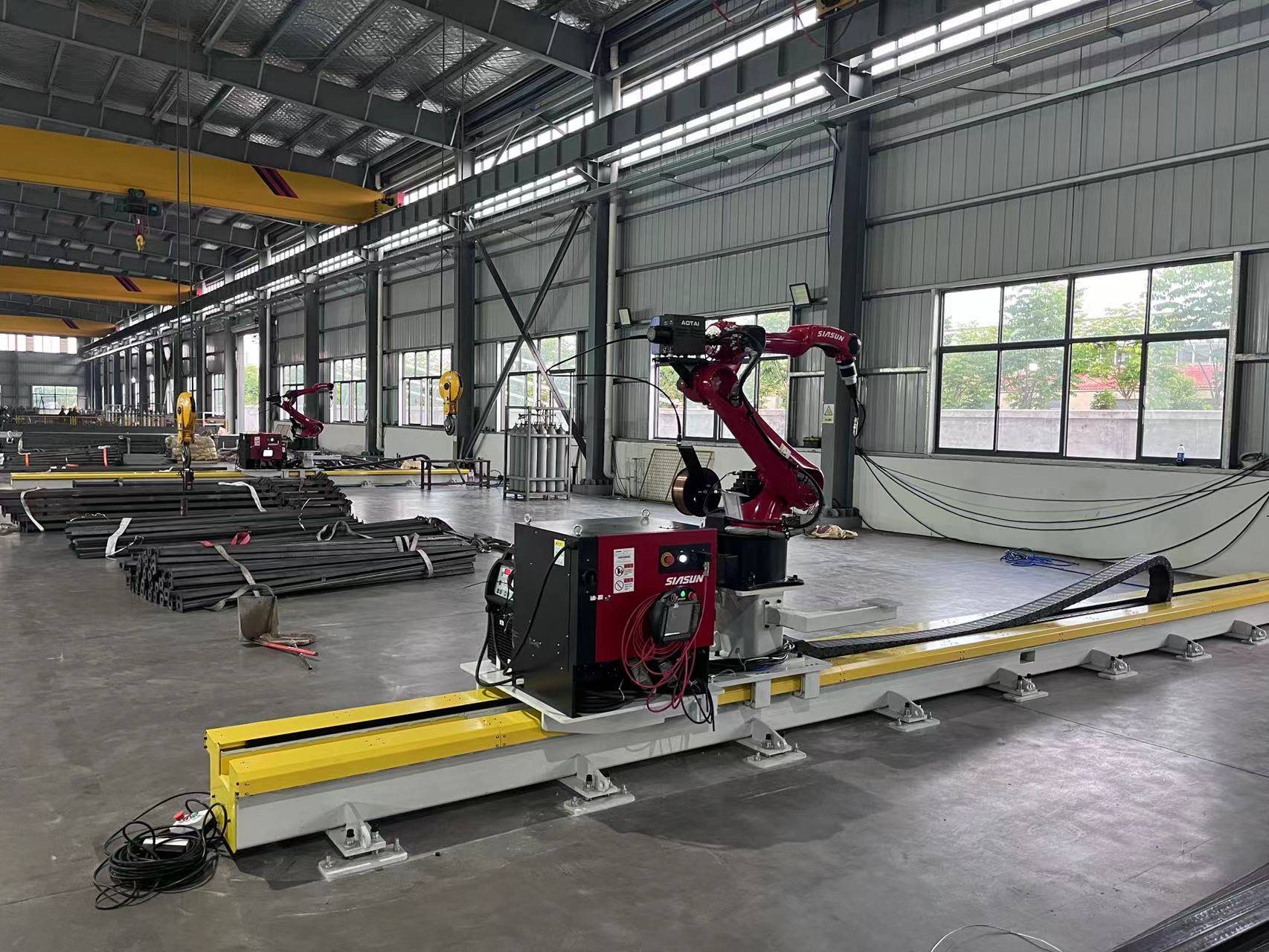
Kinematics and Motion Control of the Magnetic Crawler
The core of the robotic cell is the drive system. A magnetic crawler must navigate curved surfaces typical of LNG tanks while carrying the welding torch, wire feeder, and oscillation unit. High-torque stepper motors or brushless DC motors provide the locomotion, while the robotic brain calculates the GMAW deposition rates to adjust the travel speed dynamically.
Oscillation and Weave Patterns
To fill large gaps or manage wide grooves, the robotic arm on the crawler utilizes an integrated oscillation unit. By programming specific weave patterns—such as the “triangular” or “trapezoidal” movement—the system ensures uniform heat distribution. This prevents burn-through on thinner sections and ensures deep side-wall fusion on heavy-duty plate joints. The precision of these movements reduces the Heat Affected Zone (HAZ), which is critical for maintaining the mechanical properties of the base metal at cryogenic temperatures.
Quantifying Labor ROI and Productivity Gains
From an operational standpoint, the transition to robotic crawlers is driven by the labor productivity index. In manual welding environments, the “arc-on” time—the actual time spent welding—rarely exceeds 30 to 40 percent due to the need for repositioning, breaks, and environmental adjustments. A robotic crawler cell can push the arc-on time to 75 or 85 percent.
Labor Cost Displacement and Skill Mitigation
The scarcity of certified 6G welders capable of maintaining consistent quality over long shifts represents a significant risk to LNG project timelines. By implementing a magnetic crawler system, a single technician can oversee multiple units. This does not eliminate the need for skilled labor but shifts the requirement from physical execution to system monitoring and quality assurance. The ROI is calculated by dividing the total system cost by the hourly labor savings over the projected linear meters of weld. In most LNG tank projects, the break-even point is reached within the first 12 months of active site construction.
Safety and EHS Considerations
LNG construction often involves working at significant heights or in confined spaces. Magnetic crawlers significantly reduce the need for scaffolding and minimize the exposure of human workers to toxic fumes and intense UV radiation. From an Industrial Engineering perspective, the reduction in reportable safety incidents translates directly to lower insurance premiums and fewer work stoppages, further enhancing the project’s bottom line.
Maintenance Protocols and System Reliability
To ensure the longevity of a robotic welding cell, a rigorous maintenance schedule is mandatory. Unlike manual torches, the robotic assembly is subject to continuous duty cycles that accelerate wear on specific components.
Consumable Management
The contact tip and the wire liner are the most frequent points of failure. Industrial engineers must implement preventative maintenance cycles where contact tips are replaced based on wire throughput (measured in kilograms) rather than waiting for failure. In LNG projects, where downtime can cost thousands of dollars per hour, the use of high-quality zirconium-chrome-copper tips is recommended to extend the interval between replacements.
Magnetic Integrity and Drive Train Calibration
The magnetic tracks or wheels must be inspected daily for the accumulation of metallic dust and spatter, which can interfere with surface adhesion. Furthermore, the drive train requires periodic calibration to ensure that the encoder feedback matches the actual physical displacement. Slippage on vertical walls, if not detected by the control system, can lead to uneven weld beads and costly repairs.
Software and Data Logging
Modern robotic cells integrated into LNG projects often feature data logging capabilities. Every centimeter of weld is tracked, recording voltage, current, and gas flow. This “digital twin” of the weld process allows engineers to perform root cause analysis if a non-destructive testing (NDT) failure occurs. Instead of grinding out an entire seam, technicians can pinpoint the exact coordinates where parameters deviated from the set point.
Conclusion: The Future of LNG Infrastructure Fabrication
The implementation of magnetic crawler robotic welding cells represents a fundamental shift in how LNG storage and transport infrastructure is built. By prioritizing MAG process stability and leveraging automated motion control, companies can achieve weld quality that is statistically superior to manual methods. The focus on high-duty cycles, coupled with a data-driven approach to maintenance and labor management, ensures that the rigorous demands of the global energy sector are met with precision and efficiency. As the scale of LNG projects continues to grow, the adoption of these robotic systems will move from a competitive advantage to an industry standard.
-


LT240S tube laser cutting machine
-
LT120S tube laser cutting machine
-
Sale

Tank Fillet Welding Machine
Original price was: $1,000.00.$900.00Current price is: $900.00. -
Sale

MAK100 tube laser cutting machine
Original price was: $5,500.00.$5,000.00Current price is: $5,000.00. -

portable plasma air cutting machine
$1,200.00 -

2in1 fiber laser cutting machine
-

Air cooling Laser welding machine
-

HF h beam laser cutting machine
-

LT240 laser cutting machine
-

Laser welding machine
-


Cobot Welding Station
-

Gantry welding robot solution
-

Tracked Wheeled AGV Welding robot
-

LFH6020 Fiber laser cutting machine
-
LFP6020
-

robotic welidng machine
Advanced Fiber Laser Tube Processing Technology
Our CNC Fiber Laser Tube Cutting systems revolutionize metal fabrication by integrating high-precision cutting, punching, and profiling into a single automated workflow. Designed for versatility, this technology handles a wide array of profiles including Round, Square, Rectangular, and Oval tubes, as well as complex L-shaped and U-shaped channels.
- Precision Punching: High-speed hole punching with micron-level accuracy, eliminating the need for mechanical drilling or die-stamping.
- Complex Profiling: Advanced 3D pathing allows for intricate interlocking joints and specialized notch cuts, ideal for structural frames.
- High Material Efficiency: Intelligent nesting software minimizes scrap, reducing raw material costs across large production runs.
- Clean Finish: Delivers oxide-free, burr-free edges that require zero secondary grinding before welding.

Seamlessly processing multiple profiles with consistent precision.
Global Delivery & Logistics



From our high-tech manufacturing facility directly to your global site. PCL WeldCut ensures secure packaging, professional handling, and reliable international logistics to safeguard your equipment throughout the entire journey.