Industrial Optimization of Wind Tower Longitudinal and Circumferential Welding
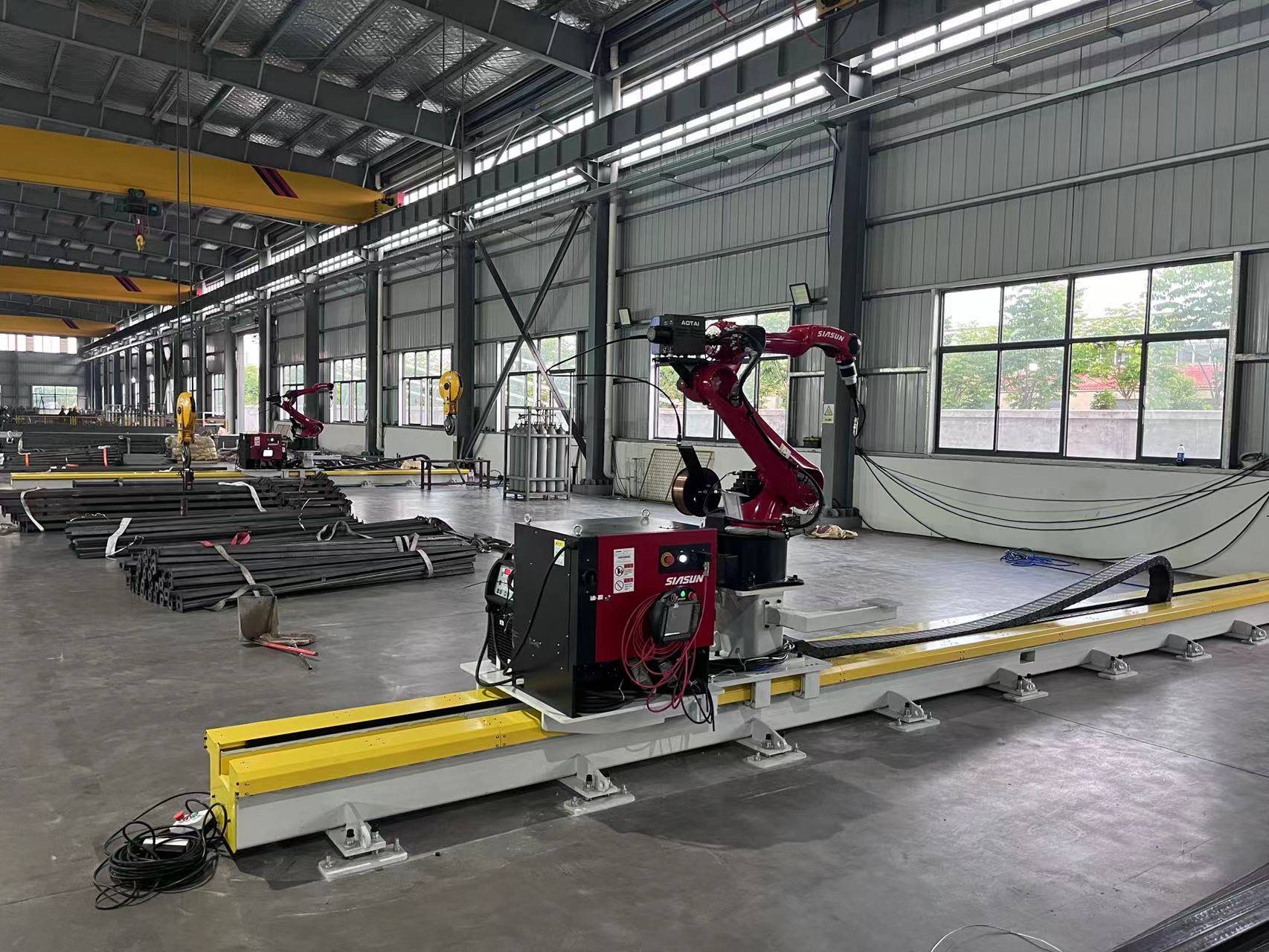
In the fabrication of wind turbine towers, the primary bottleneck often resides in the welding of massive structural sections. These towers, constructed from thick-gauge carbon steel plates, require high-integrity longitudinal and circumferential joints to withstand extreme dynamic loads. Transitioning from manual or semi-automatic processes to a Robotic Welding Cell significantly enhances throughput by addressing the physical limitations of human operators and the geometric inconsistencies of large-scale workpieces.
MAG Welding Parameters and Deposition Efficiency
The Metal Active Gas (MAG) process is the standard for wind tower production due to its high deposition rates and suitability for multi-pass configurations. In a robotic environment, the MAG process is optimized through the use of high-amperage power sources and pulsed-arc technology. This minimizes spatter and ensures deep penetration, which is critical for the 20mm to 50mm plate thicknesses typical in tower sections.
Robotic integration allows for the utilization of larger diameter wires (up to 1.6mm) and higher wire feed speeds that would be difficult for a manual welder to control consistently. By maintaining a constant stick-out and optimal torch angle, the robot achieves a spray transfer mode that maximizes deposition rates. In practical applications, robotic MAG welding can increase deposition by 30-50% compared to manual stick or semi-auto processes, directly reducing the number of passes required to fill the bevel.
Real-Time Correction via Laser Seam Tracking
Wind tower sections, often exceeding 4 meters in diameter, are prone to fit-up variations. Despite precision rolling, edges rarely align perfectly, and thermal expansion during welding further shifts the joint geometry. Laser seam tracking is the technical solution that enables robotic autonomy in this high-tolerance environment.
The system utilizes a laser triangulation sensor mounted ahead of the welding torch. This sensor scans the joint profile in real-time, measuring the gap width, root opening, and mismatch (high-low). The robotic controller processes this data to adjust the torch position and modify welding parameters—such as travel speed and weave width—on the fly. This “adaptive welding” ensures that the weld bead remains centered in the groove, maintaining the required throat thickness regardless of minor structural deviations.
Managing Thermal Distortion and Path Deviation
Large-scale welding generates significant heat input, leading to localized expansion and contraction. In a fixed-path robotic system, this would result in the torch drifting off-seam. Laser tracking compensates for this by providing a closed-loop feedback mechanism. By identifying the volumetric center of the weld preparation, the robot maintains a consistent arc length and bead profile, which is essential for meeting rigorous non-destructive testing (NDT) standards like UT (Ultrasonic Testing) and X-ray requirements.
Maintenance Protocols for High-Duty Cycle Cells
To realize the ROI of a robotic cell, maximum uptime is required. Unlike manual setups, robotic systems operate at duty cycles exceeding 80%. This places extreme stress on the welding consumables and the robotic drivetrain.
Consumable Management and Torch Maintenance
The contact tip is the most frequent point of failure in MAG welding. In a wind tower cell, the high-current demands of multi-pass welding accelerate tip erosion. Automated “reamer” stations or torch cleaning stations are integrated into the cell to perform scheduled maintenance. Every few cycles, the robot moves to the cleaning station to remove spatter from the nozzle and apply anti-spatter fluid. This prevents gas turbulence and porosity in the weld pool.
Mechanical and Electronic Calibration
Preventative maintenance schedules for the 6-axis manipulator include lubricant analysis and belt tension checks. Furthermore, the laser sensor requires periodic lens cleaning and calibration to ensure the triangulation data remains accurate within the sub-millimeter range. Neglecting these protocols leads to “arc-off” time, which severely impacts the net production rate.
Labor ROI and Economic Impact Analysis
The financial justification for robotic welding in wind tower fabrication is rooted in three pillars: labor productivity, rework reduction, and consumable efficiency. The labor ROI is particularly compelling in the current industrial climate of skilled labor shortages.
| Metric | Manual Welding | Robotic Welding Cell |
|---|---|---|
| Arc-On Time (per shift) | 35% – 45% | 75% – 85% |
| Deposition Rate (kg/hr) | 3.5 – 5.0 | 6.5 – 9.0 |
| Rework/Repair Rate | 5% – 8% | < 1.5% |
| Operator Requirement | 1 Highly Skilled Welder | 1 System Operator |
Labor Productivity and Skill Level Transition
A robotic cell allows a single operator to oversee the welding of a complete circumferential seam, a task that might require multiple manual welders working in shifts. The ROI is realized not just by replacing hours, but by upgrading the nature of the labor. A robotic operator focuses on operational efficiency and quality oversight rather than the physical strain of maintaining a steady arc for 8 hours. This reduces fatigue-related errors and workplace injuries, which are hidden costs in manual tower fabrication.
Reduction in Rework Costs
In wind tower construction, a failed weld discovered during NDT is an expensive setback. Gouging out a multi-pass weld and re-welding can cost five times the original labor cost. By utilizing laser seam tracking and consistent robotic motion, the occurrence of slag inclusions and lack of fusion is nearly eliminated. The reliability of the robotic process ensures that the first pass is as accurate as the final cap, leading to a “right-first-time” rate that manual processes cannot match.
Conclusion on System Integration
Implementing a robotic welding cell for Wind Tower fabrication is a strategic shift toward data-driven manufacturing. By leveraging MAG welding in conjunction with Laser Seam Tracking, manufacturers can achieve the throughput necessary to meet global energy infrastructure demands. The capital expenditure is offset by the drastic reduction in cycle times and the stabilization of production schedules, ensuring a competitive advantage in the heavy fabrication sector.
-


LT240S tube laser cutting machine
-
LT120S tube laser cutting machine
-
Sale

Tank Fillet Welding Machine
Original price was: $1,000.00.$900.00Current price is: $900.00. -
Sale

MAK100 tube laser cutting machine
Original price was: $5,500.00.$5,000.00Current price is: $5,000.00. -

portable plasma air cutting machine
$1,200.00 -

2in1 fiber laser cutting machine
-

Air cooling Laser welding machine
-

HF h beam laser cutting machine
-

LT240 laser cutting machine
-

Laser welding machine
-


Cobot Welding Station
-

Gantry welding robot solution
-

Tracked Wheeled AGV Welding robot
-

LFH6020 Fiber laser cutting machine
-
LFP6020
-

robotic welidng machine
Advanced Fiber Laser Tube Processing Technology
Our CNC Fiber Laser Tube Cutting systems revolutionize metal fabrication by integrating high-precision cutting, punching, and profiling into a single automated workflow. Designed for versatility, this technology handles a wide array of profiles including Round, Square, Rectangular, and Oval tubes, as well as complex L-shaped and U-shaped channels.
- Precision Punching: High-speed hole punching with micron-level accuracy, eliminating the need for mechanical drilling or die-stamping.
- Complex Profiling: Advanced 3D pathing allows for intricate interlocking joints and specialized notch cuts, ideal for structural frames.
- High Material Efficiency: Intelligent nesting software minimizes scrap, reducing raw material costs across large production runs.
- Clean Finish: Delivers oxide-free, burr-free edges that require zero secondary grinding before welding.

Seamlessly processing multiple profiles with consistent precision.
Global Delivery & Logistics



From our high-tech manufacturing facility directly to your global site. PCL WeldCut ensures secure packaging, professional handling, and reliable international logistics to safeguard your equipment throughout the entire journey.