Optimizing Pressure Vessel Throughput via Automated MAG Systems
In the realm of heavy industrial fabrication, specifically within pressure vessel manufacturing, the demand for weld integrity and repeatable penetration profiles is absolute. The transition from manual Metal Active Gas (MAG) welding to a fully integrated Robotic Welding Cell is no longer a luxury for high-volume shops; it is a fundamental requirement for maintaining competitiveness in a globalized supply chain. Pressure vessels, characterized by thick-walled cylindrical shells and hemispherical heads, present unique challenges regarding heat management and weld-path consistency.
The implementation of a robotic system addresses the primary bottleneck in these facilities: the human factor. Manual welding of long circumferential and longitudinal seams is physically taxing, leading to operator fatigue and inevitable deviations in travel speed. By contrast, a robotic arm maintains a constant torch angle and speed, ensuring that the heat-affected zone (HAZ) remains within the specified parameters of the Welding Procedure Specification (WPS).
Technical Mechanics of Robotic MAG Welding in Heavy Gauges
The MAG process in a robotic environment differs significantly from manual application in terms of duty cycle and deposition efficiency. While a manual welder may achieve a duty cycle of 30-40%, a robot can sustain arc-on time exceeding 80%. for Pressure Vessels, where multi-pass welding is common, this leads to a massive reduction in floor-to-floor time.
Wire Feed Stability and Gas Shielding
The success of a robotic welding cell relies on the precision of the wire delivery system. Industrial engineers must specify heavy-duty wire feeders capable of pushing large diameter wires (typically 1.2mm to 1.6mm) through long cable assemblies without “bird-nesting” or inconsistent friction. In MAG welding, the shielding gas—often a mixture of Argon and CO2—must be delivered at a laminar flow to prevent porosity. Robotic systems allow for the integration of digital flow meters that communicate directly with the PLC, shutting down the cell if gas coverage drops below a critical threshold, thereby preventing the manufacture of scrap vessels that would fail X-ray inspection.
Heat Input Control
Pressure vessels are subject to strict ASME or PED codes. Overheating the base material can lead to grain growth and reduced impact toughness. The robotic controller manages the pulsing parameters of the power source (Pulsed-MAG), allowing for high deposition rates with lower average heat input compared to traditional spray-transfer modes. This control is vital for maintaining the structural integrity of the vessel’s pressure-retaining boundary.
Real-Time Correction: The Role of Laser Seam Tracking
Even with precise fixturing, pressure vessel components often exhibit variations in fit-up due to rolling tolerances or thermal distortion from previous weld passes. This is where laser seam tracking becomes indispensable.
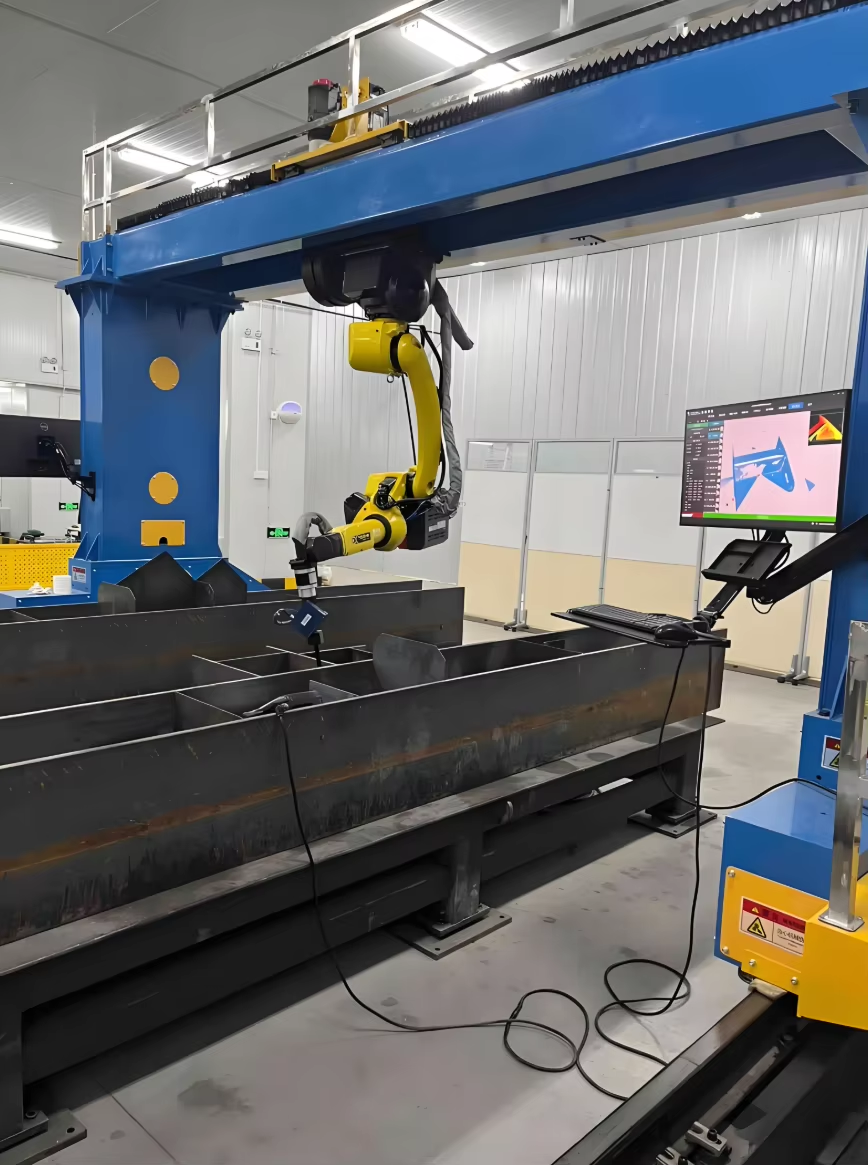
A robotic welding cell equipped with a laser sensor can “see” the joint geometry in real-time. The sensor, mounted ahead of the welding torch, scans the groove and adjusts the robot’s path and welding parameters (such as voltage and wire feed speed) to compensate for gaps or offsets. This eliminates the need for perfect part fit-up, which is often impossible in large-scale vessel fabrication. By tracking the seam dynamically, the system ensures that the weld bead is always centered in the joint, maximizing penetration and minimizing the risk of lack-of-fusion defects.
Labor ROI and Economic Impact Analysis
Calculating the labor ROI for a robotic welding investment requires looking beyond the simple hourly wage comparison. It involves analyzing the “cost per pound” of deposited weld metal.
Shift from High-Skill Welder to Robot Operator
The scarcity of Tier-1 manual welders who can pass 6G certification is a global challenge. By deploying a robot, a facility can utilize a lower-tier operator to load parts and monitor the cell, while the high-skill welder is reassigned to complex tacking operations or quality oversight. This optimization of human capital significantly lowers the labor burden per vessel.
Throughput and Rework Reduction
In manual operations, the defect rate on pressure vessels—often detected through ultrasonic or radiographic testing—can range from 3% to 7%. Each defect requires grinding out the weld and re-welding, which is three times as expensive as the original weld. A robotic system typically reduces the defect rate to under 0.5%. When factoring in the saved time, reduced consumables, and eliminated rework, most industrial facilities see a full ROI within 18 to 24 months, depending on the volume of vessels processed.
System Maintenance and Reliability Protocols
For a robotic cell to deliver the promised ROI, a rigorous preventive maintenance (PM) schedule is mandatory. Industrial engineers must treat the welding robot as a high-precision machine tool rather than a simple torch holder.
Torch and Consumable Management
The contact tip is the most frequently replaced component. In a robotic MAG setup, the wear of the contact tip can cause the arc to wander. Automated “reamer” stations or torch cleaners should be integrated into the cell to automatically clean spatter from the nozzle and spray anti-spatter fluid every few cycles. This ensures gas coverage remains optimal and extends the life of the consumables.
Robot Arm and Cable Maintenance
The “umbilical” cable—carrying the welding power, gas, and wire—is subject to constant torsional stress. Routine inspections must check for cable fatigue and shielding integrity. Furthermore, the robot’s axes should be monitored for backlash or grease contamination, especially in the harsh, dust-heavy environment of a welding shop. Using a robotic welding cell for 24/7 production necessitates a “spare-parts-on-hand” strategy for critical components like the wire drive rollers and the laser sensor’s protective glass.
Quality Assurance and Regulatory Compliance
In pressure vessel fabrication, the paper trail is as important as the weld itself. Modern robotic controllers can log every parameter of every weld pass—current, voltage, travel speed, and gas flow—and associate that data with a specific vessel serial number. This digital record provides a level of traceability that is impossible to achieve with manual welding.
Repeatability as a Safety Feature
The primary benefit of automation in this sector is repeatability. Once a weld program is validated through a Procedure Qualification Record (PQR), the robot will execute that program identically every time. This consistency is the greatest defense against catastrophic failure in pressure vessels, as it ensures that every inch of the seam meets the engineering specifications designed to withstand internal pressure.
Future-Proofing the Fabrication Facility
Adopting robotic MAG welding is the first step toward a “smart factory” environment. As data collection becomes more sophisticated, predictive analytics can warn maintenance teams of a failing component before it causes downtime. For the industrial engineer, the focus remains on the balance between technical capability and economic viability. By concentrating on labor ROI and the high deposition rates of the MAG welding process, manufacturers can ensure their operations remain robust, safe, and profitable in an increasingly automated landscape.
-


LT240S tube laser cutting machine
-
LT120S tube laser cutting machine
-
Sale

Tank Fillet Welding Machine
Original price was: $1,000.00.$900.00Current price is: $900.00. -
Sale

MAK100 tube laser cutting machine
Original price was: $5,500.00.$5,000.00Current price is: $5,000.00. -

portable plasma air cutting machine
$1,200.00 -

2in1 fiber laser cutting machine
-

Air cooling Laser welding machine
-

HF h beam laser cutting machine
-

LT240 laser cutting machine
-

Laser welding machine
-


Cobot Welding Station
-

Gantry welding robot solution
-

Tracked Wheeled AGV Welding robot
-

LFH6020 Fiber laser cutting machine
-
LFP6020
-

robotic welidng machine
Advanced Fiber Laser Tube Processing Technology
Our CNC Fiber Laser Tube Cutting systems revolutionize metal fabrication by integrating high-precision cutting, punching, and profiling into a single automated workflow. Designed for versatility, this technology handles a wide array of profiles including Round, Square, Rectangular, and Oval tubes, as well as complex L-shaped and U-shaped channels.
- Precision Punching: High-speed hole punching with micron-level accuracy, eliminating the need for mechanical drilling or die-stamping.
- Complex Profiling: Advanced 3D pathing allows for intricate interlocking joints and specialized notch cuts, ideal for structural frames.
- High Material Efficiency: Intelligent nesting software minimizes scrap, reducing raw material costs across large production runs.
- Clean Finish: Delivers oxide-free, burr-free edges that require zero secondary grinding before welding.

Seamlessly processing multiple profiles with consistent precision.
Global Delivery & Logistics



From our high-tech manufacturing facility directly to your global site. PCL WeldCut ensures secure packaging, professional handling, and reliable international logistics to safeguard your equipment throughout the entire journey.
One thought on “Robotic Welding Cell with Laser Seam Tracking for for Pressure Vessels”
Solid build quality. This is a heavy-duty machine designed for long shifts.