Engineering Precision in H-Beam Fabrication for Oil & Gas Infrastructure
In the construction of heavy-duty Oil & Gas storage tanks, the structural skeleton relies heavily on H-beams that can withstand immense hydrostatic pressures and environmental stressors. The transition toward automated production lines has prioritized the integration of high-definition Plasma Cutting as the primary method for shaping these components. Unlike traditional mechanical cutting, modern plasma systems provide the thermal energy necessary to penetrate thick-walled structural steel while maintaining a narrow kerf and minimal heat-affected zone (HAZ). This precision is not merely an aesthetic requirement but a functional necessity for the narrow gap welding preparation that follows in the assembly sequence.
The Criticality of Intersection Accuracy in 3D Profile Cutting
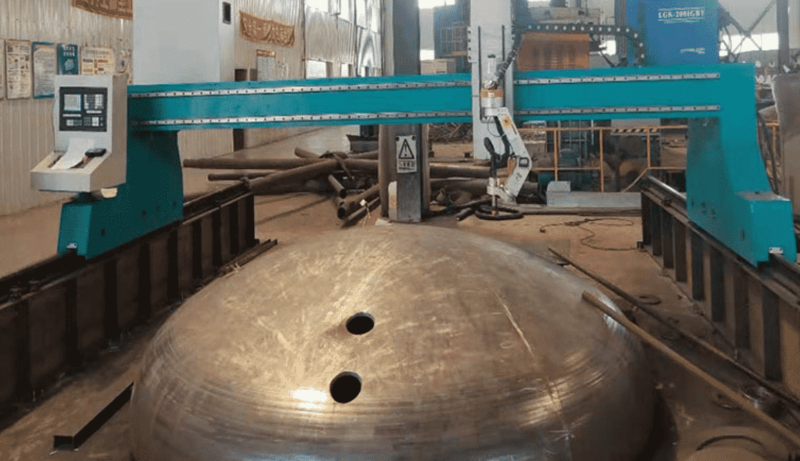
The structural integrity of a tank support system depends on the fit-up between the web and the flanges of the H-beam, as well as the beam-to-shell intersections. High-definition plasma systems utilized in industrial lines are equipped with sophisticated CNC controllers capable of five-axis or six-axis interpolation. This allows the torch to navigate the complex geometry of an H-beam, executing cope cuts, blocks, and bolt holes with plasma cutting accuracy that remains within tolerances of +/- 0.5mm.
When beams are prepared for narrow gap welding, the intersection points must be flawless. Any deviation in the cut path creates air gaps that lead to turbulence in the shielding gas during the welding phase or, worse, inconsistent penetration. By utilizing robotic plasma arms, the production line ensures that every scallop and web-cut is perpendicular or angled exactly to the design specification, eliminating the need for secondary manual trimming which often introduces human error and increases labor costs.
Advanced Beveling for Narrow Gap Welding Efficiency
Narrow gap welding is the preferred joining method for thick-section Oil & Gas components due to its ability to reduce filler metal consumption and cycle times. However, this process is extremely sensitive to joint geometry. Plasma cutting stations in an H-beam line are now engineered to perform automated beveling in a single pass. The ability to create V, Y, X, and K-shaped bevels directly on the beam ends or edges is a transformative advantage.
The plasma system’s ability to maintain a consistent bevel angle over a long distance is achieved through high-accuracy Torch Height Control (THC). THC monitors the arc voltage to adjust the distance between the nozzle and the workpiece in real-time, compensating for any material warpage. For narrow gap applications, the root face (or land) must be perfectly uniform. The latest plasma power sources utilize optimized gas mixing—incorporating oxygen, nitrogen, or H35—to produce a clean, dross-free surface that is chemically ready for high-integrity welding without the need for abrasive grinding.
Mechanical Reliability and Low Maintenance Foundations
From an industrial engineering perspective, the “H-beam low maintenance” profile of a plasma-based line is a significant contributor to Overall Equipment Effectiveness (OEE). Unlike mechanical saws or punch presses that suffer from tool wear and blade breakage, plasma cutting is a non-contact process. The primary wear components are limited to consumables such as electrodes, nozzles, and swirl rings, which can be replaced in minutes via quick-change torch heads.
The gantries are designed with robust rack-and-pinion drives and oversized linear bearings to withstand the harsh environment of a structural steel shop. Effective dust extraction and filtration systems are integrated into the cutting bed to prevent the accumulation of metallic particulates on the drive systems. This focus on H-beam structural integrity begins with a machine that stays in calibration. By reducing the mechanical complexity of the cutting head and utilizing long-life consumables, plants can achieve duty cycles exceeding 80%, ensuring that the downstream welding stations are never starved for material.
Thermal Management and Material Utilization
One of the challenges in H-beam production for Oil & Gas is the management of thermal expansion during the cutting process. High-definition plasma systems mitigate this through precise nesting software and sequenced cutting paths. By distributing the heat input across the workpiece, the system prevents the “banana effect” or longitudinal bowing of the beam. This ensures that when the H-beam arrives at the narrow gap welding station, it is straight and true, allowing for rapid clamping and alignment.
Furthermore, the software integration allows for the direct import of TEKLA or other BIM files. The CNC interprets the exact hole placements and bevel requirements, ensuring that every beam in the tank farm is a digital twin of the engineering model. This level of traceability is vital for compliance with international standards such as API 650, where material certification and fabrication precision are subject to rigorous third-party inspection.
Streamlining the Workflow for High-Volume Production
The integration of plasma cutting into a continuous H-beam line eliminates several bottlenecks typical of traditional fabrication. In a single station, a beam can be loaded, measured by laser sensors to account for mill tolerances, cut to length, beveled for a narrow gap joint, and marked with part numbers for assembly. This “all-in-one” approach reduces the overhead crane movements within the facility, which is often the most significant hidden cost in heavy manufacturing.
By focusing on the precision of the initial cut, the production line optimizes the entire lifecycle of the H-beam. The clean edges produced by modern plasma torches mean that the heat-affected zone is shallow enough that it does not compromise the metallurgical properties of the high-strength steels often used in Oil & Gas tanks (such as A516 or similar grades). The resulting joint is clean, the geometry is exact, and the foundation for a world-class narrow gap weld is established.
Conclusion of Technical Implementation
The implementation of high-definition plasma cutting in H-beam lines represents a strategic investment in quality and throughput. By prioritizing intersection accuracy and automated beveling, manufacturers can meet the demanding standards of the Oil & Gas industry while maintaining a low-maintenance operational profile. The synergy between precise thermal cutting and advanced narrow gap welding techniques ensures that storage tank structures are not only built faster but are also inherently safer and more reliable for long-term service in volatile environments.
-


LT240S tube laser cutting machine
-
LT120S tube laser cutting machine
-
Sale

Tank Fillet Welding Machine
Original price was: $1,000.00.$900.00Current price is: $900.00. -
Sale

MAK100 tube laser cutting machine
Original price was: $5,500.00.$5,000.00Current price is: $5,000.00. -

portable plasma air cutting machine
$1,200.00 -

2in1 fiber laser cutting machine
-

Air cooling Laser welding machine
-

HF h beam laser cutting machine
-

LT240 laser cutting machine
-

Laser welding machine
-


Cobot Welding Station
-

Gantry welding robot solution
-

Tracked Wheeled AGV Welding robot
-

LFH6020 Fiber laser cutting machine
-
LFP6020
-

robotic welidng machine
Advanced Fiber Laser Tube Processing Technology
Our CNC Fiber Laser Tube Cutting systems revolutionize metal fabrication by integrating high-precision cutting, punching, and profiling into a single automated workflow. Designed for versatility, this technology handles a wide array of profiles including Round, Square, Rectangular, and Oval tubes, as well as complex L-shaped and U-shaped channels.
- Precision Punching: High-speed hole punching with micron-level accuracy, eliminating the need for mechanical drilling or die-stamping.
- Complex Profiling: Advanced 3D pathing allows for intricate interlocking joints and specialized notch cuts, ideal for structural frames.
- High Material Efficiency: Intelligent nesting software minimizes scrap, reducing raw material costs across large production runs.
- Clean Finish: Delivers oxide-free, burr-free edges that require zero secondary grinding before welding.

Seamlessly processing multiple profiles with consistent precision.
Global Delivery & Logistics



From our high-tech manufacturing facility directly to your global site. PCL WeldCut ensures secure packaging, professional handling, and reliable international logistics to safeguard your equipment throughout the entire journey.