Technical Integration of H-Beam Production for Energy Infrastructure
The construction of large-scale oil and gas storage tanks requires structural foundations capable of supporting immense hydrostatic loads. H-beams serve as the primary skeletal components for these structures, demanding rigorous adherence to dimensional tolerances and material integrity. An automated H-Beam Production Line designed for this sector must move beyond simple cut-to-length operations, incorporating sophisticated thermal processing units that handle complex geometries without compromising the structural properties of the steel.
In industrial engineering terms, the efficiency of such a line is measured by its throughput-to-scrap ratio and its ability to maintain high duty cycles in harsh environments. By replacing manual marking and traditional sawing with multi-axis plasma systems, facilities can significantly reduce the “floor-to-floor” time of each structural member. This transition is underpinned by the shift from manual machine operation to high-level digital control.
The Implementation of Offline Programming (OLP)
The cornerstone of modern structural fabrication is offline programming. Traditional CNC programming requires the machine to be idle while the operator inputs coordinates or adjusts paths. For oil and gas projects involving hundreds of unique beam configurations, this downtime is unacceptable. OLP allows engineers to generate cutting paths and simulate the entire fabrication process in a virtual environment using 3D CAD models.
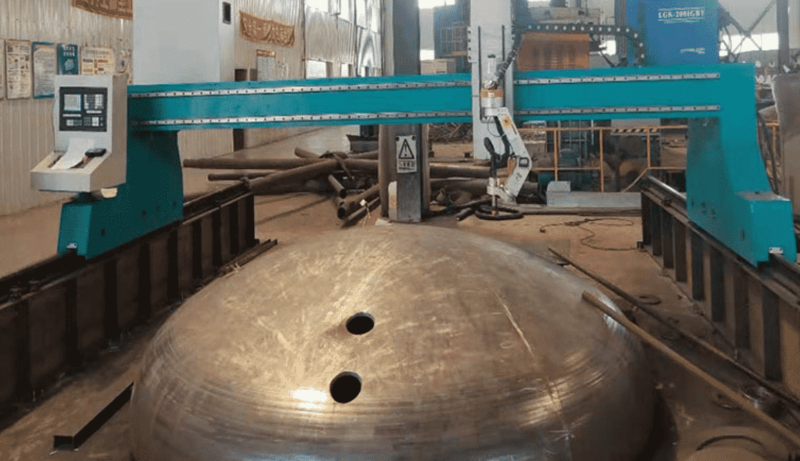
By importing DSTV or XML files directly from structural detailing software, the OLP system calculates the optimal torch path, accounting for beam camber, sweep, and flange thickness variations. This digital twin approach ensures that the plasma torch avoids collisions and maintains the correct standoff distance. Furthermore, OLP software integrates nestling algorithms that optimize the raw material usage, a critical factor when dealing with high-yield strength steel common in energy applications.
Achieving Superior Plasma Cutting Intersection Accuracy
Intersection accuracy is paramount when H-beams must be joined at non-orthogonal angles, such as those found in tank roof supports or complex bracing systems. The plasma cutting intersection accuracy achieved by modern 6-axis robotic arms or gantry-based systems ensures that the web and flange cuts align perfectly with the mating beam’s profile.
To maintain this accuracy, the production line utilizes advanced sensing technologies. Laser scanning or mechanical probing measures the actual dimensions of the H-beam as it enters the cutting zone. Because structural steel is rarely perfectly straight, the control system adjusts the cutting program in real-time to compensate for deviations. This ensures that the “cope” or “notching” cuts are performed with sub-millimeter precision, providing a tight fit-up that is essential for high-integrity structural joints.
Advanced Beveling for Weld Preparation
In the oil and gas industry, structural joints are subjected to extreme stress and environmental fatigue. Proper weld preparation through automated beveling is not optional; it is a regulatory requirement under codes such as AWS D1.1 or API 650. Plasma systems equipped with tilting torch heads allow for the creation of V, Y, X, and K-shaped bevels in a single pass.
The ability to bevel the thick flanges of H-beams using plasma technology offers a significant advantage over mechanical milling. The plasma arc penetrates the full thickness of the material, creating a clean, consistent edge angle that is ready for the subsequent assembly phases. The OLP system precisely controls the tilt and rotation of the torch, ensuring the bevel angle remains constant even as it transitions from the flange to the web. This geometric consistency is vital for ensuring full penetration in the final assembly.
Low Maintenance Requirements of Plasma Systems
From an operational expenditure (OPEX) perspective, the mechanical robustness of the cutting system is a primary concern. Plasma systems are favored in heavy industrial environments due to their relatively simple mechanical architecture. Unlike other thermal cutting methods that rely on sensitive optical components or complex gas mixing chambers, plasma power supplies and torches are designed for high-vibration, high-dust environments.
The maintenance cycle for a modern high-definition plasma system focuses primarily on consumables: the electrode, nozzle, and shield cap. Modern systems feature “quick-change” torch designs that allow operators to replace consumables in under two minutes, minimizing machine idleness. Furthermore, the absence of complex beam-delivery optics means there are fewer points of failure. The internal cooling systems of these power units are engineered to handle the 100% duty cycles required for 24/7 production schedules in the energy sector.
Optimizing the Heat-Affected Zone (HAZ)
Engineers must consider the metallurgical impact of thermal cutting on H-beams. High-definition plasma systems utilize narrow-constricted arcs that concentrate heat into a very small area. This results in a minimal heat-affected zone (HAZ) compared to oxy-fuel cutting. For oil and gas tanks, where the ductility of the steel is crucial for seismic and thermal expansion resilience, minimizing the HAZ is a significant technical benefit.
The speed of plasma cutting contributes to this advantage. By traversing the material at higher velocities, the total heat input into the beam is reduced. This prevents the warping of the thin web sections and preserves the grain structure of the high-strength steel. The result is a structural component that retains its engineered load-bearing characteristics while meeting the most stringent dimensional specifications.
Streamlining Workflow with Material Handling Integration
An efficient H-beam production line is not just about the cutting station; it is about the flow of material. Integrating the plasma unit with automated conveyors and cross-transfers creates a continuous production loop. When the OLP software sends a command, the material handling system positions the beam with high repeatability.
The synergy between the mechanical positioning and the plasma torch’s spatial accuracy allows for the fabrication of complex bolt holes, service openings, and cope cuts without removing the beam from the line. This single-pass philosophy eliminates the cumulative errors associated with moving parts between different workstations, ensuring that the final foundation assembly for the oil tank aligns perfectly on-site.
Conclusion: The Engineering Impact of Automated Plasma Processing
The transition to a plasma-centric H-beam production line with Offline Programming represents a significant leap in structural fabrication logic. For the oil and gas industry, where the costs of field errors are astronomical, the precision offered by automated intersection cutting and beveling provides a critical safety and financial buffer. By focusing on mechanical reliability and digital integration, manufacturers can deliver foundations and supports that meet the rigorous demands of global energy infrastructure with unprecedented efficiency.
-


LT240S tube laser cutting machine
-
LT120S tube laser cutting machine
-
Sale

Tank Fillet Welding Machine
Original price was: $1,000.00.$900.00Current price is: $900.00. -
Sale

MAK100 tube laser cutting machine
Original price was: $5,500.00.$5,000.00Current price is: $5,000.00. -

portable plasma air cutting machine
$1,200.00 -

2in1 fiber laser cutting machine
-

Air cooling Laser welding machine
-

HF h beam laser cutting machine
-

LT240 laser cutting machine
-

Laser welding machine
-


Cobot Welding Station
-

Gantry welding robot solution
-

Tracked Wheeled AGV Welding robot
-

LFH6020 Fiber laser cutting machine
-
LFP6020
-

robotic welidng machine
Advanced Fiber Laser Tube Processing Technology
Our CNC Fiber Laser Tube Cutting systems revolutionize metal fabrication by integrating high-precision cutting, punching, and profiling into a single automated workflow. Designed for versatility, this technology handles a wide array of profiles including Round, Square, Rectangular, and Oval tubes, as well as complex L-shaped and U-shaped channels.
- Precision Punching: High-speed hole punching with micron-level accuracy, eliminating the need for mechanical drilling or die-stamping.
- Complex Profiling: Advanced 3D pathing allows for intricate interlocking joints and specialized notch cuts, ideal for structural frames.
- High Material Efficiency: Intelligent nesting software minimizes scrap, reducing raw material costs across large production runs.
- Clean Finish: Delivers oxide-free, burr-free edges that require zero secondary grinding before welding.

Seamlessly processing multiple profiles with consistent precision.
Global Delivery & Logistics



From our high-tech manufacturing facility directly to your global site. PCL WeldCut ensures secure packaging, professional handling, and reliable international logistics to safeguard your equipment throughout the entire journey.