Advanced Fabrication Paradigms for Bridge Truss Systems
In the domain of civil engineering and structural steel fabrication, the bridge truss represents one of the most demanding applications for geometric accuracy and load-bearing reliability. Traditionally, the production of truss components—ranging from circular hollow sections (CHS) to rectangular hollow sections (RHS)—involved multiple discrete stages of manufacturing. However, the adoption of fiber Laser Cutting technology has redefined these workflows. By utilizing a high-energy density beam with a wavelength typically around 1.07 microns, industrial facilities can achieve tolerances that were previously unattainable with mechanical or older thermal methods.
The transition to laser-centric fabrication is driven by the need for exact fit-up in the field. Bridge trusses rely on complex intersection profiles where diagonal members meet chords. Any deviation in the cut profile leads to gaps that compromise structural integrity. Fiber laser systems provide a non-contact solution that maintains the base material’s properties while delivering a finish that requires zero secondary processing.
Zero-Tailing Technology: Maximizing Material Yield
One of the most significant advancements in tube processing for bridge engineering is the development of zero-tailing technology. In standard tube laser configurations, a specific length of material—often referred to as the “tailing”—remains clamped in the chuck and cannot be reached by the cutting head. For expensive, high-strength structural steel used in bridge trusses, this waste represents a significant percentage of the total project cost.
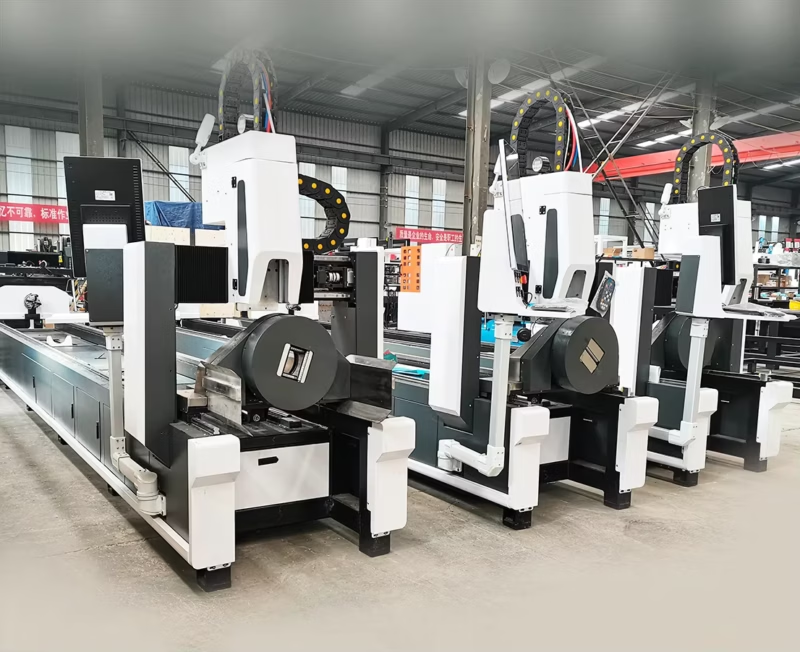
The Kinematics of Multi-Chuck Systems
Zero-tailing is achieved through a synchronized multi-chuck system, typically involving three or four independent moving chucks. As the laser nears the end of a raw tube, the chucks pass the material between one another, allowing the cutting head to process the tube even within the physical footprint of the clamping mechanism. This ensures that the material utilization rate approaches 99 percent.
From an industrial engineering perspective, the reduction of scrap directly impacts the bottom line and the environmental footprint of the project. When processing 12-meter structural members, eliminating a 400mm tailing per tube results in massive cumulative savings across thousands of truss components.
High-Precision Processing and Thermal Management
Fiber laser cutting is characterized by a very narrow kerf width and a minimal Heat Affected Zone (HAZ). In bridge trusses, the structural steel’s metallurgical properties must remain intact to handle dynamic loads and environmental stresses. Excessive heat input can lead to local hardening or embrittlement, which is a critical failure point in infrastructure.
Eliminating the Need for Grinding
Because the fiber laser operates with high-frequency pulses and precise gas assistance (using either oxygen or nitrogen), the resulting edge is smooth and free of dross. In traditional fabrication, edges often require manual grinding to remove slag and prepare the surface for coating. The high-precision nature of the fiber laser produces an “as-cut” surface that meets ISO 9013 standards for perpendicularity and roughness without human intervention. This elimination of grinding reduces labor costs and ensures that the protective coatings applied later adhere perfectly to the clean metal surface.
Consolidated Workflow: Punching, Marking, and Profiling
A primary bottleneck in truss manufacturing is the movement of parts between different work centers. A single chord might require bolt holes (punching), part identification (marking), and complex bevel cuts (profiling). A modern Fiber Laser Cutting Machine integrates these three functions into a single automated cycle.
Automated Hole Drilling and Punching
The laser system can “drill” or punch holes for bolted connections with micron-level repeatability. Unlike mechanical punching, which can cause deformation around the hole, or manual drilling, which is slow and prone to error, the laser maintains perfect circularity and positional accuracy. This is vital for bridge assembly, where hundreds of holes must align perfectly across multiple gusset plates and truss members.
Integrated Part Marking
Traceability is mandatory in bridge construction. Fiber lasers can engrave or mark heat numbers, part IDs, and assembly orientations directly onto the steel during the cutting process. This eliminates the risk of misidentification during the logistics and assembly phases. Because the marking is performed by the same software that handles the cutting, the placement is guaranteed to be accurate relative to the part’s geometry.
Optimizing the Supply Chain with Digital Integration
The implementation of fiber laser technology allows for a “BIM-to-Machine” (Building Information Modeling) workflow. Engineers can export 3D models directly into the laser’s nesting software. This digital continuity ensures that the physical component is an exact replica of the engineering design. The software calculates the most efficient nesting patterns, leveraging the zero-tailing capability to minimize the number of raw tubes required.
Structural Rigidity and Fit-Up Accuracy
When assembling a bridge truss, the “fit-up” phase is where time is won or lost. If the intersection profiles of the hollow sections are not cut perfectly, the gap must be filled, leading to potential stress concentrations. The fiber laser cutting machine uses 5-axis or 6-axis heads to create complex bevels and “bird-mouth” cuts that allow tubes to lock together with zero clearance. This precision ensures that the truss geometry remains true to the design, simplifying the assembly process and improving the overall load distribution of the bridge.
Technical Specifications and Performance Metrics
To justify the capital expenditure of a zero-tailing fiber laser system, industrial engineers look at specific performance metrics. A 12kW to 20kW fiber source is typically recommended for the heavy-wall thicknesses found in bridge trusses. These power levels allow for rapid cutting speeds even in 20mm or 25mm carbon steel, maintaining a balance between throughput and edge quality.
Key Performance Indicators (KPIs):
1. Material Utilization: Targeted at >98% through zero-tailing logic.
2. Post-Processing Time: Reduction of 70-90% by eliminating grinding and manual marking.
3. Dimensional Accuracy: Maintaining +/- 0.05mm over the length of the cut profile.
4. Throughput: Consolidation of three machines (punch, saw, marker) into one laser cell.
Conclusion
The integration of fiber laser cutting with Zero-tailing technology represents a fundamental shift in bridge truss fabrication. By prioritizing high-precision execution and maximizing material yield, manufacturers can deliver safer, more cost-effective infrastructure. The ability to perform punching, marking, and profiling in a single setup not only streamlines the production floor but also ensures a level of structural reliability that traditional methods simply cannot match. For the industrial engineer, the ROI is found not just in the speed of the cut, but in the total elimination of waste and secondary labor.
-


LT240S tube laser cutting machine
-
LT120S tube laser cutting machine
-
Sale

Tank Fillet Welding Machine
Original price was: $1,000.00.$900.00Current price is: $900.00. -
Sale

MAK100 tube laser cutting machine
Original price was: $5,500.00.$5,000.00Current price is: $5,000.00. -

portable plasma air cutting machine
$1,200.00 -

2in1 fiber laser cutting machine
-

Air cooling Laser welding machine
-

HF h beam laser cutting machine
-

LT240 laser cutting machine
-

Laser welding machine
-


Cobot Welding Station
-

Gantry welding robot solution
-

Tracked Wheeled AGV Welding robot
-

LFH6020 Fiber laser cutting machine
-
LFP6020
-

robotic welidng machine
Advanced Fiber Laser Tube Processing Technology
Our CNC Fiber Laser Tube Cutting systems revolutionize metal fabrication by integrating high-precision cutting, punching, and profiling into a single automated workflow. Designed for versatility, this technology handles a wide array of profiles including Round, Square, Rectangular, and Oval tubes, as well as complex L-shaped and U-shaped channels.
- Precision Punching: High-speed hole punching with micron-level accuracy, eliminating the need for mechanical drilling or die-stamping.
- Complex Profiling: Advanced 3D pathing allows for intricate interlocking joints and specialized notch cuts, ideal for structural frames.
- High Material Efficiency: Intelligent nesting software minimizes scrap, reducing raw material costs across large production runs.
- Clean Finish: Delivers oxide-free, burr-free edges that require zero secondary grinding before welding.

Seamlessly processing multiple profiles with consistent precision.
Global Delivery & Logistics



From our high-tech manufacturing facility directly to your global site. PCL WeldCut ensures secure packaging, professional handling, and reliable international logistics to safeguard your equipment throughout the entire journey.