Optimizing Heavy Equipment Fabrication via Fiber Laser Systems
In the current landscape of heavy equipment manufacturing, the drive toward lean production demands a radical reassessment of traditional fabrication workflows. The Fiber Laser Cutting Machine has emerged as the primary tool for achieving high-precision results in the processing of large-scale structural components. for Construction Machinery, which relies heavily on high-strength alloy tubes, channels, and H-beams, the shift from mechanical sawing or punching to automated laser processing represents a critical leap in throughput efficiency.
Industrial engineering standards now prioritize systems that can maintain dimensional tolerances within microns while operating at high feed rates. Fiber laser technology, characterized by its short wavelength and high absorption rate across various metals, provides the necessary energy density to execute complex geometries without the thermal distortion common in legacy thermal cutting methods.
The Mechanics of Zero-Tailing Technology
One of the most significant cost drivers in tube and profile processing is material waste, particularly the “tailing” or scrap left at the end of a workpiece that the chuck cannot reach. Zero-tailing technology addresses this inefficiency through advanced multi-chuck configurations. In a typical three-chuck or four-chuck system, the machine synchronizes the movement of the clamping units to allow the cutting head to process the material between the chucks.
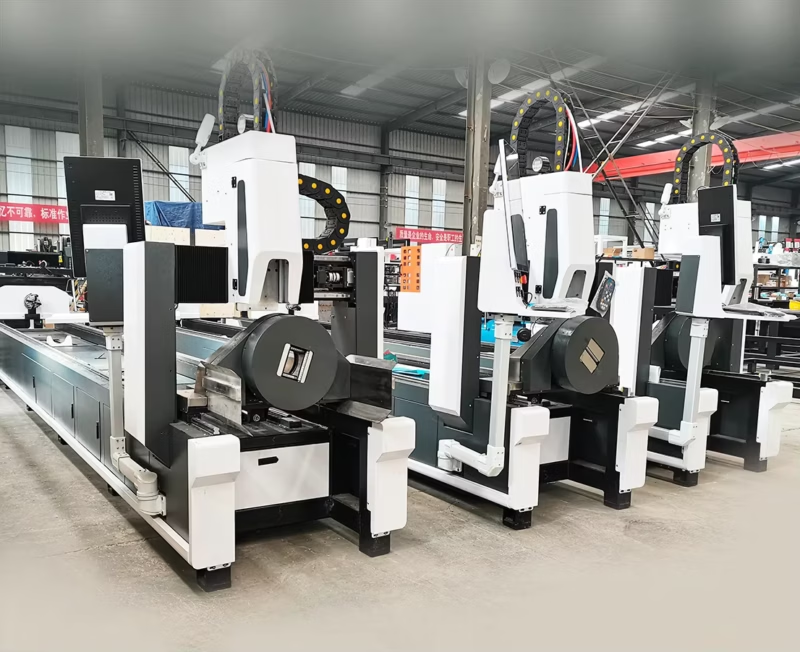
By utilizing a “pulling” and “feeding” sequence where the rear chuck hands off the material to the middle and front chucks, the laser can cut right up to the edge of the raw stock. From an industrial engineering perspective, this increases material utilization by 10% to 15% across high-volume production runs. When dealing with expensive high-tensile steels used in excavator booms or crane chassis, these savings directly translate to a lower Bill of Materials (BOM) cost and a faster Return on Investment (ROI) for the machinery.
High Precision and the Elimination of Secondary Grinding
Traditional methods of preparing structural steel often require extensive post-processing. Mechanical shearing or older thermal methods leave behind burrs, dross, and a significant heat-affected zone (HAZ) that necessitates manual grinding or milling to meet assembly specifications. A high-power fiber laser eliminates these steps entirely.
The beam quality of a fiber laser ensures a narrow kerf and a smooth edge finish that meets the stringent requirements of construction machinery ISO standards. Because the laser creates a perpendicular, dross-free cut, the components can move directly from the cutting bed to the assembly line. This “no-grinding” capability reduces labor hours per unit and eliminates the health and safety risks associated with manual abrasive grinding, such as dust inhalation and repetitive strain injuries.
Integrated Workflow: Punching, Marking, and Cutting
Modern fiber laser systems for construction machinery are not merely cutting tools; they are multi-functional machining centers. Through sophisticated CNC software and nesting algorithms, a single setup can perform three distinct operations:
1. Punching/Perforation: Instead of using a separate hydraulic press, the laser creates bolt holes and drainage ports with perfect concentricity. The speed of the laser piercing process is optimized through frequency-modulated pulsing, preventing blowouts and ensuring hole diameters remain consistent across varying plate thicknesses.
2. Marking: Fiber lasers can etch part numbers, assembly guides, and QR codes directly onto the metal surface using a low-power setting. This ensures traceability throughout the manufacturing lifecycle and simplifies complex assembly tasks for downstream operators.
3. Precision Cutting: The final profile is cut with high kinematic accuracy. For tube processing, this includes complex intersections and saddle cuts required for frame joints, ensuring a perfect fit-up that requires no manual adjustment during the fit-up phase.
Structural Integrity and Material Yield
The structural integrity of earth-moving equipment is paramount. Any micro-cracking or excessive thermal stress during the cutting phase can lead to fatigue failure in the field. Fiber laser cutting minimizes the thermal input into the workpiece. The high speed of the cut means the heat is dissipated quickly, preserving the metallurgical properties of the high-strength steel.
Furthermore, the implementation of zero-tailing software allows for “common line cutting” where two parts share a single cut line. This further optimizes material utilization and reduces the total travel distance of the laser head, thereby extending the life of consumables like nozzles and protective windows. By reducing the number of pierces required and maximizing the nest density, the overall cost-per-part is lowered significantly.
Conclusion: Lean Fabrication Strategy
For the industrial engineer, the adoption of a fiber laser cutting machine with Zero-tailing technology is a strategic move toward a fully optimized, lean fabrication facility. By consolidating multiple manufacturing steps into a single, high-precision automated process, manufacturers can achieve higher throughput with a smaller factory footprint.
The elimination of tailing waste, coupled with the removal of secondary grinding and the integration of marking and punching, creates a streamlined workflow. This technical evolution ensures that construction machinery manufacturers can remain competitive in a global market that demands both high quality and aggressive pricing. The data is clear: the precision of fiber laser technology is the cornerstone of modern heavy industrial production.
-


LT240S tube laser cutting machine
-
LT120S tube laser cutting machine
-
Sale

Tank Fillet Welding Machine
Original price was: $1,000.00.$900.00Current price is: $900.00. -
Sale

MAK100 tube laser cutting machine
Original price was: $5,500.00.$5,000.00Current price is: $5,000.00. -

portable plasma air cutting machine
$1,200.00 -

2in1 fiber laser cutting machine
-

Air cooling Laser welding machine
-

HF h beam laser cutting machine
-

LT240 laser cutting machine
-

Laser welding machine
-


Cobot Welding Station
-

Gantry welding robot solution
-

Tracked Wheeled AGV Welding robot
-

LFH6020 Fiber laser cutting machine
-
LFP6020
-

robotic welidng machine
Advanced Fiber Laser Tube Processing Technology
Our CNC Fiber Laser Tube Cutting systems revolutionize metal fabrication by integrating high-precision cutting, punching, and profiling into a single automated workflow. Designed for versatility, this technology handles a wide array of profiles including Round, Square, Rectangular, and Oval tubes, as well as complex L-shaped and U-shaped channels.
- Precision Punching: High-speed hole punching with micron-level accuracy, eliminating the need for mechanical drilling or die-stamping.
- Complex Profiling: Advanced 3D pathing allows for intricate interlocking joints and specialized notch cuts, ideal for structural frames.
- High Material Efficiency: Intelligent nesting software minimizes scrap, reducing raw material costs across large production runs.
- Clean Finish: Delivers oxide-free, burr-free edges that require zero secondary grinding before welding.

Seamlessly processing multiple profiles with consistent precision.
Global Delivery & Logistics



From our high-tech manufacturing facility directly to your global site. PCL WeldCut ensures secure packaging, professional handling, and reliable international logistics to safeguard your equipment throughout the entire journey.