Advanced Structural Precision via Fiber Laser Integration
In the sector of heavy infrastructure, specifically bridge truss manufacturing, the shift from conventional mechanical processing to high-power fiber Laser Cutting technology represents a fundamental evolution in industrial engineering. Bridge trusses, characterized by large-scale dimensions and the requirement for extreme load-bearing reliability, demand tolerances that traditional methods struggle to maintain consistently. The application of fiber lasers, operating typically in the 12kW to 30kW range for structural steel, allows for a concentrated energy density that minimizes the Heat Affected Zone (HAZ) while maintaining superior edge quality.
Unlike older thermal cutting methods, the fiber laser provides a stable, monochromatic beam that facilitates a narrow kerf width. For bridge components like gusset plates, chord members, and diagonals, this precision is not merely an aesthetic advantage; it is a structural necessity. By utilizing a high-frequency fiber source, the system achieves a surface roughness that meets international standards for bridge construction without the need for manual rectification or post-process edge treatment.
The Role of 3D Vision Positioning in Material Compensation
One of the most significant challenges in bridge truss fabrication is the inherent geometric deviation found in large-format structural steel. Even high-grade carbon steel beams and plates exhibit slight warping, twisting, or thickness variations. Traditional CNC paths assume a perfectly flat or linear workpiece, which leads to dimensional inaccuracies. The integration of a 3D vision positioning system solves this by capturing real-time spatial data of the workpiece before the piercing sequence begins.
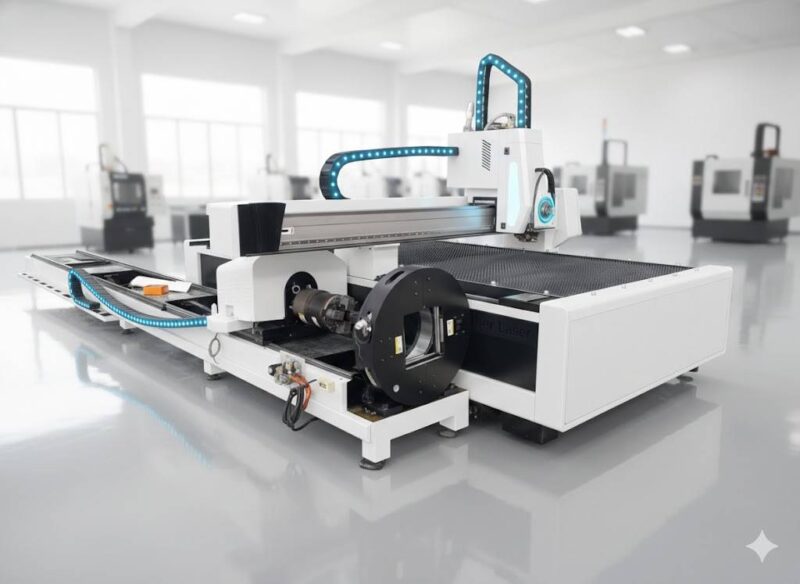
The vision system utilizes industrial-grade cameras and laser sensors to generate a point cloud mapping of the steel profile. This data is fed into the CNC controller, which automatically adjusts the cutting head’s trajectory and focal position to match the actual physical state of the material. for Bridge Trusses, where bolt hole alignment across multiple layers of steel is critical, this spatial compensation ensures that every cut is mathematically aligned with the global coordinate system of the bridge design, regardless of local material inconsistencies.
Tri-Stage Processing: Punch, Mark, and Cut
Industrial efficiency is maximized when the number of times a workpiece is handled is minimized. Fiber laser systems designed for bridge truss fabrication incorporate a “three-in-one” operational logic. Historically, a structural steel member would be moved from a marking station to a mechanical punch or drill, and finally to a cutting station. Each transfer introduces potential for cumulative error and increases labor costs.
Modern fiber systems execute these functions in a single programmed sequence:
- Marking: The laser operates at a lower power density to etch assembly lines, part numbers, and QC codes directly onto the steel surface. This provides permanent traceability and layout assistance for downstream assembly.
- Punching (Laser Piercing): Instead of mechanical punching which can cause stress fractures around the hole circumference, the laser performs high-speed piercing. The 3D vision ensures that the center-point of every bolt hole is precisely located to within ±0.05mm.
- Cutting: The final profile cutting is executed at high speed. Because the fiber laser produces such a clean finish, the typical “grinding stage” required to remove dross or harden edge layers is eliminated.
Eliminating Secondary Operations and Grinding
From a Lean Manufacturing perspective, grinding is a non-value-added activity that consumes significant man-hours and abrasive consumables. In bridge construction, edges must be free of micro-cracks and slag to prevent fatigue failure under cyclic loading. The high-beam quality of a fiber laser creates a smooth, square edge with minimal dross attachment.
By controlling the auxiliary gas pressure (typically Oxygen or Nitrogen depending on thickness) and the focal geometry, the structural steel precision achieved at the machine level is sufficient for immediate assembly. This “ready-to-assemble” output significantly accelerates the production timeline of the truss modules. Furthermore, the absence of mechanical contact during laser cutting means there is no tool wear, ensuring that the first part and the thousandth part are identical in dimension.
Kinematic Optimization for Large-Scale Profiles
The mechanical architecture of these machines often features a gantry-style design with heavy-duty beds capable of supporting 20-meter or longer truss segments. To maintain precision over such distances, the 3D vision system works in tandem with high-dynamic servo drives and helical rack-and-pinion systems. The vision system provides “look-ahead” capabilities, identifying the edge of the material to prevent “dry cutting” or collision with slag remnants from previous pierces.
For H-beams, I-beams, and box girders used in bridge trusses, 5-axis laser heads are often employed. These heads, guided by the 3D vision sensors, can perform complex bevel cuts for preparation of joints. The ability of the laser to maintain a constant standoff distance even on uneven surfaces ensures that the bevel angle remains consistent throughout the entire length of the cut, which is vital for the integrity of the structural joints.
Data-Driven Manufacturing and Quality Assurance
In contemporary industrial engineering, data is as important as the hardware. Fiber laser systems with 3D vision generate digital twins of the cutting process. Every part cut for a bridge truss can be logged with its specific material batch, the vision-detected deviations, and the final cutting parameters. This creates a robust quality assurance trail.
The integration of CAD/CAM software allows bridge designers to export BIM (Building Information Modeling) data directly to the laser’s nesting engine. The software optimizes material utilization, reducing scrap rates in expensive high-strength alloys. When the 3D vision system detects that a steel plate is slightly smaller or larger than specified, the software can re-nest parts in real-time to maximize yield without compromising the structural integrity of the individual truss components.
Conclusion: The Engineering Advantage
The implementation of fiber laser cutting with 3D Vision positioning represents a significant leap in bridge truss manufacturing efficiency. By eliminating the inaccuracies of manual layout and the physical toll of grinding, manufacturers can produce higher-quality infrastructure in shorter timeframes. The precision of the laser ensures that complex truss geometries fit together perfectly during site erection, reducing the need for costly field corrections. For the industrial engineer, this technology offers a measurable ROI through reduced labor, lower consumable costs, and superior structural reliability.
-


LT240S tube laser cutting machine
-
LT120S tube laser cutting machine
-
Sale

Tank Fillet Welding Machine
Original price was: $1,000.00.$900.00Current price is: $900.00. -
Sale

MAK100 tube laser cutting machine
Original price was: $5,500.00.$5,000.00Current price is: $5,000.00. -

portable plasma air cutting machine
$1,200.00 -

2in1 fiber laser cutting machine
-

Air cooling Laser welding machine
-

HF h beam laser cutting machine
-

LT240 laser cutting machine
-

Laser welding machine
-


Cobot Welding Station
-

Gantry welding robot solution
-

Tracked Wheeled AGV Welding robot
-

LFH6020 Fiber laser cutting machine
-
LFP6020
-

robotic welidng machine
Advanced Fiber Laser Tube Processing Technology
Our CNC Fiber Laser Tube Cutting systems revolutionize metal fabrication by integrating high-precision cutting, punching, and profiling into a single automated workflow. Designed for versatility, this technology handles a wide array of profiles including Round, Square, Rectangular, and Oval tubes, as well as complex L-shaped and U-shaped channels.
- Precision Punching: High-speed hole punching with micron-level accuracy, eliminating the need for mechanical drilling or die-stamping.
- Complex Profiling: Advanced 3D pathing allows for intricate interlocking joints and specialized notch cuts, ideal for structural frames.
- High Material Efficiency: Intelligent nesting software minimizes scrap, reducing raw material costs across large production runs.
- Clean Finish: Delivers oxide-free, burr-free edges that require zero secondary grinding before welding.

Seamlessly processing multiple profiles with consistent precision.
Global Delivery & Logistics



From our high-tech manufacturing facility directly to your global site. PCL WeldCut ensures secure packaging, professional handling, and reliable international logistics to safeguard your equipment throughout the entire journey.