Advanced Kinematics in Bridge Truss Fabrication
Modern bridge engineering demands extreme structural integrity and dimensional accuracy. Traditional methods of fabricating massive truss components often involve stationary CNC centers that require the workpiece to be transported to the machine. for Bridge Trusses, which can span dozens of meters, this logistics-heavy approach introduces bottlenecks. The shift toward Magnetic Crawler Technology represents a fundamental change in industrial logic: moving the tool to the workpiece rather than the workpiece to the tool.
The magnetic crawler serves as a mobile motion platform, utilizing high-power permanent magnets or switchable electromagnets to adhere to the steel surface of the truss. This allows the system to operate in horizontal, vertical, and even inverted positions. When integrated with a fiber laser head, the crawler becomes a high-precision cutting robot capable of executing complex geometries on-site or in the assembly yard, significantly reducing the lead time for structural steel preparation.
Thermal Dynamics and Fiber Laser Precision
The core of this system is the fiber laser source, typically operating at a wavelength of approximately 1.07 microns. Unlike CO2 lasers, the fiber laser beam is delivered via a flexible optical fiber, making it ideally suited for mobile crawler applications where a rigid mirror-based delivery system would be impossible to maintain.
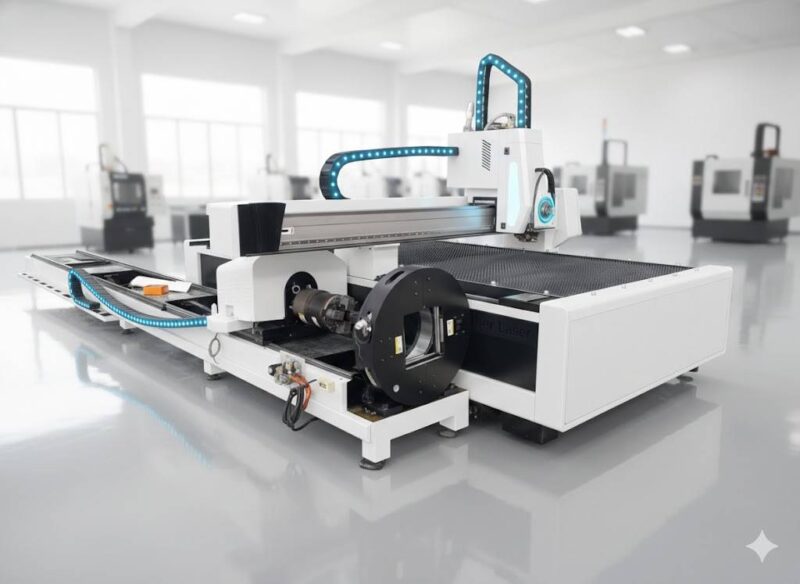
Kerf Width and Heat Affected Zone (HAZ)
In Fiber Laser Cutting, the energy density is focused into a microscopic spot, resulting in a narrow kerf width—often less than 0.3mm depending on material thickness. This concentration of energy ensures that the total heat input into the bridge truss is minimized. In bridge construction, excessive heat can lead to localized metallurgical changes or unintended warping. The high-speed processing of the fiber laser ensures that the Heat Affected Zone is kept to a negligible depth, preserving the mechanical properties of the structural steel as specified by the design engineers.
No Secondary Grinding Operations
One of the most significant cost-saving factors of fiber laser integration is the edge quality. The high-pressure assist gas (typically Oxygen for carbon steel or Nitrogen for stainless alloys) ejects the molten material with such velocity that the resulting cut face is smooth and free of dross. For bridge trusses, where fatigue life is paramount, the absence of micro-cracks and the high surface finish of the laser cut mean that the component can move directly from the cutting stage to assembly. The elimination of manual grinding not only reduces labor costs but also ensures a level of consistency that manual operators cannot replicate.
Integrated Workflow: Punch, Mark, and Cut
The efficiency of a crawler-based fiber laser system lies in its ability to perform multiple operations in a single programmed sequence. This “all-in-one” approach is critical for maintaining the tight tolerances required in bridge truss node connections.
High-Speed Piercing and Punching
Before the cutting begins, the fiber laser performs high-speed “punching” or piercing. Advanced CNC controllers use frequency-modulated ramping to pierce the thick structural steel without creating significant splatter. This allows for the precise placement of bolt holes or drainage apertures with a diametric tolerance that meets or exceeds international standards for structural steelwork.
Automated Layout Marking
Structural Steel Precision is further enhanced by the laser’s ability to operate in a low-power marking mode. The system can etch assembly lines, part numbers, and orientation markers directly onto the steel surface. This replaces manual chalk-lining or template-based marking, which are prone to human error. By using the same coordinate system for marking as for cutting, the spatial relationship between the cut edges and the assembly guides is maintained with absolute fidelity.
Mechanical Stability and Surface Following
Operating a laser on a mobile platform presents challenges in maintaining the focal point. Bridge trusses are rarely perfectly flat; they may have slight surface undulations or be composed of curved plates. To solve this, the magnetic crawler is equipped with a non-contact capacitive sensing head.
This sensor monitors the distance between the laser nozzle and the steel plate at a kilohertz sampling rate. The Z-axis actuator on the crawler dynamically adjusts the height of the laser head to maintain a constant focal distance. Combined with the high attractive force of the magnetic tracks, which can exceed several thousand Newtons, the system remains stable even when navigating over mill scale or minor surface irregularities. This stability is what allows the fiber laser to maintain a high-quality cut throughout long, continuous paths along the truss length.
Industrial Engineering ROI and Throughput
From a production management perspective, the implementation of a Bridge Truss Fabrication crawler system shifts the focus from “machine hours” to “effective output.” Because the system is portable, multiple crawlers can be deployed on a single large-scale truss simultaneously.
Technical Advantage Summary:
- Elimination of workpiece transport logistics and crane dependency.
- Reduction of specialized tooling for different hole diameters (laser handles all sizes).
- 100% digital workflow from CAD/CAM to the steel surface.
- Minimal thermal distortion, ensuring easier fit-up during final assembly.
The data suggests that for a standard bridge truss project, the transition to fiber laser crawler cutting can reduce the “fit-up” time by up to 30%. This is primarily due to the precision of the cut parts and the accuracy of the laser-etched marking guides, which allow the assembly teams to position components with millimeter-level accuracy without iterative measurements.
Conclusion on Process Optimization
The convergence of fiber laser technology and magnetic mobility represents the pinnacle of current structural steel fabrication. By removing the constraints of the traditional machine bed, manufacturers can achieve a level of flexibility previously reserved for manual operations, while maintaining the rigorous precision of CNC automation. For the bridge industry, where safety and longevity are non-negotiable, the fiber laser’s ability to produce clean, high-precision edges without the need for secondary mechanical cleaning is not just an efficiency gain—it is a significant upgrade in structural quality control.
-


LT240S tube laser cutting machine
-
LT120S tube laser cutting machine
-
Sale

Tank Fillet Welding Machine
Original price was: $1,000.00.$900.00Current price is: $900.00. -
Sale

MAK100 tube laser cutting machine
Original price was: $5,500.00.$5,000.00Current price is: $5,000.00. -

portable plasma air cutting machine
$1,200.00 -

2in1 fiber laser cutting machine
-

Air cooling Laser welding machine
-

HF h beam laser cutting machine
-

LT240 laser cutting machine
-

Laser welding machine
-


Cobot Welding Station
-

Gantry welding robot solution
-

Tracked Wheeled AGV Welding robot
-

LFH6020 Fiber laser cutting machine
-
LFP6020
-

robotic welidng machine
Advanced Fiber Laser Tube Processing Technology
Our CNC Fiber Laser Tube Cutting systems revolutionize metal fabrication by integrating high-precision cutting, punching, and profiling into a single automated workflow. Designed for versatility, this technology handles a wide array of profiles including Round, Square, Rectangular, and Oval tubes, as well as complex L-shaped and U-shaped channels.
- Precision Punching: High-speed hole punching with micron-level accuracy, eliminating the need for mechanical drilling or die-stamping.
- Complex Profiling: Advanced 3D pathing allows for intricate interlocking joints and specialized notch cuts, ideal for structural frames.
- High Material Efficiency: Intelligent nesting software minimizes scrap, reducing raw material costs across large production runs.
- Clean Finish: Delivers oxide-free, burr-free edges that require zero secondary grinding before welding.

Seamlessly processing multiple profiles with consistent precision.
Global Delivery & Logistics



From our high-tech manufacturing facility directly to your global site. PCL WeldCut ensures secure packaging, professional handling, and reliable international logistics to safeguard your equipment throughout the entire journey.