Automatic Girth Seam Welder with 5-Axis Beveling for Construction Machinery

In this article
- Optimizing Heavy Component Fabrication via Automatic Girth Seam Welding
- The Mechanics of 5-Axis Beveling in MAG Applications
- Quantifying the ROI of Robotic Integration
- Maintenance Protocols for High-Uptime Systems
- Addressing Labor Shortages in Heavy Manufacturing
- Technical Synergy: MAG Process and 5-Axis Motion
Optimizing Heavy Component Fabrication via Automatic Girth Seam Welding
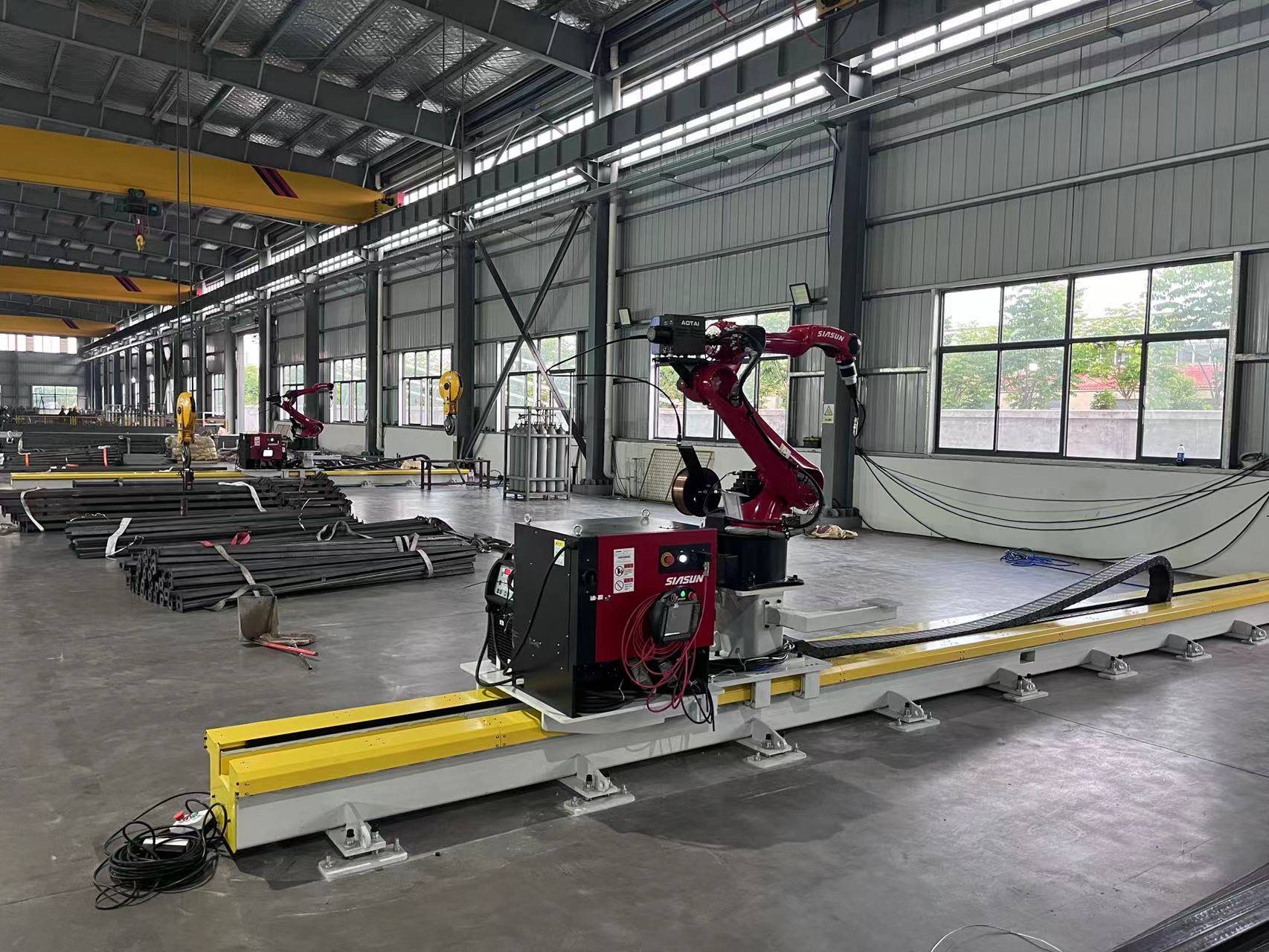
In the fabrication of construction machinery, specifically for hydraulic cylinders, pressure vessels, and undercarriage components, the circumferential or “girth” seam is a critical failure point if not executed with precision. Traditional manual welding methods often struggle with the sheer volume and consistency required for heavy-duty structural integrity. The transition to an Automatic Girth Seam Welder integrated with 5-axis motion control represents a fundamental shift in production efficiency. By utilizing 5-axis beveling, the system can adjust the torch angle dynamically relative to the workpiece geometry, ensuring deep penetration and consistent bead profiles regardless of minor fit-up variances.
The Mechanics of 5-Axis Beveling in MAG Applications
The 5-Axis Beveling system allows for synchronized movement across the X, Y, and Z axes, complemented by rotation (C-axis) and tilt (B-axis). In a Metal Active Gas (MAG) environment, this capability is vital. Unlike standard 3-axis systems that maintain a fixed vertical orientation, a 5-axis head adjusts the torch lead and lag angles in real-time. This is particularly beneficial for heavy-walled pipes or cylinders used in excavators and cranes where a V-groove or J-groove preparation is standard.
The MAG process, typically utilizing an Argon-CO2 gas mixture, is chosen for its high deposition rate and deep penetration characteristics. When the 5-axis system manages the bevel, it can perform multi-pass welding without requiring the workpiece to be repositioned manually. The software compensates for the bevel angle, maintaining the optimal arc length and wire stick-out. This results in a superior metallurgical bond and reduces the heat-affected zone (HAZ) by optimizing travel speed relative to the wire feed rate.
Quantifying the ROI of Robotic Integration
From an industrial engineering perspective, the Return on Investment (ROI) for an Automatic Girth Seam Welder is calculated through three primary vectors: labor reduction, consumable efficiency, and the elimination of secondary rework.
First, consider labor costs. A manual welder capable of performing high-code girth welds is a high-cost asset. By automating the MAG process, a single operator can oversee multiple stations. The “Arc-On Time” typically increases from 30 percent in manual operations to over 75 percent in automated cells.
Second, the 5-axis system minimizes over-welding. Manual welders often compensate for poor fit-up by adding more filler metal than necessary. A robotic system, guided by precision sensors, deposits the exact volume required by the weld procedure specification (WPS). This reduces wire consumption by an estimated 15 to 20 percent annually.
Third, the reduction in rework is substantial. In construction machinery, a single weld failure detected by ultrasonic testing can cost thousands of dollars in grinding and re-welding time. The repeatability of robotic MAG Welding ensures that once a program is validated, the success rate exceeds 99 percent, drastically lowering the cost of quality.
Maintenance Protocols for High-Uptime Systems
To sustain the performance of a 5-axis welding system, a rigorous preventive maintenance (PM) schedule must be enforced. Because these machines operate in the harsh environments typical of construction machinery plants—characterized by dust and high ambient heat—component longevity depends on cleanliness and calibration.
Wire Delivery System Maintenance
The wire feeder is the heart of the MAG process. Maintenance engineers must inspect the drive rolls for wear every 40 operating hours. Misaligned or worn rolls lead to wire “bird-nesting” or erratic arc stability. Additionally, the conduit liner should be purged with compressed air or replaced regularly to prevent the accumulation of copper flaking and dust, which increases friction and strains the feeder motor.
Torch and 5-Axis Calibration
The 5-axis head involves complex gearing and servo motors. Zero-point calibration must be checked weekly to ensure the Tool Center Point (TCP) has not drifted. A drifted TCP will result in the arc missing the root of the bevel, leading to lack of fusion. Automated nozzle cleaning stations—equipped with reamers and anti-spatter sprayers—are essential for maintaining gas flow consistency and preventing spatter buildup from shorting the contact tip.
Addressing Labor Shortages in Heavy Manufacturing
The construction machinery sector faces a chronic shortage of skilled Construction Machinery welders. The technical barrier to entry for manual girth welding is high, requiring years of experience to master torch manipulation on circular paths. Automating this process with 5-axis technology lowers the skill floor for the operator while raising the ceiling for production quality. The role of the worker shifts from manual laborer to a “Cell Technician” who monitors data, manages consumables, and performs basic maintenance. This shift not only solves the labor availability issue but also increases the ergonomic safety of the plant by removing workers from the immediate vicinity of welding fumes and intense UV radiation.
Technical Synergy: MAG Process and 5-Axis Motion
The synergy between the MAG process and 5-axis motion is most evident during the root pass of a girth seam. Achieving a consistent root bead in a thick-walled cylinder requires precise control of the heat input. The 5-axis controller allows the welder to oscillate the torch (weaving) with varying widths and dwell times at the edges of the bevel. This ensures that the sidewalls are properly wetted, preventing cold-lap defects.
Furthermore, the ability to integrate seam tracking—either through through-arc sensing or tactile probes—allows the 5-axis system to adapt to workpieces that are not perfectly circular. This flexibility is critical in heavy industry where large components may have slight deformations from previous heat-intensive processes.
Conclusion
The implementation of an Automatic Girth Seam Welder with 5-Axis Beveling is not merely an equipment upgrade; it is a strategic necessity for Construction Machinery manufacturers aiming for scale. By focusing on the MAG process and the mechanical advantages of multi-axis control, facilities can achieve a level of throughput and consistency that manual operations cannot match. The ROI is clearly defined by increased duty cycles and the mitigation of the skilled labor gap, while a dedicated maintenance strategy ensures these robotic assets remain operational for the long term.






