Automatic Girth Seam Welder with Zero-tailing technology for Bridge Trusses

In this article
- Engineering Efficiency in Bridge Truss Fabrication
- Robotic MAG Welding Dynamics
- Advanced Arc Control and Parameter Synchronization
- Gas Shielding and Porosity Prevention
- Maintenance Protocols for Industrial Uptime
- Labor ROI and Economic Impact
- Reduction in Rework and Non-Destructive Testing (NDT) Failures
- Duty Cycle and Throughput Optimization
- Strategic Implementation in Modern Fabrication
Engineering Efficiency in Bridge Truss Fabrication
In heavy civil infrastructure, the structural integrity of bridge trusses is non-negotiable. Traditionally, girth seam welding—the process of joining circular or tubular sections—has been a bottleneck characterized by high labor costs and inconsistent penetration depths. The introduction of the Automatic Girth Seam Welder with Zero-tailing technology represents a significant leap in industrial engineering. This system is designed to automate the circumferential welding of large-diameter tubular members, ensuring high-integrity joints that meet stringent AWS D1.5 bridge welding codes.
The core objective of implementing zero-tailing technology is the elimination of “tails” or unused wire and electrode overlap at the start and stop points of the weld. In manual or standard automated systems, the overlap often requires post-weld grinding or leads to stress concentrations. Zero-tailing systems utilize precision encoders and synchronized wire feeders to ensure the weld bead transitions seamlessly, maintaining a constant heat-affected zone (HAZ) and reducing material waste.
Robotic MAG Welding Dynamics
The primary process utilized in these automated girth welders is Metal Active Gas (MAG) welding, often referred to as GMAW in North American standards. In bridge truss applications, MAG is preferred over Submerged Arc Welding (SAW) in specific configurations due to its versatility in out-of-position welding and its ability to provide high deposition rates without the need for flux recovery systems.
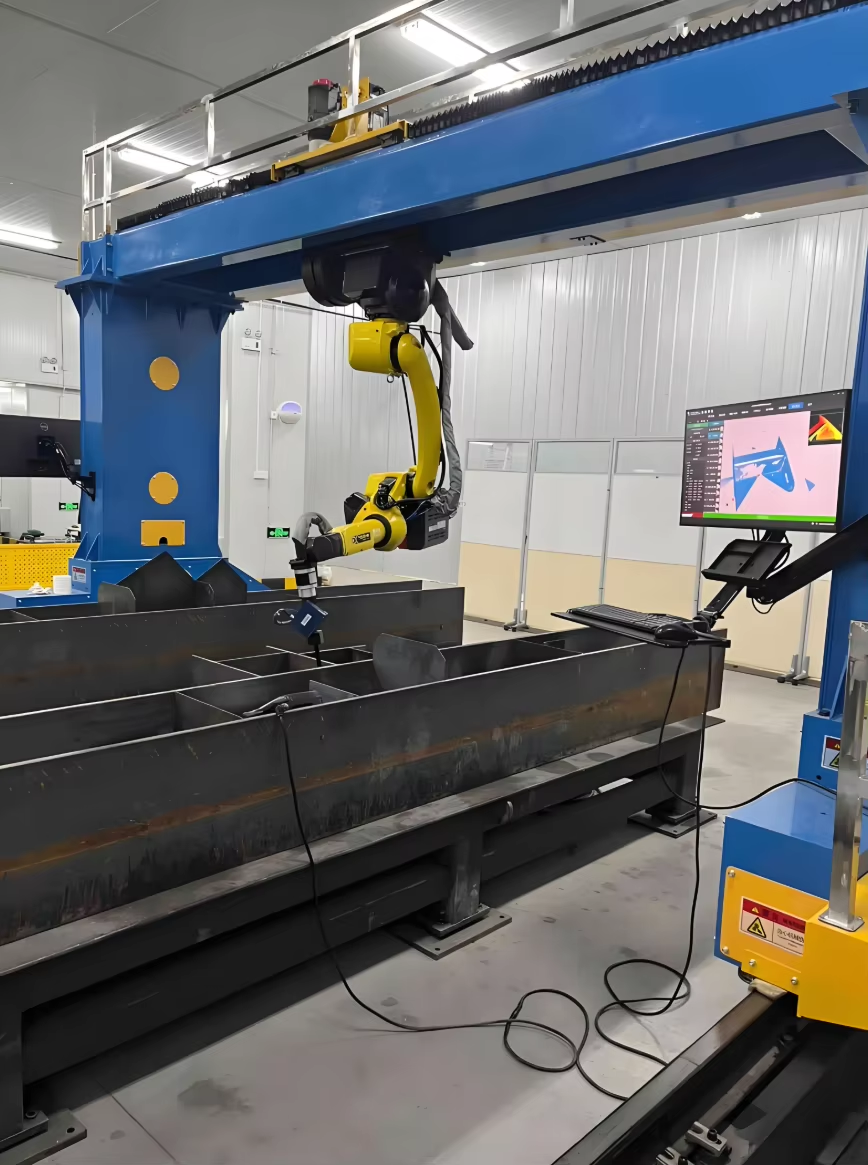
Advanced Arc Control and Parameter Synchronization
Modern robotic systems integrate the MAG welding power source with the mechanical drive of the girth welder. This synchronization allows for real-time adjustments of the wire feed speed, voltage, and travel speed. When the robot detects a variance in the joint gap, the control system adjusts the oscillation width of the torch. This ensures that the weld puddle remains stable even when the fit-up of the bridge truss components is not perfectly uniform. The zero-tailing mechanism specifically controls the crater-fill sequence, ramping down current and wire speed at the precise millisecond the 360-degree rotation is completed.
Gas Shielding and Porosity Prevention
Shielding gas composition—typically a blend of Argon and CO2—is critical for preventing porosity in heavy-duty bridge welds. The automated system maintains a consistent torch angle and standoff distance, which is often impossible for a human welder to sustain over a long-duration circumferential weld. This consistency ensures that the gas envelope remains intact, protecting the molten puddle from atmospheric nitrogen and oxygen, which are the primary causes of hydrogen-induced cracking in high-tensile steel trusses.
Maintenance Protocols for Industrial Uptime
From an industrial engineering perspective, the reliability of the Zero-tailing technology is contingent upon a rigorous preventative maintenance schedule. Unlike manual welding machines, robotic girth welders involve complex mechanical drive systems, electronic sensors, and precision torch assemblies that require specific attention.
Mechanical Drive and Alignment Maintenance
The rotation unit of the girth welder must be inspected weekly for concentricity. Any deviation in the rollers or the drive chain can lead to “ghosting” in the weld path, where the arc moves off-center. Lubrication of the drive gears and inspection of the rotary earth (grounding) connection is vital. A poor ground connection in an automated system can cause electrical noise, interfering with the PLC (Programmable Logic Controller) signals and disrupting the zero-tailing timing.
Torch and Consumable Lifecycle Management
The contact tip and nozzle are high-wear items. In a high-volume bridge truss facility, these should be replaced based on “arc-on time” metrics rather than visual inspection. Robotic systems often include automated torch cleaning stations that ream the nozzle and apply anti-spatter fluid. Ensuring these stations are functional reduces downtime by 15% compared to manual cleaning. Additionally, the wire conduit liners must be blown out or replaced regularly to prevent friction increases that lead to wire “bird-nesting” at the feeder.
Labor ROI and Economic Impact
The financial justification for transitioning to an Automatic Girth Seam Welder is rooted in Labor ROI. The bridge construction industry currently faces a critical shortage of certified welders capable of performing 6G position welds to code. By automating the girth seam, a manufacturer can reallocate its most skilled human assets to more complex, non-linear joinery while the robot handles the repetitive, high-volume circumferential work.
Reduction in Rework and Non-Destructive Testing (NDT) Failures
In manual welding, the failure rate for NDT (Ultrasonic or Radiographic testing) on girth seams typically ranges from 3% to 5% due to human fatigue and start-stop defects. Automated zero-tailing systems reduce this failure rate to under 0.5%. The cost of gouging out a defective weld, re-preparing the joint, and re-welding is approximately four times the cost of the initial weld. Reducing these occurrences provides a direct and massive boost to the project’s bottom line.
Duty Cycle and Throughput Optimization
A human welder typically operates at a 20% to 30% duty cycle, accounting for breaks, setup, and fatigue. A robotic girth welder operates at a duty cycle of 75% to 85%. For a standard bridge truss section requiring 50 linear meters of girth welding, the automated system can complete the task in approximately one-third of the time required for a manual crew. This increased throughput allows bridge fabricators to take on more contracts without increasing their physical footprint or headcount.
Calculating the Payback Period
When calculating ROI, engineers must consider the “Cost per Pound of Weld Metal.” Automated MAG welding significantly lowers this cost by optimizing wire usage (zero-tailing) and reducing shielding gas waste. Most facilities find that the capital expenditure for a robotic girth welding cell is recouped within 18 to 24 months, depending on the volume of bridge components processed. This calculation excludes the indirect savings from reduced insurance premiums and workers’ compensation claims associated with the hazardous fumes and ergonomic strain of manual welding.
Strategic Implementation in Modern Fabrication
Integrating zero-tailing technology into a bridge truss production line is not merely a hardware upgrade; it is a strategic shift toward data-driven manufacturing. These systems provide digital logs of every weld, recording voltage, amperage, and travel speed. This data is invaluable for Quality Assurance (QA) documentation required by government transport departments, providing a “digital twin” of the structural integrity of the bridge.
In conclusion, the Automatic Girth Seam Welder with MAG robotic integration offers a robust solution for the challenges of modern infrastructure fabrication. By focusing on precision arc control, systematic maintenance, and the clear economic advantages of labor optimization, industrial engineers can ensure that bridge trusses are not only built faster but with a level of consistency that manual processes simply cannot replicate. The move toward zero-tailing technology is the final step in eliminating the inherent weaknesses of traditional circumferential welding, paving the way for safer and more cost-effective bridge construction.






