Optimizing Shipbuilding Throughput via Automatic Girth Seam Welder Implementation
In the heavy industrial landscape of shipbuilding, the integrity of structural welds is non-negotiable. The girth seam—the circumferential or horizontal joint connecting large cylindrical sections of a hull or storage tank—represents a significant portion of total man-hours. Traditionally, these seams required highly skilled manual operators working in physically demanding positions, often leading to fatigue-induced defects and inconsistent bead morphology. The introduction of the Automatic Girth Seam Welder has shifted this paradigm from labor-intensive manual work to a process-controlled robotic environment.
By utilizing specialized carriage systems that travel along the circumference of the vessel, the automation system ensures a constant travel speed and optimal torch angle. In the context of shipbuilding, where plate thickness can exceed 50mm, the ability to maintain a consistent root opening and fill rate is critical for passing stringent Non-Destructive Testing (NDT) requirements. This technical shift is not merely about speed; it is about the stabilization of the heat-affected zone (HAZ) and the minimization of rework.
The Technical Advantage of MAG Welding in Ship Construction
The primary process utilized in these automated systems is Metal Active Gas (MAG) welding. Unlike manual metal arc welding, MAG provides a continuous electrode feed, which eliminates the frequent stops and starts associated with stick electrodes. This continuity is vital for girth seams, where a single interruption can introduce a point of failure or a slag inclusion. The use of flux-cored or solid wires, combined with shielding gases like CO2 or Argon mixes, allows for high deposition rates that manual operators cannot match over an eight-hour shift.
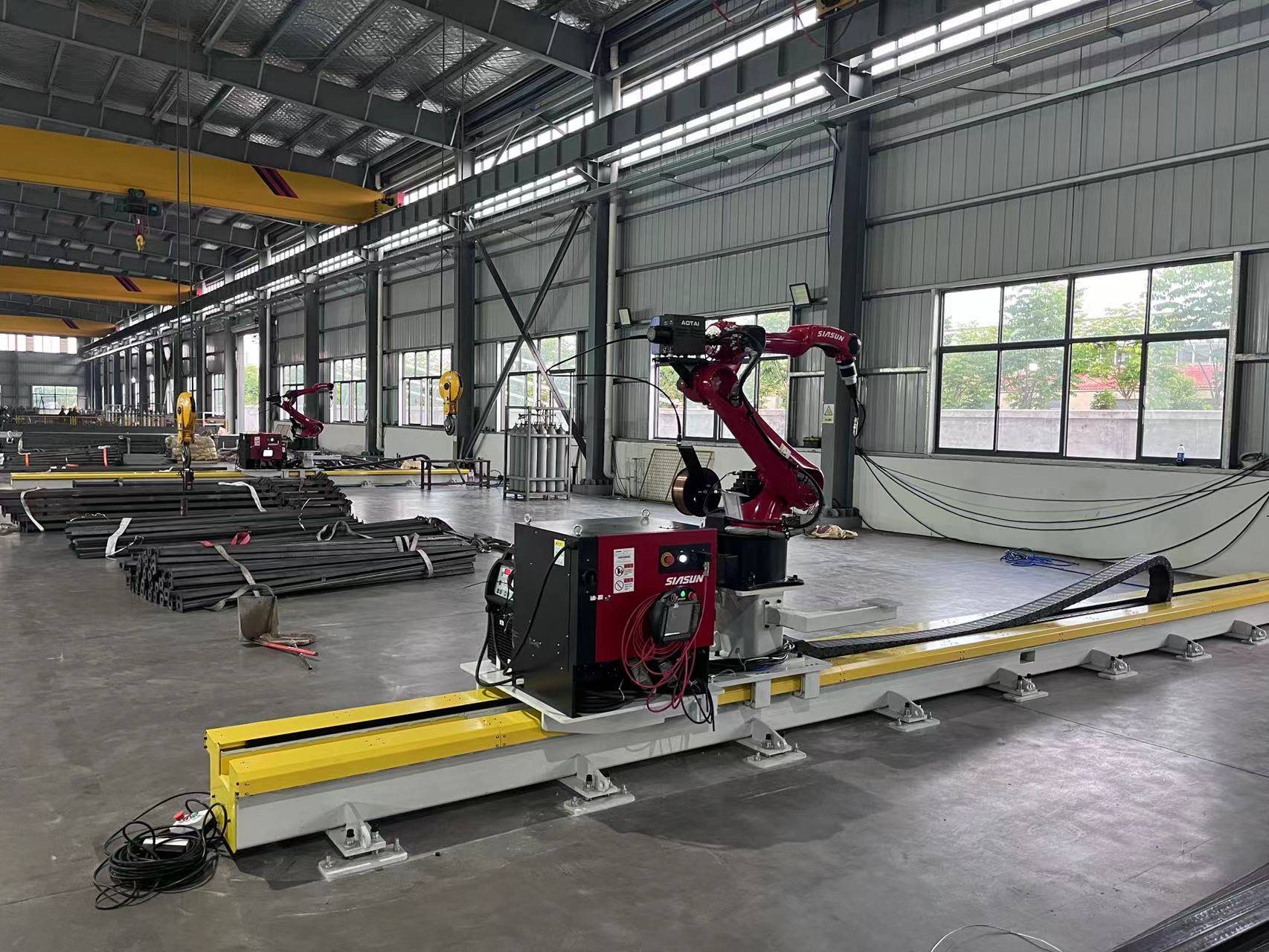
From an industrial engineering perspective, the MAG welding process in an automated setup allows for precise control over wire feed speed and voltage. When integrated with a mechanized tractor, the system achieves a “duty cycle” of nearly 85-90%, compared to the 30-40% typically seen in manual operations. This massive increase in arc-on time is the primary driver of throughput in modern shipyards.
Precision Integration: Laser Seam Tracking Systems
While the mechanical carriage provides the movement, the Laser Seam Tracking system provides the “eyes.” In shipbuilding, large-scale components are rarely perfectly uniform. Thermal distortion, fit-up tolerances, and gravity-induced sagging can cause the actual weld path to deviate from the theoretical path. A laser-based tracking sensor mounted ahead of the welding torch scans the joint geometry in real-time.
This sensor calculates the gap width, depth, and centerline position, feeding this data back to the controller. The controller then makes micro-adjustments to the cross-slide actuators, ensuring the torch remains centered in the groove. This is particularly crucial for multi-pass welding on thick plates. Without real-time tracking, the risk of “missed seams” or lack of side-wall fusion increases exponentially, leading to costly gouging and repair cycles. By automating the tracking, the system compensates for imperfect fit-ups, allowing for a wider tolerance in the preceding fabrication stages.
Maintenance Protocols for High-Utilization Robotic Systems
To maintain the ROI of an automated welding system, a rigorous preventative maintenance schedule is mandatory. Industrial engineers must account for the wear and tear associated with high-duty cycle MAG welding. The most common failure points include the wire delivery system and the torch consumables.
Liner and Contact Tip Management
Continuous wire feeding causes internal wear on the torch liners. In a shipyard environment, dust and metallic particles can exacerbate this wear, leading to “bird-nesting” at the drive rolls. Liners should be replaced based on wire throughput (e.g., every 500kg of wire) rather than waiting for a failure. Similarly, contact tips undergo thermal erosion and diameter expansion, which affects arc stability. Using high-quality chrome-zirconium copper tips can extend the life of these components, but they remain a primary consumable that must be tracked.
Carriage and Track Calibration
The drive motors and gearboxes of the girth welder carriage require periodic lubrication and inspection for backlash. Since the system often operates in outdoor or semi-sheltered environments, the tracks must be cleared of weld spatter and debris to prevent carriage stalls. Calibration of the laser sensor is also necessary; the protective glass or “spatter shield” on the laser head must be replaced or cleaned daily to ensure the sensor maintains a clear signal return from the metal surface.
Labor ROI: Quantifying the Shift to Automation
The most compelling argument for the labor ROI of automatic girth seam welders is the reduction in cost-per-meter of weld. A manual welder might complete 2 to 3 meters of high-quality girth seam in a shift, accounting for setup, positioning, and fatigue breaks. An automated system, managed by a single technician, can often quadruple this output.
However, the ROI is not just found in speed. It is found in the “de-skilling” of the operation. While a manual girth weld requires a “Class A” certified welder—a demographic that is shrinking and increasingly expensive—an automated system can be operated by a “Class B” technician trained in machine parameters. This allows the shipyard to reallocate its most skilled manual welders to complex tie-ins and out-of-position welds that cannot be easily mechanized.
Reduction in Rework and NDT Costs
Rework is the silent killer of shipyard profitability. In manual welding, a 5-8% repair rate is often budgeted. With laser-tracked automation, this rate typically drops below 1%. When considering the cost of X-ray inspection, carbon-arc gouging, and re-welding, the savings from “right-first-time” production often pay for the capital equipment within the first 12 to 18 months of operation. Furthermore, the reduction in consumables waste (stub loss and over-welding) contributes to a leaner manufacturing profile.
Conclusion: The Future of Shipyard Efficiency
The implementation of an Automatic Girth Seam Welder with Laser Seam Tracking represents a vital step toward the “Shipyard 4.0” concept. By focusing on the reliability of the MAG process and the precision of digital tracking, engineers can ensure that the backbone of the vessel—its structural seams—are produced with a level of consistency that manual labor simply cannot achieve. As global competition in maritime construction intensifies, the transition from manual-centric to process-centric welding is no longer an option but a structural necessity for economic survival.
-


LT240S tube laser cutting machine
-
LT120S tube laser cutting machine
-
Sale

Tank Fillet Welding Machine
Original price was: $1,000.00.$900.00Current price is: $900.00. -
Sale

MAK100 tube laser cutting machine
Original price was: $5,500.00.$5,000.00Current price is: $5,000.00. -

portable plasma air cutting machine
$1,200.00 -

2in1 fiber laser cutting machine
-

Air cooling Laser welding machine
-

HF h beam laser cutting machine
-

LT240 laser cutting machine
-

Laser welding machine
-


Cobot Welding Station
-

Gantry welding robot solution
-

Tracked Wheeled AGV Welding robot
-

LFH6020 Fiber laser cutting machine
-
LFP6020
-

robotic welidng machine
Advanced Fiber Laser Tube Processing Technology
Our CNC Fiber Laser Tube Cutting systems revolutionize metal fabrication by integrating high-precision cutting, punching, and profiling into a single automated workflow. Designed for versatility, this technology handles a wide array of profiles including Round, Square, Rectangular, and Oval tubes, as well as complex L-shaped and U-shaped channels.
- Precision Punching: High-speed hole punching with micron-level accuracy, eliminating the need for mechanical drilling or die-stamping.
- Complex Profiling: Advanced 3D pathing allows for intricate interlocking joints and specialized notch cuts, ideal for structural frames.
- High Material Efficiency: Intelligent nesting software minimizes scrap, reducing raw material costs across large production runs.
- Clean Finish: Delivers oxide-free, burr-free edges that require zero secondary grinding before welding.

Seamlessly processing multiple profiles with consistent precision.
Global Delivery & Logistics



From our high-tech manufacturing facility directly to your global site. PCL WeldCut ensures secure packaging, professional handling, and reliable international logistics to safeguard your equipment throughout the entire journey.