Optimizing Wind Tower Fabrication via 3D Vision and Magnetic Stability
Industrial engineering in the renewable energy sector demands rigorous adherence to structural tolerances and production efficiency. Wind tower sections, characterized by their massive diameter and thickness, present unique challenges for traditional welding setups. The shift toward specialized wind tower fabrication techniques has highlighted the necessity for automated systems that can operate reliably in field conditions.
The primary objective is the execution of high-quality fillet welds at the junction of flange rings and tower shells. Unlike factory-bound systems, field construction requires mobility and resistance to environmental variables. By utilizing a 3D vision-guided positioning system paired with a high-traction magnetic crawler, engineers can eliminate the variability associated with manual torch manipulation and the physical strain of vertical-up or overhead welding positions.
The Role of 3D Vision Positioning in Fillet Geometry
Precision in Fillet Welding is predicated on the accurate identification of the joint root and the maintenance of a consistent standoff distance. 3D vision positioning utilizes structured light or stereoscopic sensors to map the contour of the pipe profile and the flange face in real-time. This data provides a digital twin of the weld path, allowing the system to compensate for fit-up discrepancies, such as gaps or misalignments that frequently occur in large-scale assembly.
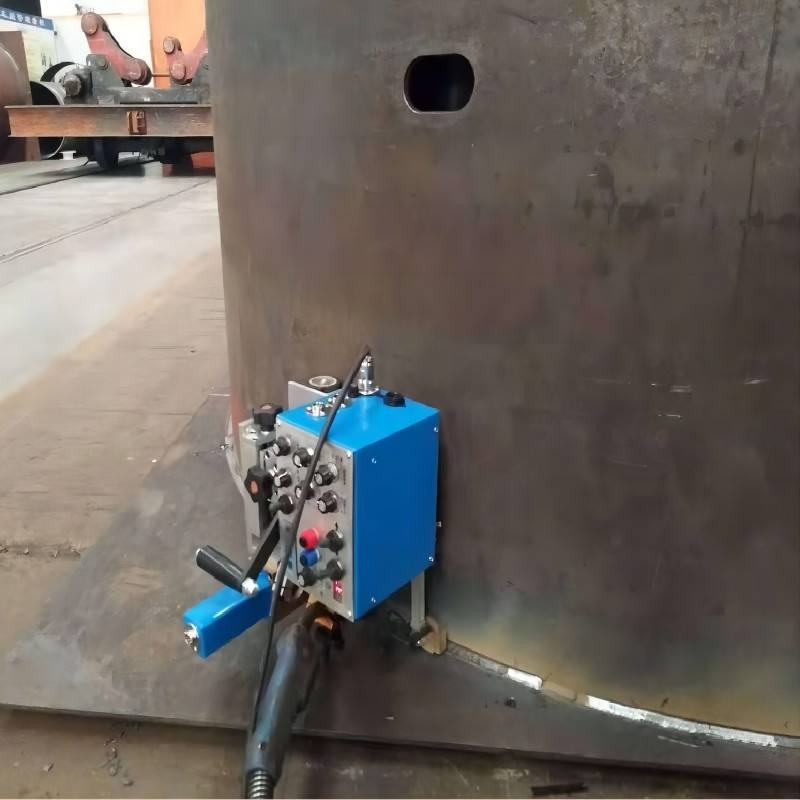
In an industrial workflow, the 3D vision system scans the joint ahead of the welding arc. This “look-ahead” capability ensures that the oscillation parameters and travel speed are dynamically adjusted to maintain the specified throat thickness. For industrial engineers, this means a significant reduction in rework and a higher first-pass yield, as the system can navigate the subtle curvatures and irregularities of heavy-gauge steel plates without manual intervention.
Magnetic Crawler Mechanics and Field Stability
Field construction environments are rarely ideal. Factors such as wind-induced vibration, surface moisture, and uneven ground can compromise the stability of traditional track-based systems. The implementation of a magnetic crawler addresses these issues by providing a constant, high-force adhesion to the carbon steel surface of the wind tower.
These crawlers utilize high-flux permanent magnets or switchable electromagnets to lock the welding carriage onto the workpiece. This magnetic grip allows the machine to traverse circular profiles and vertical seams with zero slippage. From an engineering standpoint, the stability offered by magnetic adhesion ensures that the torch remains perfectly perpendicular to the fillet joint, which is critical for achieving deep penetration and avoiding undercut. Furthermore, the absence of bulky external tracks simplifies the setup process, reducing the time required to transition between different tower sections.
Technical Implementation of Fillet Welding Systems
Joint Tracking and Real-Time Correction
The core of the system’s efficiency lies in its ability to process spatial data into motion commands. As the crawler moves along the circumference of the tower, the 3D vision sensor identifies the precise intersection of the two planes. If the flange is slightly out of round—a common occurrence in heavy manufacturing—the system calculates the deviation and shifts the torch trajectory in milliseconds. This real-time correction is vital for fillet welding where the leg length must be uniform to meet international structural codes.
Thermal Management and Duty Cycle
Welding thick-walled wind tower sections involves high heat input. Industrial engineers must manage the duty cycle of the equipment to prevent overheating while maintaining a high deposition rate. The crawler systems are designed with heat shields and optimized cooling paths to protect the 3D vision sensors and internal motors. By automating the travel speed, the system ensures a consistent heat-affected zone (HAZ), which preserves the mechanical properties of the steel and reduces the risk of hydrogen-induced cracking.
Operational Efficiency and Cost-Benefit Analysis
The transition from manual or semi-automatic processes to a vision-guided magnetic crawler system represents a capital investment that pays dividends in throughput. In a typical wind tower project, the volume of welding is immense. Reducing the time per weld by even 15% through optimized travel speeds and reduced setup times translates to thousands of man-hours saved over a project’s lifecycle.
Moreover, the consistency of automated welding significantly lowers the cost of non-destructive testing (NDT). When a machine maintains a constant arc length and angle, the occurrence of porosity, slag inclusions, or lack of fusion is minimized. This reliability allows for a more streamlined quality control process, where engineers can focus on spot checks rather than exhaustive repairs of manual welding errors.
Stability Constraints in Outdoor Construction
Mitigating Environmental Interference
One of the specific advantages of the magnetic crawler in field construction is its low profile. High-profile equipment can act like a sail, catching the wind and introducing oscillations into the weld pool. The compact, high-mass design of the magnetic carriage lowers the center of gravity and increases the friction coefficient against the pipe wall. This physical stability is augmented by software filters within the 3D vision system that can ignore environmental noise, such as ambient sunlight or sparks, ensuring that the tracking remains locked on the joint.
Surface Preparation and Adhesion
While the magnetic force is powerful, industrial engineers must ensure the surface is free of heavy scale or thick coatings that could reduce the magnetic pull. The 3D vision system can also be used to verify the surface condition before the arc is struck, providing an additional layer of quality assurance. The synergy between mechanical adhesion and visual verification creates a robust platform that outperforms traditional wheeled or track-guided alternatives in the rugged environment of a wind farm construction site.
Conclusion for Industrial Engineering Workflows
In conclusion, the integration of 3D vision positioning with magnetic crawler technology offers a specialized solution for the fillet welding requirements of wind tower fabrication. By focusing on mechanical stability and precise geometric tracking, manufacturers can achieve the high-quality standards required for structural energy components. This approach prioritizes the practicalities of field construction—durability, repeatability, and ease of use—ensuring that large-scale infrastructure projects are completed on schedule and within technical specifications. The data-driven nature of these systems also provides engineers with a wealth of information for continuous process improvement, ultimately lowering the cost of wind energy through manufacturing excellence.
-


LT240S tube laser cutting machine
-
LT120S tube laser cutting machine
-
Sale

Tank Fillet Welding Machine
Original price was: $1,000.00.$900.00Current price is: $900.00. -
Sale

MAK100 tube laser cutting machine
Original price was: $5,500.00.$5,000.00Current price is: $5,000.00. -

portable plasma air cutting machine
$1,200.00 -

2in1 fiber laser cutting machine
-

Air cooling Laser welding machine
-

HF h beam laser cutting machine
-

LT240 laser cutting machine
-

Laser welding machine
-


Cobot Welding Station
-

Gantry welding robot solution
-

Tracked Wheeled AGV Welding robot
-

LFH6020 Fiber laser cutting machine
-
LFP6020
-

robotic welidng machine
Advanced Fiber Laser Tube Processing Technology
Our CNC Fiber Laser Tube Cutting systems revolutionize metal fabrication by integrating high-precision cutting, punching, and profiling into a single automated workflow. Designed for versatility, this technology handles a wide array of profiles including Round, Square, Rectangular, and Oval tubes, as well as complex L-shaped and U-shaped channels.
- Precision Punching: High-speed hole punching with micron-level accuracy, eliminating the need for mechanical drilling or die-stamping.
- Complex Profiling: Advanced 3D pathing allows for intricate interlocking joints and specialized notch cuts, ideal for structural frames.
- High Material Efficiency: Intelligent nesting software minimizes scrap, reducing raw material costs across large production runs.
- Clean Finish: Delivers oxide-free, burr-free edges that require zero secondary grinding before welding.

Seamlessly processing multiple profiles with consistent precision.
Global Delivery & Logistics



From our high-tech manufacturing facility directly to your global site. PCL WeldCut ensures secure packaging, professional handling, and reliable international logistics to safeguard your equipment throughout the entire journey.