Optimizing Tank Fillet Welding in Construction Machinery via 3D Vision and Magnetic Crawlers
In the heavy construction machinery industry, the fabrication of large-scale fluid tanks, hydraulic reservoirs, and structural tubular components demands a level of precision that traditional manual methods struggle to provide. As equipment scales in size and complexity, the interface between pipe profiles and tank shells requires exact geometry to ensure weld penetration and structural longevity. The implementation of 3D vision positioning in Pipe Profile Cutting Machines offers a sophisticated solution for preparing these complex joints, particularly for tank fillet welding applications where field stability is a primary concern.
The Challenge of Field Construction and Profile Fitting
Field construction presents unique variables that are rarely encountered in a controlled factory environment. Environmental factors, uneven terrain, and the sheer scale of components like excavator chassis or crane boom sections necessitate equipment that can operate with high stability. When joining a pipe to a curved tank surface, the resulting intersection—often a saddle-type joint—creates a non-linear path for the welding torch. If the pipe profile is not cut with extreme accuracy, the resulting gaps lead to inconsistent fillet welds, increased filler material consumption, and potential structural failure under high-pressure hydraulic cycles.
Traditional mechanical cutting often relies on templates or manual layout, which are prone to human error. By utilizing 3D vision systems, the machine can scan the actual workpiece surface to account for deformations, thickness variations, and slight misalignments in the tank shell. This ensures that the bevel angle and the fit-up gap remain constant throughout the entire circumference of the joint.
Mechanical Profile Cutting and 3D Vision Integration
The core of this system lies in its ability to translate visual data into mechanical motion. The pipe profile cutting machine uses a multi-axis mechanical head to execute complex saddle cuts and miters. Unlike standard pipe cutters, this system integrates a 3D vision sensor that maps the topographical features of the tank or vessel where the pipe will be mounted.
The vision system captures a point cloud of the shell surface, identifying the exact curvature and any local irregularities. The control software then calculates the optimal cutting path for the pipe end. This process ensures that the pipe profile matches the mating surface perfectly, creating a tight fit that is ideal for high-strength tank fillet joints. Because the system focuses on mechanical cutting methods, it avoids the complexities of high-frequency interference, making it more robust for heavy industrial sites where electrical noise is prevalent.
Achieving Field Stability with Magnetic Crawler Welding
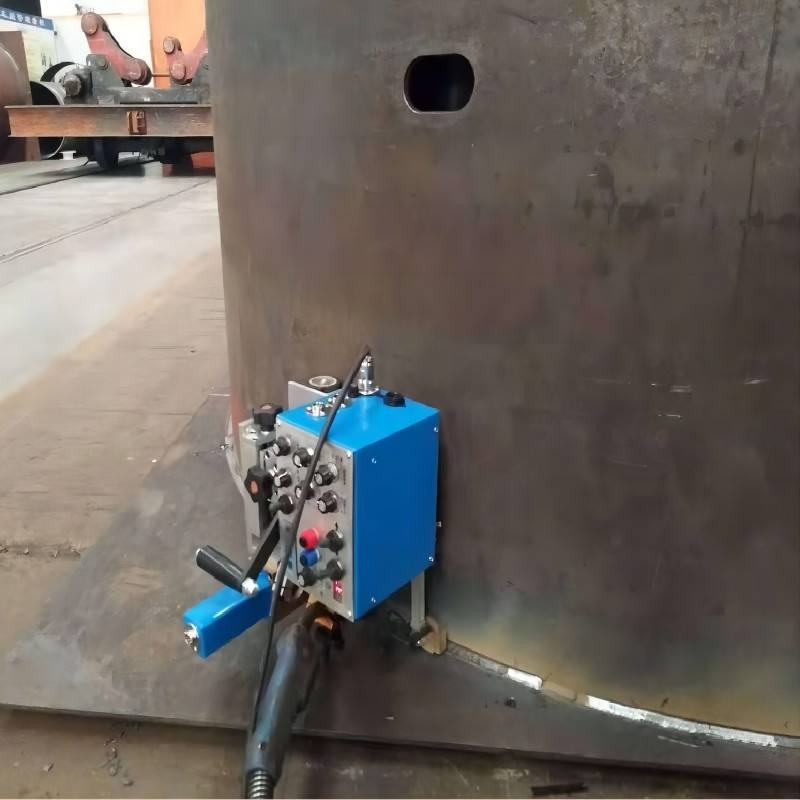
Once the pipe is precisely profiled and tacked into place, the focus shifts to the welding process. In construction machinery fabrication, the stability of the welding platform is critical. Portable magnetic crawler welding units have emerged as the standard for this phase. These crawlers utilize high-strength permanent magnets or electromagnets to adhere directly to the tank shell or the pipe wall.
The advantage of a magnetic crawler over other automated systems is its immunity to gravity-induced slippage on vertical or overhead surfaces. In the field, where scaffolding may be unstable or wind speeds can interfere with manual torch control, the magnetic crawler provides a rigid, vibration-resistant platform. It carries the welding torch along the pre-defined path at a constant travel speed, ensuring uniform heat input and a consistent fillet bead profile.
Traction and Load Distribution
Industrial engineers must consider the traction-to-weight ratio of these crawlers. For heavy-duty construction machinery, the crawler must be able to carry not only the torch but also the wire feeder and cable bundles without losing position. The magnetic grip must be strong enough to overcome the resistance of the cables while maintaining a smooth, stutter-free movement. This mechanical stability is what allows for X-ray quality fillet welds in field conditions that would typically degrade weld integrity.
Technical Parameters for Fillet Weld Preparation
To achieve optimal results in tank-to-pipe intersections, several technical parameters must be strictly controlled during the profile cutting stage:
Bevel Angle Consistency
The 3D vision system allows the cutting head to vary the bevel angle dynamically as it moves around the pipe. For a fillet weld, the angle of preparation changes depending on whether the torch is at the “crown” or the “crotch” of the saddle. Maintaining a consistent root gap is only possible if the cutting machine can adjust its tilt in real-time based on the 3D scan of the mating tank.
Surface Roughness and Heat Affected Zone (HAZ)
Mechanical cutting methods used in these machines are designed to minimize the heat-affected zone before welding begins. By maintaining a clean, cold-cut edge, the subsequent welding process can achieve better fusion with the base metal of the construction machinery components. This is vital for parts subject to fatigue, such as those found in mining equipment or large-scale earthmovers.
Workflow Optimization for Construction Machinery
The integration of these technologies results in a streamlined workflow that significantly reduces the man-hours required for assembly. The process follows a logical engineering sequence:
1. Data Acquisition: The 3D vision system scans the tank shell to determine the actual geometry of the mounting location.
2. Profile Calculation: Software generates a custom cutting path for the pipe, compensating for any measured deviations in the tank surface.
3. Precision Cutting: The pipe profile cutting machine executes the mechanical cut, including complex bevels required for the fillet joint.
4. Fit-up: The pipe is positioned on the tank. Due to the precision of the 3D scan, the fit is nearly seamless, requiring minimal clamping force.
5. Automated Welding: The magnetic crawler is deployed. It follows the intersection line, guided by the mechanical accuracy of the previous steps, to complete the fillet weld.
Structural Integrity and Quality Assurance
In the context of construction machinery fabrication, the failure of a tank weld can lead to catastrophic oil spills, hydraulic failure, or structural collapse. The combination of 3D vision and magnetic crawlers addresses the primary causes of weld failure: poor fit-up and inconsistent torch movement. By ensuring that the pipe profile is an exact mirror of the tank surface, the internal stresses caused by “forcing” a fit are eliminated. Furthermore, the steady movement of the crawler ensures that the weld root is fully fused, preventing the formation of slag inclusions or porosity.
From an industrial engineering perspective, the return on investment (ROI) is realized through the elimination of rework. Manual grinding to fix poor fits is a non-value-added activity that is largely eliminated by this technology. The predictability of the process allows for better scheduling and higher throughput in the assembly of large-scale machinery fleets.
Conclusion on System Synergy
The synergy between 3D vision positioning and magnetic crawler-based welding represents a significant advancement in field construction. By focusing on mechanical precision and stability, manufacturers of construction machinery can achieve factory-level quality in the most challenging environments. This approach prioritizes mechanical reliability and dimensional accuracy, ensuring that every pipe-to-tank intersection meets the rigorous standards required for heavy-duty operational cycles.
-


LT240S tube laser cutting machine
-
LT120S tube laser cutting machine
-
Sale

Tank Fillet Welding Machine
Original price was: $1,000.00.$900.00Current price is: $900.00. -
Sale

MAK100 tube laser cutting machine
Original price was: $5,500.00.$5,000.00Current price is: $5,000.00. -

portable plasma air cutting machine
$1,200.00 -

2in1 fiber laser cutting machine
-

Air cooling Laser welding machine
-

HF h beam laser cutting machine
-

LT240 laser cutting machine
-

Laser welding machine
-


Cobot Welding Station
-

Gantry welding robot solution
-

Tracked Wheeled AGV Welding robot
-

LFH6020 Fiber laser cutting machine
-
LFP6020
-

robotic welidng machine
Advanced Fiber Laser Tube Processing Technology
Our CNC Fiber Laser Tube Cutting systems revolutionize metal fabrication by integrating high-precision cutting, punching, and profiling into a single automated workflow. Designed for versatility, this technology handles a wide array of profiles including Round, Square, Rectangular, and Oval tubes, as well as complex L-shaped and U-shaped channels.
- Precision Punching: High-speed hole punching with micron-level accuracy, eliminating the need for mechanical drilling or die-stamping.
- Complex Profiling: Advanced 3D pathing allows for intricate interlocking joints and specialized notch cuts, ideal for structural frames.
- High Material Efficiency: Intelligent nesting software minimizes scrap, reducing raw material costs across large production runs.
- Clean Finish: Delivers oxide-free, burr-free edges that require zero secondary grinding before welding.

Seamlessly processing multiple profiles with consistent precision.
Global Delivery & Logistics



From our high-tech manufacturing facility directly to your global site. PCL WeldCut ensures secure packaging, professional handling, and reliable international logistics to safeguard your equipment throughout the entire journey.