Intelligent Robotic Welder with Narrow Gap welding for Construction Machinery

In this article
Optimization of Robotic Welding in Heavy Machinery Fabrication
In the production of construction machinery, such as excavator booms, crane chassis, and loader frames, welding remains the most critical structural process. The shift toward high-strength steels and massive plate thicknesses necessitates a transition from conventional manual welding to intelligent robotic cells. The primary objective is to maximize the Duty Cycle while maintaining structural integrity across deep-groove joints. Robotic MAG (Metal Active Gas) welding, specifically when paired with narrow gap techniques, provides the precision required to handle these heavy-wall components without the excessive heat input typically associated with wide-groove manual processes.
The Mechanics of Narrow Gap MAG Welding
Narrow gap welding is a specialized technique designed for plate thicknesses exceeding 20mm. In traditional fabrication, a V-groove might require a 45 to 60-degree opening, leading to a high volume of filler metal and multiple passes that increase the risk of thermal distortion. By reducing the groove angle to between 5 and 10 degrees, the volume of the weld pool is significantly decreased.
Industrial robotic systems utilize specific torch geometries and oscillating parameters to ensure sidewall fusion within these tight tolerances. The MAG process, utilizing an Argon/CO2 shielding gas mix, allows for stable arc characteristics at high current densities. Intelligent power sources now synchronize the wire feed speed and pulsed current to control the metal transfer mode, minimizing spatter and maximizing the Deposition Rate. This control is essential for preventing slag inclusions and ensuring that the root pass achieves 100% penetration in critical load-bearing joints.
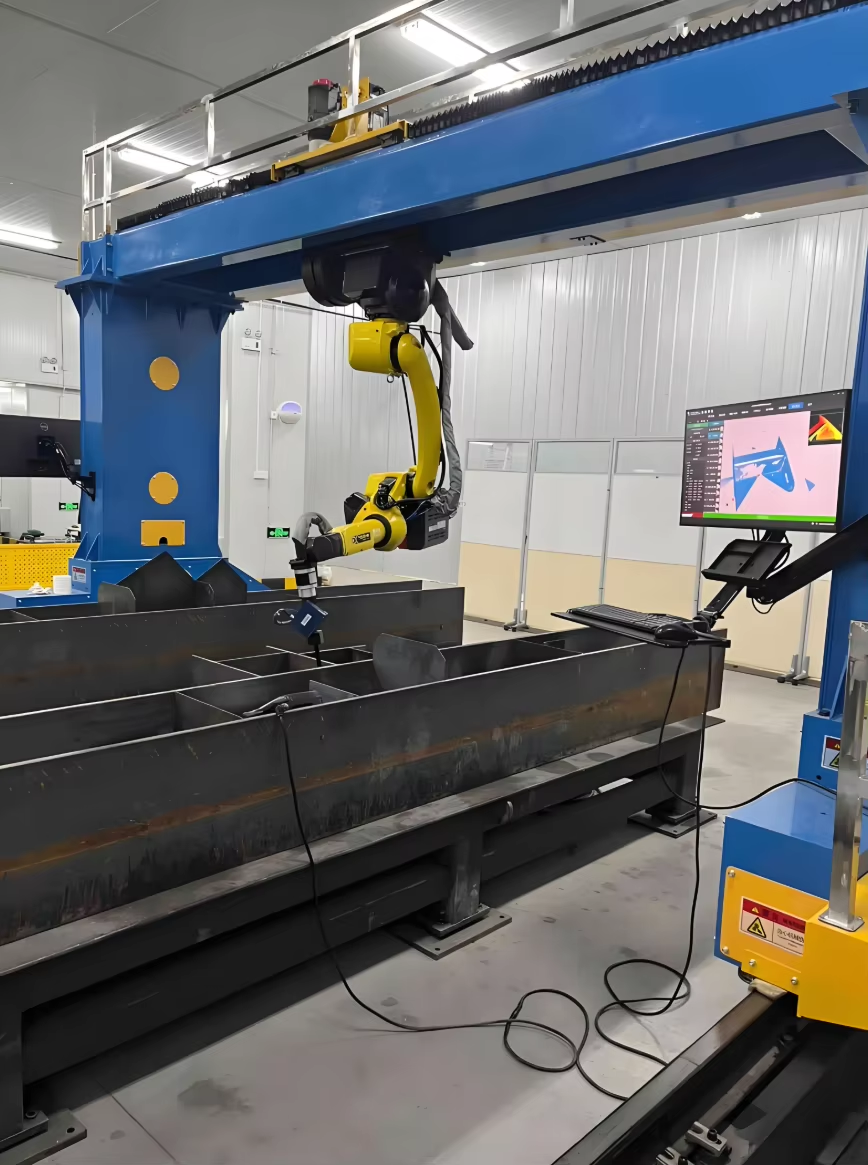
Intelligent Sensing and Real-Time Seam Tracking
Construction machinery components often exhibit dimensional variances due to upstream processing or thermal expansion during the welding sequence. An Intelligent Robotic Welder must compensate for these variances in real-time. This is achieved through a combination of “Touch Sensing” for initial part localization and “Through-Arc Seam Tracking” (TAST) or optical laser tracking for path correction during the welding process.
TAST monitors the change in welding current as the robot oscillates the torch across the narrow gap. As the distance between the contact tip and the workpiece changes, the impedance in the arc shifts, allowing the controller to adjust the robot’s trajectory instantaneously. Optical sensors, mounted ahead of the torch, provide a three-dimensional map of the groove geometry. This data allows the system to adjust parameters such as travel speed and oscillation width to account for variations in the gap width, ensuring consistent fill levels across every layer of a multi-pass weld.
Maintenance Protocols for High-Availability Robotic Cells
From an industrial engineering perspective, the reliability of the robotic cell is measured by its Mean Time Between Failures (MTBF). In a high-volume construction machinery environment, the welding torch is subject to extreme thermal stress and spatter accumulation. Automated maintenance stations are a mandatory component of the cell architecture.
Torch Cleaning and Reaming
A programmed cleaning cycle, occurring every few cycles or after a specific arc-on time, involves the robot docking with a reaming station. Mechanical blades remove spatter from the gas nozzle, while an anti-spatter liquid is applied to extend the life of the consumables. This prevents gas turbulence, which can lead to porosity in the weld bead.
Wire Delivery and Contact Tip Management
The wire feeding system must provide constant tension without kinking. For narrow gap welding, where the torch often reaches deep into the joint, contact tip wear is accelerated. Industrial systems utilize “Wire Brake” technology to ensure precise wire stick-out for touch sensing. Scheduled replacement of the contact tip and the wire liner is essential to prevent arc instability and feeding issues that could lead to costly downtime or weld defects.
Economic Analysis and Labor ROI
The justification for investing in intelligent robotic narrow gap welding is driven by two primary factors: the scarcity of high-skill welders and the demand for increased throughput. Manual welding of heavy machinery components is physically demanding and requires a level of consistency that is difficult for human operators to maintain over an eight-hour shift. Typically, a manual welder’s arc-on time averages between 25% and 30%. In contrast, a well-optimized robotic cell can achieve arc-on times exceeding 75%.
The ROI (Return on Investment) is calculated not just through direct labor replacement, but through the reduction of “Non-Value Added” (NVA) activities. Narrow gap technology reduces the amount of filler metal required by up to 40% compared to traditional V-grooves. This results in direct savings on wire and gas consumption. Furthermore, the reduction in heat input minimizes structural distortion, which eliminates the need for expensive secondary straightening operations.
Quantifiable Labor Impact
By shifting to an automated system, a single operator can oversee two or three robotic cells simultaneously. This leverages the operator’s role from manual execution to “Process Monitoring.” In the construction machinery industry, where weld quality is a safety-critical requirement, the data logging capabilities of intelligent robots provide a digital record of every weld parameter. This reduces the cost of Non-Destructive Testing (NDT) by providing high confidence in process stability, significantly lowering the rework rate which, in manual processes, can often reach 5-10% in complex joints.
Process Integration and Future Scalability
Implementation of Narrow Gap MAG Welding requires a holistic approach to the production line. Upstream precision in plate edge preparation and fit-up is vital. While the robot can compensate for some variations, maintaining a consistent root gap significantly improves the success rate of automated passes. Modern robotic controllers now utilize Industry 4.0 protocols to communicate with factory-level MES (Manufacturing Execution Systems), allowing for real-time tracking of consumables and energy consumption.
As construction machinery continues to evolve toward larger and more complex designs, the ability to automate the welding of thick sections becomes a competitive necessity. The integration of multi-axis positioners—such as headstock-tailstock units or L-track positioners—allows the robot to maintain the torch in the “Downhand” (1G/1F) position, which is optimal for narrow gap MAG welding. This ensures the highest possible deposition rates and the most uniform bead profiles, ultimately leading to superior fatigue life of the heavy equipment components.
Conclusion
For industrial manufacturers in the construction machinery sector, the adoption of intelligent robotic welding is no longer optional. The technical advantages of narrow gap MAG welding—reduced filler material, controlled heat input, and high-speed execution—provide a clear path toward operational excellence. By focusing on robust maintenance schedules and leveraging real-time sensing technology, facilities can achieve a significant ROI, offsetting labor shortages and enhancing the overall structural integrity of their heavy machinery products.






