Precision Automation in Wind Tower Longitudinal and Circumferential Seams
The fabrication of wind turbine towers demands exceptional structural integrity to withstand multi-axial fatigue loads over a 25-year service life. As tower heights increase and plate thicknesses reach up to 50mm or more, manual welding becomes a bottleneck in terms of both speed and quality control. Transitioning to an Intelligent Robotic Welder allows for a level of precision that human operators cannot maintain over 12-hour shifts. These systems are specifically designed to handle the heavy-duty demands of Metal Active Gas (MAG) welding, where high deposition rates and deep penetration are non-negotiable.
In the context of industrial engineering, the primary objective is to maximize throughput while minimizing the defect rate (Rework Ratio). Traditional automated systems often struggle with variations in joint fit-up, which are common in large-scale rolling processes. This is where the integration of Arc Voltage Control (AVC) transforms a standard robotic arm into a responsive, intelligent system capable of real-time adjustments.
The Mechanics of Arc Voltage Control (AVC) in MAG Welding
Arc Voltage Control is a sophisticated feedback mechanism that maintains a constant distance between the welding torch and the workpiece. In wind tower fabrication, the roundness of the tower sections can vary slightly, and the “V” or “U” groove preparations may have inconsistencies in the root gap. Without AVC, a robot following a fixed path would either bury the contact tip into the puddle or pull too far away, leading to porosity or lack of fusion.
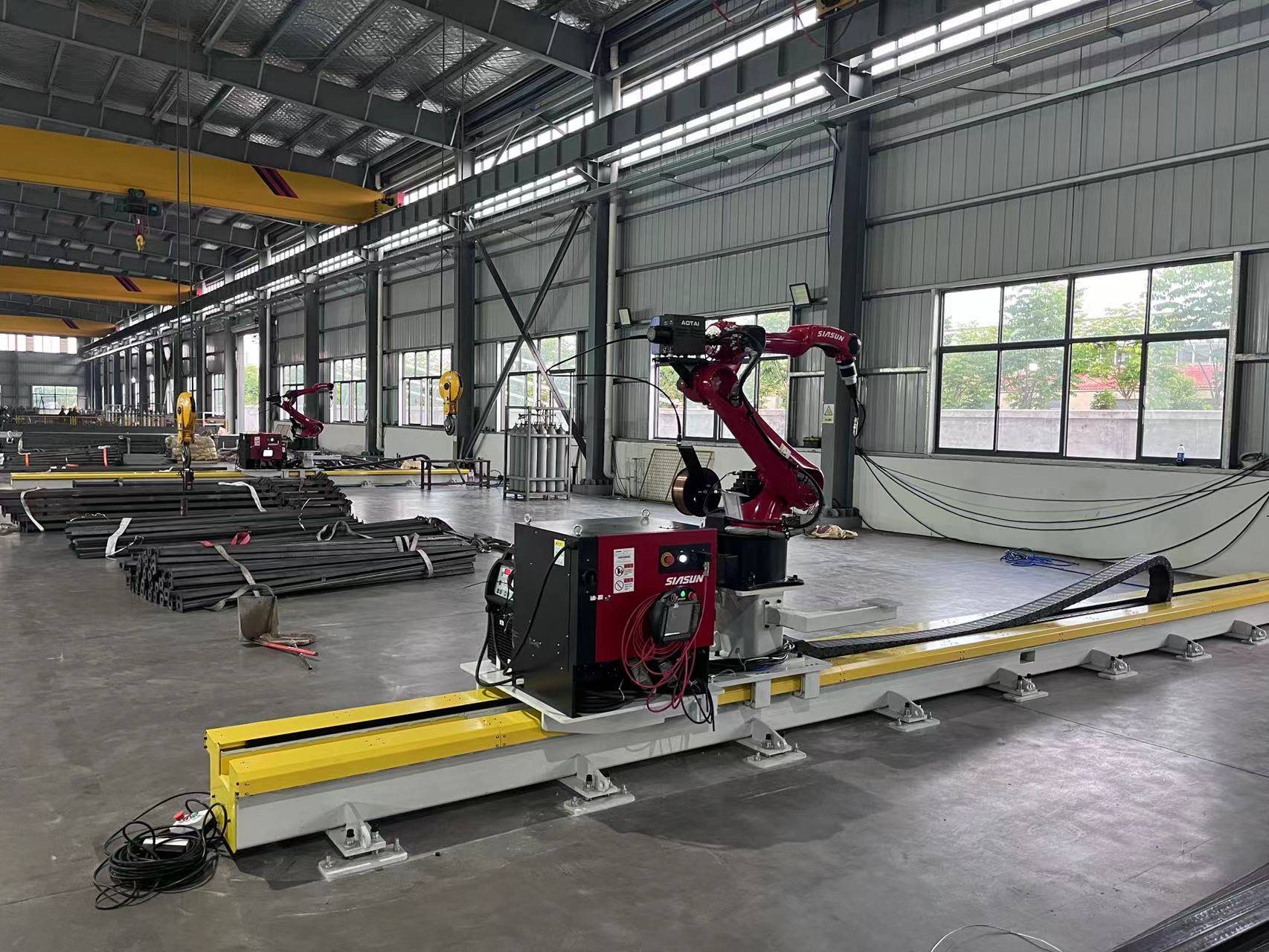
Real-Time Feedback Loops
The AVC system monitors the voltage across the welding arc. Since voltage is directly proportional to the arc length, any change in the distance between the wire and the base metal results in a voltage fluctuation. The robot controller processes these fluctuations at millisecond intervals, automatically adjusting the Z-axis (height) of the torch to return to the preset voltage. This ensures that the robotic MAG welding process remains stable despite mechanical imperfections in the tower shells.
Impact on Weld Bead Morphology
Consistent arc length results in a uniform bead profile. For wind towers, which require multiple passes (root, hot, fill, and cap), maintaining a flat and predictable bead is essential for subsequent passes. AVC prevents the “humping” effect often seen in manual MAG welding at high currents, significantly reducing the time spent on inter-pass cleaning and grinding.
Operational Parameters and Metallurgical Integrity
Implementing an intelligent system requires a rigorous definition of Welding Procedure Specifications (WPS). When utilizing MAG welding for wind towers, the choice of shielding gas—typically a mixture of Argon and CO2—is critical for achieving the right balance of penetration and spatter control. The robot’s ability to maintain a precise travel speed, synchronized with wire feed speed, allows for a controlled heat input, which is vital for preserving the Heat Affected Zone (HAZ) properties of high-strength structural steels.
Wire Feed Optimization
Robotic systems utilize heavy-duty wire feeders capable of pulling from 500kg bulk drums. This minimizes downtime associated with spool changes. The intelligent controller monitors motor torque in the wire feeder to detect any friction increases in the liner, allowing for predictive maintenance before a “bird-nesting” event occurs.
Maintenance Engineering for High-Uptime Environments
To realize the full potential of Robotic Welding, a proactive maintenance strategy must be employed. Unlike manual setups, where a welder might compensate for a worn contact tip, a robot requires standardized consumable replacement intervals to maintain the accuracy of the AVC feedback loop.
Consumable Lifecycle Management
The contact tip is the most vulnerable component in high-duty cycle MAG welding. As the internal diameter of the tip erodes (keyholing), the electrical contact point shifts, causing arc instability. Industrial engineers should implement a “Fixed-Interval Replacement” strategy, where tips are replaced every 4-6 hours of arc-on time, regardless of apparent wear. This drastically reduces the probability of mid-seam failures in large circumferential welds.
Automated Torch Cleaning Stations
Spatter accumulation in the gas nozzle disrupts the laminar flow of shielding gas, leading to atmospheric contamination. Integrating an automated “Reamer” or cleaning station allows the robot to self-clean between passes. This process, including the application of anti-spatter spray, takes less than 30 seconds and ensures that the Wind tower fabrication environment remains productive without manual intervention.
Quantitative ROI: Labor Reallocation and Throughput
The financial justification for an intelligent robotic welder is often centered on the “Arc-On Time” or duty cycle. In manual wind tower welding, a highly skilled welder typically achieves a duty cycle of 20% to 30% due to fatigue, heat exposure, and the need for repositioning. A robotic system, conversely, can maintain a duty cycle of 80% to 85%.
Labor ROI and Skill Shift
The return on investment is not merely found in replacing a human with a machine, but in the upskilling of the workforce. A manual welder becomes a Robotic System Operator, overseeing two or even three welding cells simultaneously. This multiplication of output per man-hour is the primary driver of Welding ROI. In a typical wind tower facility, the payback period for a fully integrated AVC robotic cell is often less than 18 months when considering the reduction in rework and the increase in linear meters welded per shift.
Reduction in Material Waste
Manual welding often leads to over-welding (applying more filler metal than specified) to ensure a safety margin. Robotic systems, guided by AVC, deposit the exact volume of metal required. Over the course of a single wind tower project, the savings in wire consumption and shielding gas can amount to thousands of dollars, further padding the bottom line.
Integration with Enterprise Resource Planning (ERP)
Modern intelligent welders provide data logging capabilities that are invaluable for quality assurance. Every weld seam can be tracked with a digital “birth certificate,” recording the voltage, current, and travel speed for every millimeter of the weld. This level of traceability is increasingly required by energy developers and regulatory bodies to ensure the long-term safety of wind energy infrastructure.
Conclusion: Scaling Production for the Green Energy Transition
As the demand for wind energy scales globally, the fabrication sector must move away from artisanal methods toward standardized, high-precision automation. The intelligent robotic welder, bolstered by Arc Voltage Control, represents the pinnacle of current MAG welding technology. By focusing on mechanical reliability, stringent maintenance, and the strategic reallocation of labor, manufacturers can achieve the throughput necessary to meet aggressive production targets while maintaining the uncompromising quality standards required for offshore and onshore wind structures.
-


LT240S tube laser cutting machine
-
LT120S tube laser cutting machine
-
Sale

Tank Fillet Welding Machine
Original price was: $1,000.00.$900.00Current price is: $900.00. -
Sale

MAK100 tube laser cutting machine
Original price was: $5,500.00.$5,000.00Current price is: $5,000.00. -

portable plasma air cutting machine
$1,200.00 -

2in1 fiber laser cutting machine
-

Air cooling Laser welding machine
-

HF h beam laser cutting machine
-

LT240 laser cutting machine
-

Laser welding machine
-


Cobot Welding Station
-

Gantry welding robot solution
-

Tracked Wheeled AGV Welding robot
-

LFH6020 Fiber laser cutting machine
-
LFP6020
-

robotic welidng machine
Advanced Fiber Laser Tube Processing Technology
Our CNC Fiber Laser Tube Cutting systems revolutionize metal fabrication by integrating high-precision cutting, punching, and profiling into a single automated workflow. Designed for versatility, this technology handles a wide array of profiles including Round, Square, Rectangular, and Oval tubes, as well as complex L-shaped and U-shaped channels.
- Precision Punching: High-speed hole punching with micron-level accuracy, eliminating the need for mechanical drilling or die-stamping.
- Complex Profiling: Advanced 3D pathing allows for intricate interlocking joints and specialized notch cuts, ideal for structural frames.
- High Material Efficiency: Intelligent nesting software minimizes scrap, reducing raw material costs across large production runs.
- Clean Finish: Delivers oxide-free, burr-free edges that require zero secondary grinding before welding.

Seamlessly processing multiple profiles with consistent precision.
Global Delivery & Logistics



From our high-tech manufacturing facility directly to your global site. PCL WeldCut ensures secure packaging, professional handling, and reliable international logistics to safeguard your equipment throughout the entire journey.