Advanced MAG Welding Integration for Heavy Construction Machinery
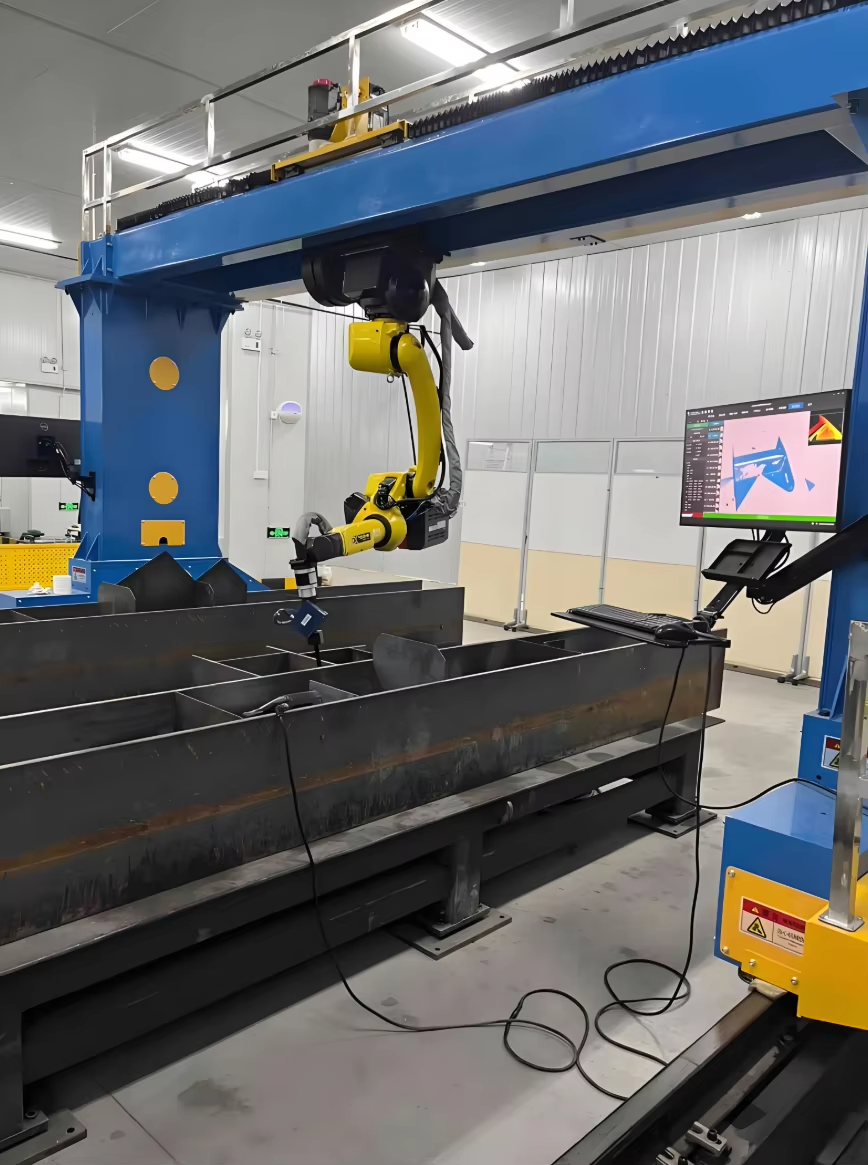
In the fabrication of heavy construction machinery, such as excavators, bulldozers, and crane chassis, the structural integrity of the frame is non-negotiable. These components are subjected to extreme fatigue cycles and high torsional stress. Transitioning from manual processes to an Intelligent Robotic Welder equipped with 5-Axis Beveling capabilities represents a fundamental shift in production efficiency. Unlike standard 3-axis systems, the addition of two rotational axes at the torch head allows the system to maintain the optimal work angle and travel angle throughout complex geometries, ensuring deep penetration in thick-plate MAG (Metal Active Gas) applications.
The Mechanics of 5-Axis Beveling in Metal Active Gas Processes
The primary challenge in heavy-duty welding is the preparation and filling of thick joints. For plates exceeding 15mm, a simple butt weld is insufficient. 5-axis robotic systems utilize intelligent sensors to track the seam and adjust the torch orientation in real-time. This is not merely about moving along a path; it is about managing the weld pool dynamics. By manipulating the torch across five axes, the robot can perform multi-pass welding in V, U, or K-shaped grooves with high precision.
During the MAG welding process, the shielding gas (typically an Argon-CO2 mix) must be directed precisely to protect the molten pool from atmospheric contamination. The 5-axis movement ensures that the gas nozzle remains perpendicular to the weld face even as the groove angle changes. This prevents porosity and ensures a clean, slag-free bead that meets ISO 5817 Level B quality standards for structural components.
Operational Efficiency and Seam Tracking Intelligence
Intelligent robotic welders utilize laser-based or through-arc seam tracking to compensate for fabrication tolerances in large-scale components. In the construction machinery sector, large steel plates often have slight deviations due to previous forming or tacking stages. A 5-axis system identifies these variations and adjusts the wire stick-out and travel speed dynamically. This “intelligence” reduces the need for costly rework, which is often the primary bottleneck in heavy manufacturing.
Furthermore, the 5-axis capability allows for the automation of “out-of-position” welds. In manual operations, large frames must be rotated using heavy-duty positioners to allow the welder to work in a flat position. While positioners are still used in robotic cells, the robot’s ability to weld at various angles reduces the frequency of part rotation, thereby decreasing cycle times and improving safety by minimizing crane lifts.
Calculating Return on Investment (ROI) for Robotic Welding
The Return on Investment (ROI) for an intelligent robotic welding cell is determined by three primary factors: labor substitution, deposition rate, and consumable efficiency. In a typical manual welding environment, the “arc-on” time—the actual time spent welding versus prepping—is often as low as 20% to 30%. Robotic systems can maintain an arc-on time exceeding 75%.
Labor costs in developed markets for certified high-pressure welders continue to rise, coupled with a shrinking talent pool. A single robotic cell can often replace the output of three to four manual welders, depending on the complexity of the part. When calculating the payback period, engineers must factor in the reduction of scrap and the elimination of post-weld grinding. Because 5-axis robots deliver consistent heat input, thermal distortion is minimized, which preserves the dimensional accuracy of the machinery frame and reduces the time spent in final assembly.
Deposition Rates and Throughput Gains
Manual MAG welding is limited by the physical endurance of the operator and the need for frequent breaks. A robotic system can utilize high-current spray transfer modes or pulsed-MAG settings consistently. This increases the deposition rate—the amount of metal added to the joint per hour—by up to 50% compared to manual stick or semi-automatic MAG welding. Over a fiscal year, this translates to hundreds of additional units produced without increasing the facility’s footprint.
Maintenance Protocols for High-Duty Cycle Robots
To realize the projected ROI, maintenance must shift from reactive to preventive. In a high-volume construction machinery plant, downtime is measured in thousands of dollars per hour. The maintenance of a 5-axis robotic welder focuses on the wire delivery system and the torch assembly.
Contact Tip and Liner Management
The contact tip is a critical consumable. Even slight wear can cause arc instability or wire “wandering,” which negates the precision of the 5-axis head. Automated tip changers or scheduled replacements every 4 to 8 hours of arc time are standard practice. Similarly, the wire liner must be blown out with compressed air periodically to prevent the buildup of copper flaking and dust, which causes feed motor strain and erratic wire delivery.
Torch Alignment and Calibration
Since the 5-axis system relies on precise mathematical coordinates, any collision—even a minor “snag” of the torch on a tack weld—can throw off the Tool Center Point (TCP). Automated TCP calibration stations should be integrated into the cell. Every few cycles, the robot moves to a sensing station to verify its alignment. If a deviation is detected, the robot automatically adjusts its internal coordinate system, ensuring that the 5-axis beveling remains accurate to within sub-millimeter tolerances.
Integration with Industry 4.0 Data Logging
Modern 5-axis robotic beveling systems act as data nodes. Every weld parameter—voltage, amperage, gas flow, and wire feed speed—is logged. for Construction Machinery, this provides a “birth certificate” for every structural joint. If a failure occurs in the field, engineers can trace the data back to the specific timestamp of the weld to verify that it was within the specified WPS (Welding Procedure Specification). This traceability is a significant advantage for original equipment manufacturers (OEMs) regarding liability and quality assurance.
Conclusion: The Future of Heavy Fabrication
The adoption of intelligent 5-axis robotic welding is no longer an optional upgrade for construction machinery manufacturers; it is a necessity for maintaining global competitiveness. By automating the MAG welding process and utilizing 5-axis movement to handle complex bevels, manufacturers can achieve a level of consistency and throughput that manual labor cannot match. The focus must remain on rigid maintenance schedules and optimized programming to ensure that the initial capital expenditure results in a shortened payback period and a superior finished product.
-


LT240S tube laser cutting machine
-
LT120S tube laser cutting machine
-
Sale

Tank Fillet Welding Machine
Original price was: $1,000.00.$900.00Current price is: $900.00. -
Sale

MAK100 tube laser cutting machine
Original price was: $5,500.00.$5,000.00Current price is: $5,000.00. -

portable plasma air cutting machine
$1,200.00 -

2in1 fiber laser cutting machine
-

Air cooling Laser welding machine
-

HF h beam laser cutting machine
-

LT240 laser cutting machine
-

Laser welding machine
-


Cobot Welding Station
-

Gantry welding robot solution
-

Tracked Wheeled AGV Welding robot
-

LFH6020 Fiber laser cutting machine
-
LFP6020
-

robotic welidng machine
Advanced Fiber Laser Tube Processing Technology
Our CNC Fiber Laser Tube Cutting systems revolutionize metal fabrication by integrating high-precision cutting, punching, and profiling into a single automated workflow. Designed for versatility, this technology handles a wide array of profiles including Round, Square, Rectangular, and Oval tubes, as well as complex L-shaped and U-shaped channels.
- Precision Punching: High-speed hole punching with micron-level accuracy, eliminating the need for mechanical drilling or die-stamping.
- Complex Profiling: Advanced 3D pathing allows for intricate interlocking joints and specialized notch cuts, ideal for structural frames.
- High Material Efficiency: Intelligent nesting software minimizes scrap, reducing raw material costs across large production runs.
- Clean Finish: Delivers oxide-free, burr-free edges that require zero secondary grinding before welding.

Seamlessly processing multiple profiles with consistent precision.
Global Delivery & Logistics



From our high-tech manufacturing facility directly to your global site. PCL WeldCut ensures secure packaging, professional handling, and reliable international logistics to safeguard your equipment throughout the entire journey.