High-Precision Tube Laser Processing for Medical Equipment Manufacturing
The manufacturing of medical equipment, ranging from surgical robotic arms to hospital bed frames, requires a level of geometric accuracy and surface integrity that traditional mechanical cutting cannot provide. The primary objective in modern medical fabrication is the elimination of secondary processes. By utilizing advanced fiber laser oscillators and precise motion control, manufacturers can achieve finishes that require no manual grinding or deburring. This technical transition reduces labor costs and ensures the structural integrity of the components by minimizing the Heat Affected Zone (HAZ).
Thermal Management and Edge Quality
In medical-grade stainless steel (304/316L) and aluminum processing, the quality of the cut edge is determined by the laser’s pulse frequency and gas pressure synchronization. When the laser maintains a focused spot size with high energy density, the material vaporizes instantly, leaving a clean edge. A minimal HAZ is critical because excessive heat can alter the grain structure of the metal, leading to potential stress corrosion or failure in sterilized environments.
For components requiring assembly, 45-degree beveling is an essential capability. Advanced 5-axis laser heads allow for high-speed beveling of round and square tubes. This precision allows for a perfect fit-up during the welding phase, requiring significantly less filler material and resulting in a flush joint that does not require post-weld grinding. This “finished-out-of-machine” capability is the benchmark for high-efficiency medical production lines.
Hardware Stability: Cast Iron Bed vs. Welded Frames
The mechanical foundation of the tube laser dictates its long-term accuracy. High-speed laser processing generates significant inertia during rapid acceleration and deceleration of the cutting head. To counteract this, industrial-grade machines utilize a high-tensile cast iron bed. Unlike welded steel frames, a cast iron bed offers superior Vibration damping. This inherent material property absorbs the frequencies generated by high-speed servo motors, preventing the resonance that causes “scalloping” or micro-striae on the cut surface.
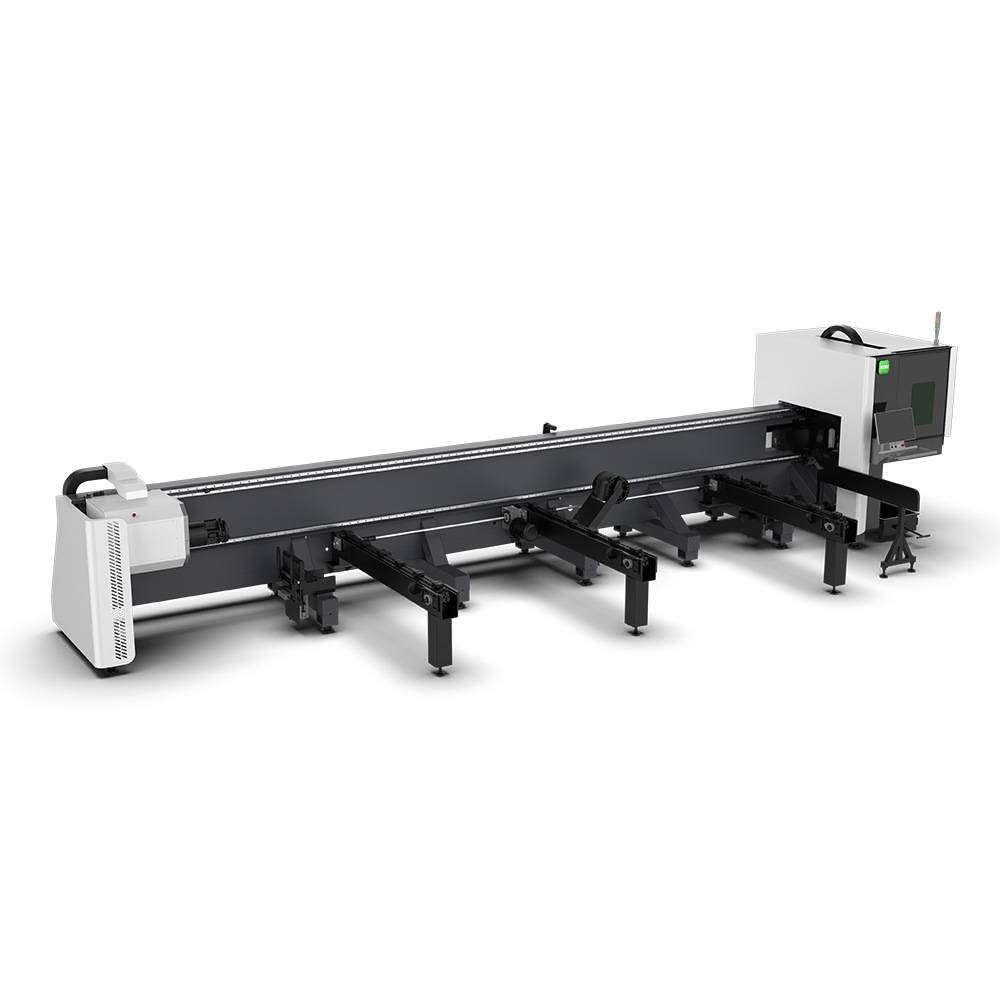
Furthermore, the chuck configuration plays a vital role in tube stability. While 2-chuck systems are standard for general-purpose cutting, medical equipment often utilizes thin-walled or heavy-profile tubes that require a 3-chuck arrangement.
Technical Analysis: 2-Chuck vs. 3-Chuck Systems
The following table outlines the performance differences in tube stability and material utilization:
| Feature | 2-Chuck System | 3-Chuck System (Pro) |
|---|---|---|
| Tailing Material Waste | 150mm – 300mm | Zero Tailing (in specific modes) |
| Tube Support | Minimal at end-of-pipe | Continuous mid-span support |
| Accuracy on Long Tubes | Lower (prone to tube sag) | High (compensated for bow) |
| Processing Versatility | Standard profiles | H-beams, C-channels, Heavy profiles |
Material Versatility and Reflectivity Control
Medical devices frequently incorporate aluminum for lightweight structures or copper for conductivity. These materials are highly reflective, which can damage the laser source if back-reflection occurs. Modern fiber lasers incorporate Anti-reflection technology, which uses optical isolators and sensors to detect back-reflection and adjust the beam parameters in real-time. This allows for continuous, high-speed cutting of non-ferrous metals without the risk of equipment downtime.
Beyond standard round and square tubing, the demand for complex profiles like H-beams and C-channels in medical infrastructure (such as MRI room shielding or overhead surgical lighting supports) is increasing. A 3-chuck system allows for the rotation and positioning of these non-symmetric shapes with the same precision as standard tubing, ensuring that bolt holes and cutouts align perfectly with mating components.
Cloud-Based Production Tracking and Traceability
For medical manufacturers, traceability is a regulatory requirement. Integrating the tube laser with a cloud-based production tracking system allows for real-time OEE monitoring (Overall Equipment Effectiveness). Every cut, every job, and every operator interaction is logged and stored in a centralized database. This data-driven approach provides several advantages:
- Real-time visualization of machine status and cycle times.
- Automatic material inventory tracking and nesting optimization.
- Predictive maintenance alerts based on component wear patterns.
- Full digital traceability for ISO 13485 compliance.
Cloud integration enables managers to monitor production from any location, identifying bottlenecks immediately. When a tube laser is connected to a smart factory ecosystem, the transition from raw material to a precision-cut component becomes a transparent, measurable process.
Strategic Economic Value
The convergence of zero-grind cutting and cloud tracking shifts the economic model of the factory. By eliminating the manual deburring station, a manufacturer can repurpose labor and reduce the footprint of the production line. While the initial investment in a 3-chuck, cast-iron bed system is higher than entry-level alternatives, the ROI is realized through material savings (zero tailing), reduced secondary processing, and the elimination of scrap due to high-accuracy tolerances.
In the medical sector, where quality is non-negotiable, the ability to produce a burr-free, perfectly beveled part in a single operation is a decisive competitive advantage. High-precision tube lasers, supported by robust hardware and intelligent software, are the primary drivers for this manufacturing evolution.
-


LT240S tube laser cutting machine
-
LT120S tube laser cutting machine
-
Sale

Tank Fillet Welding Machine
Original price was: $1,000.00.$900.00Current price is: $900.00. -
Sale

MAK100 tube laser cutting machine
Original price was: $5,500.00.$5,000.00Current price is: $5,000.00. -

portable plasma air cutting machine
$1,200.00 -

2in1 fiber laser cutting machine
-

Air cooling Laser welding machine
-

HF h beam laser cutting machine
-

LT240 laser cutting machine
-

Laser welding machine
-


Cobotic Welding Station
-

Gantry welding robot solution
-

Tracked Wheeled AGV Welding robot
-

LFH6020 Fiber laser cutting machine
-
LFP6020
-

robotic welidng machine
