High-Speed Fiber Tube Laser Cutting in Bicycle Frame Production: Technical Standards and Economic Analysis
The bicycle manufacturing industry has transitioned from manual processing to automated fabrication to meet the demands of high-volume production and structural precision. The integration of high-speed fiber laser tube cutting machines addresses the specific challenges of thin-walled tubing, complex mitering, and the necessity for clean weld preparation. By replacing traditional sawing, drilling, and milling with a single-pass laser process, manufacturers achieve tighter tolerances and significant material savings.
Aesthetic Optimization and Seamless Welding Preparation
In high-end bicycle frame production, the aesthetic quality of the weld seam is directly dictated by the precision of the fit-up. Fiber laser cutting provides a kerf width of less than 0.1mm, allowing for complex 3D contours and interlocking joints that manual notchers cannot replicate. This precision is critical for thin-walled chromoly or aluminum tubes where gaps in the fit-up lead to burn-through or excessive bead build-up during the TIG welding process.
The High-speed fiber source allows for the creation of intricate “hidden” holes. In modern bicycle design, internal cable routing is a standard requirement. The laser produces burr-free entry and exit ports for brake lines and derailleur cables, eliminating the need for secondary deburring. This same technology is frequently applied to high-end tubular furniture, where internal fasteners and hidden joints require precise slots that do not compromise the structural integrity or the visual finish of the powder-coated surface. The consistency of the laser ensures that every hole is positioned with a repeatability of ±0.03mm, ensuring that assembly components fit perfectly every time.
Risk Mitigation: Fiber Source Stability and Chuck Precision
Industrial environments, particularly those involving metal fabrication, are prone to dust and temperature fluctuations. High-speed fiber sources are designed with sealed resonators and redundant cooling systems to maintain beam stability over 24-hour production cycles. Unlike CO2 lasers, fiber delivery systems involve no moving mirrors, which mitigates the risk of beam misalignment caused by mechanical vibration or thermal expansion. This stability ensures that the power density remains constant, preventing incomplete cuts or slag formation on the inner diameter of the tube.
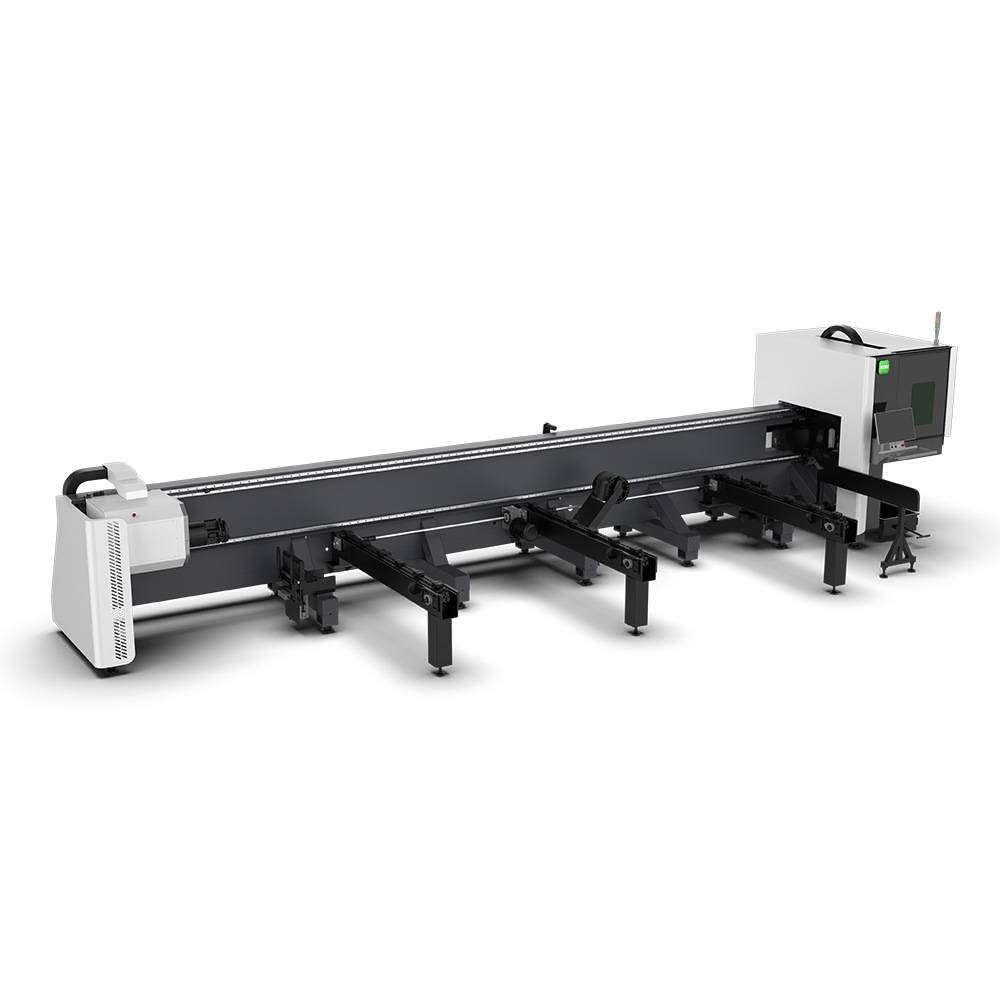
Another critical technical risk in tube processing is material slippage or deformation within the chuck. High-speed machines utilize servo-driven chucks that provide self-centering capabilities with adjustable clamping pressure. In bicycle frames, tubes are often thin-walled (0.8mm to 1.5mm). Excessive pressure from a pneumatic chuck can crush the tube, while insufficient pressure leads to rotational inaccuracy. Intelligent chuck systems monitor the torque and adjust the grip in real-time, ensuring that the tube remains centered during high-speed rotations and rapid accelerations. This precision is vital when cutting the head tube or bottom bracket shells, where concentricity is mandatory for subsequent machining or assembly.
Economic Impact: Labor Substitution and Material Yield
The primary driver for adopting fiber laser technology in bicycle production is the reduction of total cost per part. Traditionally, a bicycle frame assembly line requires multiple workstations: one for cutting to length, one for mitering the tube ends, and another for drilling cable ports and water bottle boss holes. Each of these stations requires a dedicated worker and increases the risk of cumulative error. A fiber tube laser consolidates these processes into a single operation managed by one technician. This labor substitution allows a facility to reallocate 3 to 5 workers to higher-value tasks such as final welding or quality inspection, significantly lowering the overhead per frame.
Material waste is another significant cost factor. Standard tube cutting machines often leave a “tailing” of 150mm to 200mm at the end of each raw pipe because the chuck cannot hold the material close enough to the cutting head. Modern zero-tailing technology utilizes a triple-chuck or moving-chuck configuration that allows the laser to process almost the entire length of the raw material. By reducing the tailing to less than 20mm, manufacturers save between 10cm and 20cm per pipe. In mass production, where thousands of meters of tubing are processed daily, the cumulative material savings can pay for the machine’s financing costs within 18 to 24 months.
Technical Comparison: Manual vs. Fiber Laser Processing
| Feature | Manual/Conventional | Fiber Laser (Zero-Tailing) |
|---|---|---|
| Labor Requirement | 4-5 Operators | 1 Operator |
| Material Waste (Per Tube) | 150mm – 250mm | <30mm |
| Processing Time (Per Frame Set) | 15 – 20 Minutes | 2 – 3 Minutes |
| Hole/Miter Precision | ±0.5mm | ±0.03mm |
| Secondary Finishing | Required (Deburring/Grinding) | None/Minimal |
Optimizing Throughput with Automatic Loading
To maximize the ROI of a high-speed fiber laser, automatic bundle loading systems are integrated into the workflow. These systems allow the machine to run autonomously for extended periods by automatically measuring, feeding, and orienting the tubes. In a bicycle factory, where various tube diameters and profiles (round, oval, teardrop) are used, the software-driven loader ensures the correct material is fed into the chuck without manual intervention. This reduces downtime between batches and ensures that the heat-affected zone (HAZ) is minimized through high-speed cutting parameters, preserving the metallurgical properties of high-performance alloys.
The Strategic Value of Data Integration
Modern tube lasers utilize CAD/CAM software that allows engineers to import 3D frame models directly. The software automatically calculates the nesting to minimize scrap and optimizes the cutting path to reduce travel time. This digital workflow eliminates the risk of human error in measurement and layout. For manufacturers looking to scale, this data-driven approach allows for rapid prototyping and the ability to switch between different frame sizes or designs without changing physical tooling or jigs.
Conclusion
The adoption of high-speed fiber Tube laser cutting machines is a strategic necessity for bicycle manufacturers aiming for the premium segment. By addressing the critical dimensions of aesthetic precision, mechanical stability, and aggressive cost reduction through zero-tailing technology, these machines provide a quantifiable competitive advantage. The ability to produce complex, weld-ready components with minimal labor and near-zero material waste ensures long-term profitability in a market that demands both high performance and structural perfection.
-


LT240S tube laser cutting machine
-
LT120S tube laser cutting machine
-
Sale

Tank Fillet Welding Machine
Original price was: $1,000.00.$900.00Current price is: $900.00. -
Sale

MAK100 tube laser cutting machine
Original price was: $5,500.00.$5,000.00Current price is: $5,000.00. -

portable plasma air cutting machine
$1,200.00 -

2in1 fiber laser cutting machine
-

Air cooling Laser welding machine
-

HF h beam laser cutting machine
-

LT240 laser cutting machine
-

Laser welding machine
-


Cobotic Welding Station
-

Gantry welding robot solution
-

Tracked Wheeled AGV Welding robot
-

LFH6020 Fiber laser cutting machine
-
LFP6020
-

robotic welidng machine
