Optimizing Wind Tower Fabrication via Advanced Tank Fillet Welding
The manufacturing of wind towers presents unique structural challenges, primarily due to the immense scale of the cylindrical sections and the stringent requirements for weld integrity. Industrial engineers increasingly prioritize the Tank Fillet Welding Machine as a primary solution for the circumferential and longitudinal joints found in these structures. Unlike general-purpose welding equipment, these specialized machines are designed to navigate the curvature of large-diameter shells while maintaining consistent electrode positioning. The focus remains on achieving deep penetration and uniform bead profiles to withstand the cyclic loading inherent in wind energy applications.
Field construction stability is often the limiting factor in weld quality. Traditional methods frequently struggle with environmental variables such as wind gusts, surface irregularities, and the sheer physical reach required to weld tower internals. By utilizing magnetic crawler systems, fabricators achieve a level of mechanical coupling that ensures the welding torch remains at a fixed distance and angle relative to the joint, regardless of the crawler’s orientation. This stability is critical for the continuous flux-cored or metal-active gas welding processes utilized in high-volume tower production.
Mechanical Stability of Magnetic Crawler Systems
The foundation of a reliable tank fillet welding machine lies in its traction mechanism. In wind tower fabrication, the crawler must ascend vertical surfaces and maintain a precise path across the internal and external diameters of the shell. High-flux permanent magnets provide the necessary downforce to keep the carriage adhered to the carbon steel plates, typically ranging from 20mm to 80mm in thickness. This magnetic adhesion must be balanced; it must be strong enough to prevent slippage under the weight of the wire feeder and torch assembly, yet calibrated to allow smooth movement across surface imperfections.
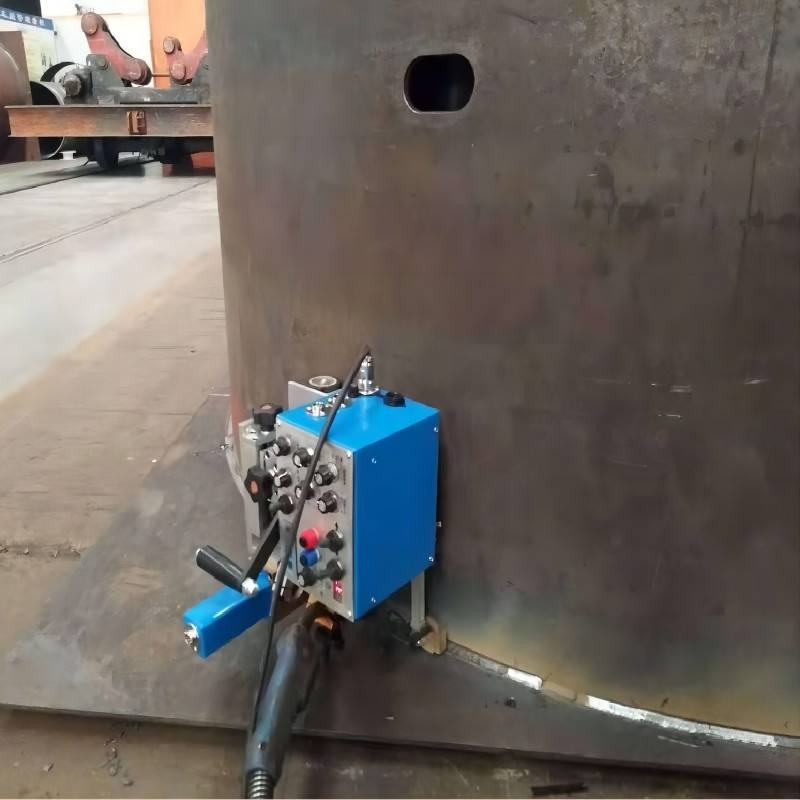
From an engineering perspective, the stability of the crawler minimizes “arc wander” and ensures that the heat input remains within the calculated limits of the Welding Procedure Specification (WPS). When a machine maintains a constant travel speed and torch oscillation frequency, the resulting cooling rate of the weld metal becomes predictable. This predictability is vital for maintaining the mechanical properties of the heat-affected zone (HAZ), particularly in sub-zero temperature environments where wind towers are often deployed.
The Role of Offline Programming in Large-Scale Assembly
Efficiency in wind tower fabrication is not solely a product of the welding arc; it is heavily influenced by the preparation and planning phases. Offline programming (OLP) serves as a force multiplier for mechanized welding. OLP allows industrial engineers to simulate the welding path on a digital twin of the tower section. This process identifies potential collisions with internal stiffeners or flanges and optimizes the torch angle for maximum throat thickness in fillet welds before the machine even touches the steel.
Implementing OLP for tank fillet welding machines eliminates the “trial and error” approach common in manual setups. By pre-defining the weld start and stop points, as well as the ramp-up and ramp-down parameters for current and voltage, the system ensures that the start and end of each weld segment are free from craters or lack of fusion defects. This level of digital control allows for the synchronization of multiple crawlers operating on a single tower section, drastically reducing the total cycle time for assembly.
Consistency in Fillet Weld Geometry
In fillet welding, the leg length and convexity must be strictly controlled to avoid stress concentrations. A mechanized crawler equipped with a precision weave unit can be programmed to perform specific oscillation patterns. These patterns ensure that the weld puddle wets the edges of the joint correctly, preventing undercut—a common defect in manual large-scale welding. The integration of offline programming ensures that these weave parameters are standardized across all production shifts, removing the variability of operator skill levels.
Furthermore, the data logged by the offline programming interface provides a comprehensive record of the welding process. For wind tower manufacturers, this traceability is essential for quality assurance and compliance with international standards such as ISO 9001 and AWS D1.1. Every millimeter of the fillet weld is backed by a digital record of the heat input, allowing for rapid auditing and structural verification without solely relying on non-destructive testing (NDT) after the fact.
Overcoming Environmental Challenges in Field Construction
Wind tower fabrication often takes place in yard environments rather than climate-controlled shops. The equipment must be ruggedized to handle dust, moisture, and temperature fluctuations. The magnetic crawler’s drive system is typically enclosed, using high-torque motors that can overcome the resistance of mill scale or surface rust. The stability provided by the magnetic base allows the machine to operate effectively even when the tower section is subjected to slight vibrations from nearby heavy machinery.
By focusing on the mechanical rigidity of the torch mount and the precision of the drive wheels, engineers can ensure that the machine maintains a constant velocity. Even a minor fluctuation in travel speed can lead to variations in the weld cross-section, which could compromise the tower’s structural integrity. The combination of heavy-duty hardware and pre-verified offline paths ensures that the welding process is isolated from the typical instabilities of a field construction site.
Throughput and Duty Cycle Optimization
The primary metric for any industrial welding operation is the deposition rate. Tank fillet welding machines are designed for high duty cycles, often exceeding 80%, which is unattainable for manual welders in similar conditions. Because the crawler handles the weight of the torch and manages the arc length via automated height control, the system can run continuously for the entire length of a circumferential seam.
Offline programming contributes to this throughput by reducing the setup time. When the machine is moved from one section to the next, the operator simply loads the relevant program for that specific diameter and plate thickness. The machine then executes the path with minimal intervention. This allows a single technician to oversee multiple crawlers, effectively multiplying the production capacity of the facility. The reduction in arc-off time directly translates to a lower cost per meter of weld, providing a clear return on investment for the technology.
Final Considerations for Engineering Implementation
Successful deployment of these systems requires a holistic view of the fabrication workflow. The plates must be rolled to tight tolerances to ensure that the fit-up gap for the fillet welds remains consistent. While the magnetic crawler can compensate for some geometric variance, the best results are achieved when the offline program is based on accurate pre-weld measurements. As the wind energy sector moves toward larger turbines and taller towers, the reliance on mechanized tank fillet welding will only increase. The synergy between robust magnetic traction and sophisticated offline planning represents the current ceiling of efficiency for tower assembly, providing the stability and precision necessary for modern infrastructure demands.
-


LT240S tube laser cutting machine
-
LT120S tube laser cutting machine
-
Sale

Tank Fillet Welding Machine
Original price was: $1,000.00.$900.00Current price is: $900.00. -
Sale

MAK100 tube laser cutting machine
Original price was: $5,500.00.$5,000.00Current price is: $5,000.00. -

portable plasma air cutting machine
$1,200.00 -

2in1 fiber laser cutting machine
-

Air cooling Laser welding machine
-

HF h beam laser cutting machine
-

LT240 laser cutting machine
-

Laser welding machine
-


Cobotic Welding Station
-

Gantry welding robot solution
-

Tracked Wheeled AGV Welding robot
-

LFH6020 Fiber laser cutting machine
-
LFP6020
-

robotic welidng machine
