Optimization of Tank Fillet Welding in Large-Scale Steel Structures
In the field of heavy steel construction, particularly the fabrication of oil storage tanks and industrial silos, the integrity of the fillet weld is a critical determinant of structural longevity. Manual welding of shell-to-bottom joints and lap joints often faces challenges regarding consistency, especially when exposed to variable environmental conditions. The implementation of a Tank Fillet Welding Machine addresses these variables by transitioning from manual manipulation to a mechanized, precision-controlled process. This transition is not merely about speed; it focuses on the standardization of the weld bead profile and the depth of penetration across kilometers of linear joints.
Industrial engineers prioritize systems that minimize rework. By utilizing automated carriages specifically designed for fillet geometries, manufacturers can ensure that the heat input remains within specified parameters, reducing the risk of distortion in thin-walled sections. The mechanical stability of these units, combined with digital control interfaces, creates a predictable production environment even in high-stakes field construction scenarios.
The Role of Magnetic Crawler Technology in Field Stability
Field construction presents unique challenges that shop-floor environments do not, primarily regarding surface orientation and environmental interference. A magnetic crawler serves as the mobility platform for the welding torch, utilizing high-strength permanent magnets or electromagnets to maintain a constant distance and pressure against the workpiece. This magnetic adhesion is vital for vertical and horizontal-vertical (2F/2G) positions, where gravity would otherwise compromise the stability of a standard wheeled carriage.
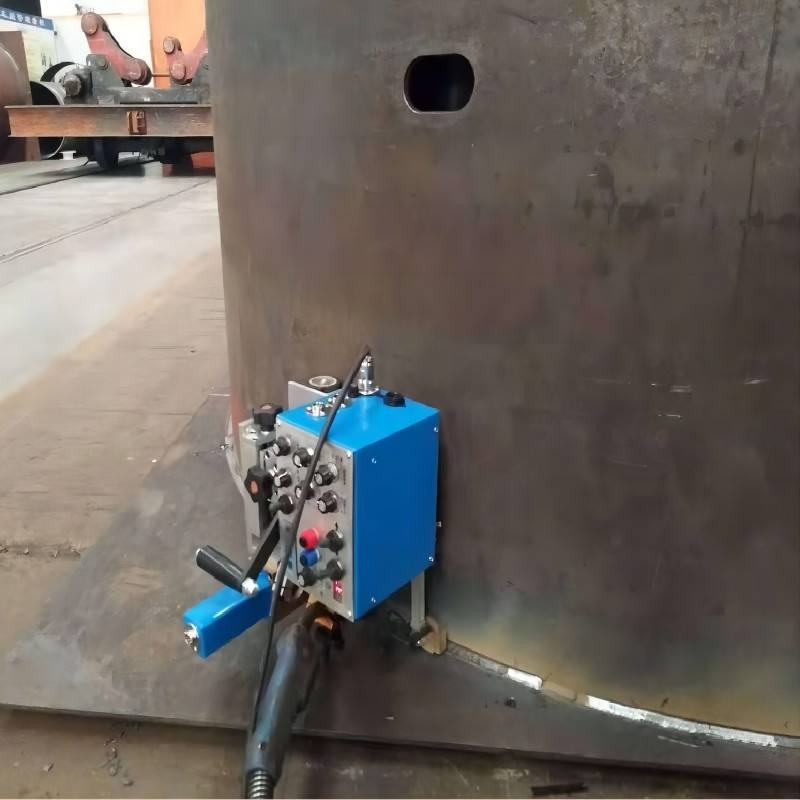
The stability provided by the magnetic grip ensures that the welding arc remains focused in the root of the joint. This eliminates “arc wander” and allows for the use of high-deposition welding processes such as Flux-Cored Arc Welding (FCAW). From an engineering perspective, the constant traction prevents slippage on surfaces that may have slight oxidation or protective primers, ensuring that the travel speed remains constant—a key factor in maintaining a uniform weld throat thickness.
Offline Programming for Mechanized Welding Sequences
While often associated with complex articulated systems, offline programming (OLP) has become a transformative tool for mechanized crawler systems. In the context of tank construction, OLP involves the digital pre-configuration of welding parameters and travel paths based on the specific geometry of the tank. Engineers can input the tank diameter, plate thickness, and joint type into a software interface to generate a precise operational blueprint.
This approach allows for the simulation of the welding sequence before a single arc is struck. It identifies potential interference points with tank manways, nozzles, or internal stiffeners. Once the program is optimized, it is uploaded to the crawler’s control unit via a simple interface. This reduces the “knob-turning” time on-site, as the operator only needs to align the crawler at the starting point. The digital control of the OLP ensures that the overlap of weld segments is handled with programmed precision, which is essential for liquid-tight integrity in storage vessels.
Technical Advantages of Path Pre-Planning
The primary advantage of utilizing OLP for tank fillet welding is the synchronization of wire feed speed, voltage, and travel speed. In a manual setup, an operator might struggle to maintain a consistent speed over a 50-meter circumference. The programmed crawler, however, maintains a steady velocity down to the millimeter per minute. This level of control results in a significant reduction in weld metal consumption, as over-welding (creating a larger fillet than required) is eliminated through precise calculation of the deposition rate.
Furthermore, OLP allows for the integration of multi-pass logic. For thick shell-to-bottom joints requiring multiple layers, the software calculates the precise offset for each pass, ensuring that the final weld profile meets the American Petroleum Institute (API) or similar international standards for structural soundness.
Ensuring Field Construction Stability and Reliability
The harsh conditions of a construction site—dust, wind, and uneven foundations—require hardware that is robust and simple. The field construction stability of a magnetic crawler system is derived from its low center of gravity and high torque-to-weight ratio. Unlike bulkier equipment, these machines can be easily hoisted into the interior of a tank shell and deployed quickly. The tracks of the crawler are typically made of heat-resistant materials that can withstand the localized thermal expansion of the steel during the welding process.
Reliability is further enhanced by the feedback loops within the motor controllers. If the crawler encounters a slight obstruction or a change in magnetic flux, the system can adjust the motor torque to maintain a constant velocity. This ensures that the weld cooling rate remains uniform, which is critical for preventing hydrogen cracking and ensuring the metallurgical properties of the Heat Affected Zone (HAZ) are preserved.
Economic Impact and Labor Efficiency
From a project management standpoint, the use of automated tank fillet welders provides a quantifiable Return on Investment (ROI). Labor costs are optimized as one operator can often manage multiple crawler units simultaneously. The reduction in grinding and repair work—common in manual welding due to start-stop defects—significantly shortens the project timeline. In large-scale tank farms where dozens of vessels are constructed, the cumulative time savings can amount to weeks of production time.
The data logged by the OLP system also provides a digital record of the welding parameters used for each joint. This “digital twin” of the welding process is invaluable for quality assurance and future maintenance inspections, providing a level of traceability that manual logs cannot match.
Conclusion: The Future of Mechanized Steel Structure Assembly
The integration of magnetic crawler systems and offline programming represents a significant leap forward in the industrial engineering of steel structures. By focusing on mechanical stability and digital precision, the industry can overcome the traditional bottlenecks of tank fabrication. These systems provide a robust, reliable, and highly efficient solution for fillet welding, ensuring that the critical joints of our global infrastructure are built to the highest possible standards of safety and performance.
-


LT240S tube laser cutting machine
-
LT120S tube laser cutting machine
-
Sale

Tank Fillet Welding Machine
Original price was: $1,000.00.$900.00Current price is: $900.00. -
Sale

MAK100 tube laser cutting machine
Original price was: $5,500.00.$5,000.00Current price is: $5,000.00. -

portable plasma air cutting machine
$1,200.00 -

2in1 fiber laser cutting machine
-

Air cooling Laser welding machine
-

HF h beam laser cutting machine
-

LT240 laser cutting machine
-

Laser welding machine
-


Cobotic Welding Station
-

Gantry welding robot solution
-

Tracked Wheeled AGV Welding robot
-

LFH6020 Fiber laser cutting machine
-
LFP6020
-

robotic welidng machine
