Optimizing Shipyard Productivity through Mechanized Tank Fillet Welding
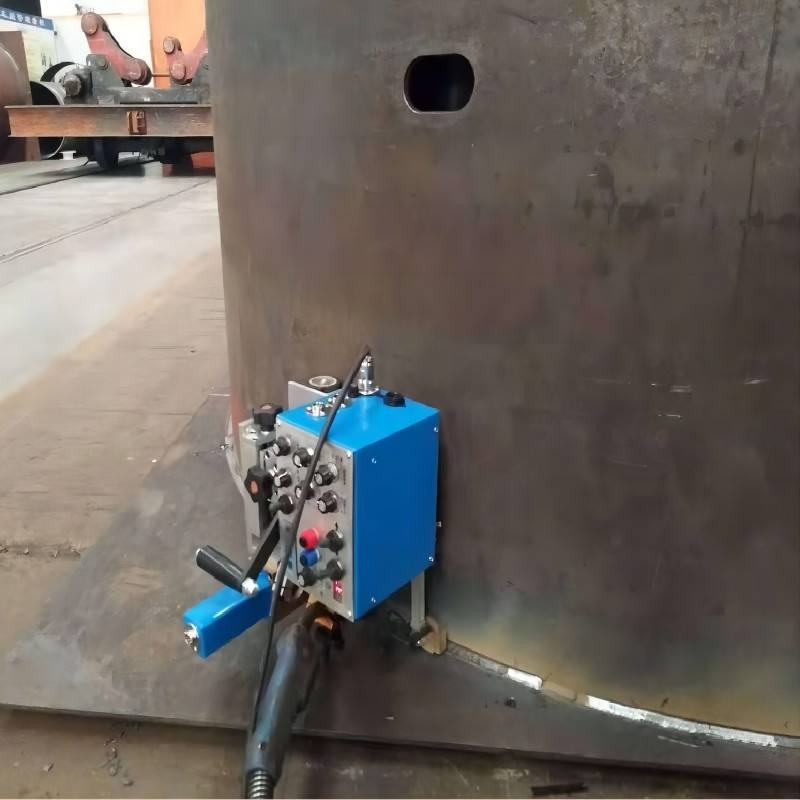
In the heavy industrial sector of shipbuilding, the efficiency of tank construction often dictates the overall project timeline. The transition from manual welding to the use of a Tank Fillet Welding Machine represents a critical shift in operational strategy. Unlike general manufacturing, shipyard environments involve vast, open structures where traditional stationary automation is impractical. The focus here is on the specialized magnetic crawler, a device designed to navigate the vertical and horizontal expanses of ship tanks with high precision and reliability.
Manual fillet welding in confined or elevated tank spaces is prone to human error, resulting in inconsistent bead profiles and potential structural vulnerabilities. By deploying a mechanized crawler, shipyards can achieve a level of consistency that manual operators cannot sustain over long shifts. This machine is engineered specifically for the Flux-Cored Arc Welding (FCAW) and Gas Metal Arc Welding (GMAW) processes common in maritime applications, ensuring deep penetration and clean fillet profiles on carbon steel and alloy plates.
The Role of Offline Programming in Field Construction
A significant advancement in this technology is the integration of Offline Programming for Shipbuilding. Historically, mechanization required tedious on-site setup and manual adjustment of the welding path. OLP allows engineers to simulate the welding sequence and parameters in a virtual environment before the equipment is even deployed to the hull or tank. This process involves mapping the tank geometry and pre-defining the travel speed, oscillation width, and torch angle based on the specific thickness of the bulkhead and hull plating.
The OLP software generates a data file that is uploaded to the crawler’s control unit. This eliminates the “trial and error” phase on the shop floor, which is particularly vital in field construction where access to resources may be limited. By pre-calculating the heat input and wire feed speed, the OLP ensures that the thermal distortion of the plates is kept within engineering tolerances, maintaining the structural integrity of the vessel.
Engineering Stability: The Magnetic Crawler Advantage
The core of this system is the Magnetic Crawler Welding unit. In the context of tank construction, stability is the most critical factor. The crawler utilizes high-strength permanent magnets or electromagnets to adhere to the steel surface, allowing it to climb vertical walls and traverse overhead sections without the need for complex rigging or track systems. This tractive force is calibrated to overcome the weight of the welding lead and the internal wire feeder, ensuring that the travel speed remains constant regardless of the orientation.
Maintaining Field Construction Stability
Field construction presents challenges such as surface irregularities, rust, and varying environmental conditions. To maintain Field Construction Stability, these machines are equipped with four-wheel drive systems and high-torque motors. The chassis is often articulated to handle the slight curvatures of the tank walls. By maintaining a constant distance between the contact tip and the work piece (CTWD), the machine stabilizes the arc voltage, which is essential for minimizing spatter and ensuring a uniform fillet throat thickness.
Furthermore, the mechanical stability of the crawler minimizes the vibration transferred to the weld pool. In manual welding, fatigue often leads to “shaking” or inconsistent travel speeds, especially in the 2F or 3F positions. The crawler’s steady motion results in a refined grain structure in the weld metal, which is crucial for passing non-destructive testing (NDT) such as ultrasonic or radiographic inspections required by maritime classification societies.
Eliminating Manual Inconsistency in High-Volume Joints
Standardizing the fillet weld is a primary objective for any industrial engineer. When thousands of meters of fillet welds are required for a single tanker, even a 5% failure rate in manual welds can lead to massive rework costs. The mechanized crawler provides a repeatable process. Once the OLP has determined the optimal parameters for a 6mm or 8mm fillet, the machine executes that exact specification across every meter of the joint. This predictability allows for more accurate material requisitioning and scheduling, as the “arc-on” time becomes a known constant rather than a variable dependent on welder stamina.
Technical Specifications and Duty Cycles
Industrial-grade tank welding machines are built for a 100% duty cycle. The internal electronics are shielded against the high-frequency interference and the harsh dust levels found in shipyards. Most crawlers operate on a 24V or 48V DC system for safety, while the welding power source provides the necessary current for high-deposition FCAW. The oscillation units are capable of widths up to 30mm, allowing the machine to perform multi-pass welds or large single-pass fillets in a single traverse.
Data-Driven Workflow Integration
The shift towards a data-driven shipyard involves more than just the physical weld. The control units of these machines can log data such as total wire consumed, average current, and total arc time. This information is fed back into the shipyard’s PLM (Product Lifecycle Management) system. By analyzing this data against the OLP predictions, engineers can identify bottlenecks in the construction process, such as excessive setup times or surface preparation issues that cause the crawler to slip or stop.
Operational Efficiency and Labor Allocation
The implementation of a Tank Fillet Welding Machine does not eliminate the need for skilled labor but rather reallocates it. A single operator can monitor two or three crawlers simultaneously, significantly increasing the “inches per minute” output per man-hour. This is essential in a global market where shipyard capacity is often limited by the availability of certified welders. The operator focuses on setup, monitoring the arc through a specialized shield or camera, and ensuring the wire supply is replenished, while the machine handles the grueling task of maintaining the weld path.
Moreover, the safety profile of the shipyard is improved. Welders are removed from the immediate vicinity of the welding fumes and intense UV radiation. In the tight confines of a double-bottom tank or a wing tank, reducing the number of personnel required to be physically present at the weld joint simplifies ventilation requirements and reduces the risk of workplace injuries.
Conclusion: The Strategic Impact on Maritime Engineering
For the industrial engineer, the choice to invest in mechanized tank fillet welding is driven by the need for measurable quality and throughput. By combining the physical robustness of the magnetic crawler with the digital precision of offline programming, shipyards can overcome the inherent challenges of field construction. This system ensures that every fillet weld meets the rigorous standards of the industry while optimizing the use of resources. As vessel designs become more complex and delivery timelines shorten, the move toward such mechanized, software-supported welding solutions is not just an advantage—it is a necessity for modern maritime manufacturing.
-


LT240S tube laser cutting machine
-
LT120S tube laser cutting machine
-
Sale

Tank Fillet Welding Machine
Original price was: $1,000.00.$900.00Current price is: $900.00. -
Sale

MAK100 tube laser cutting machine
Original price was: $5,500.00.$5,000.00Current price is: $5,000.00. -

portable plasma air cutting machine
$1,200.00 -

2in1 fiber laser cutting machine
-

Air cooling Laser welding machine
-

HF h beam laser cutting machine
-

LT240 laser cutting machine
-

Laser welding machine
-


Cobotic Welding Station
-

Gantry welding robot solution
-

Tracked Wheeled AGV Welding robot
-

LFH6020 Fiber laser cutting machine
-
LFP6020
-

robotic welidng machine
