Optimization of Tank Fillet Welding via Magnetic Crawler Systems
In the heavy industrial sector, the fabrication of large-scale pressure vessels and storage tanks presents unique logistical and structural challenges. Traditional manual welding methods, while flexible, often suffer from inconsistencies in travel speed and bead morphology, leading to increased rework and non-destructive testing (NDT) failures. To address these inefficiencies, industrial engineering standards now favor the implementation of tank fillet welding systems utilizing mechanized magnetic crawlers. These systems are designed to provide a stable, repeatable platform for Gas Metal Arc Welding (GMAW) and Flux-Cored Arc Welding (FCAW) in field environments where traditional fixed automation is impractical.
The core of this technology lies in the magnetic traction mechanism. Unlike track-mounted systems that require the time-consuming installation of rigid guide rails, magnetic crawlers utilize high-intensity permanent magnets or electromagnets to adhere directly to the carbon steel shell of the vessel. This allows the machine to traverse vertical, horizontal, and overhead planes with high positional accuracy. For fillet welds—specifically those joining the tank floor to the shell or internal reinforcements—the crawler provides a consistent torch angle and standoff distance, which are critical for maintaining the required throat thickness and leg length.
Mechanical Stability in Field Construction
Field construction environments are inherently volatile. Factors such as wind gusts, surface irregularities on hot-rolled steel plates, and varying ambient temperatures can compromise weld quality. A magnetic crawler welding system mitigates these risks through mechanical damping and high-torque drive motors. The magnetic flux density is calibrated to ensure that the carriage remains seated against the work surface even when carrying a full payload of wire feeders and oscillating torch heads.
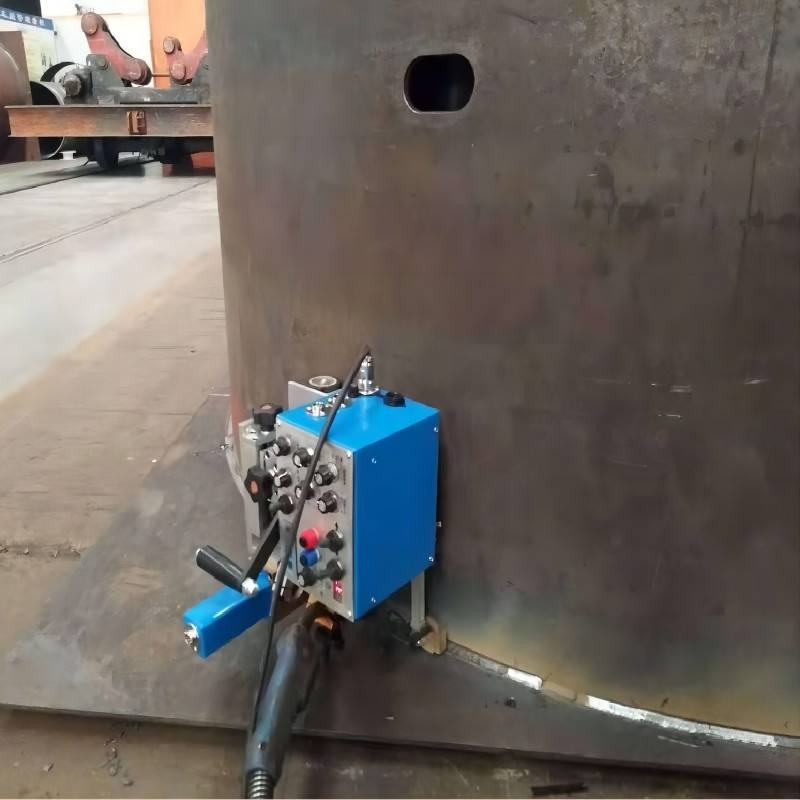
Industrial engineers must consider the “slip-to-pull” ratio of these machines. A well-engineered crawler maintains a constant velocity, which is the primary determinant of heat input (kJ/mm). By stabilizing the travel speed, the machine ensures a uniform Heat Affected Zone (HAZ), reducing the risk of hydrogen-induced cracking in high-tensile pressure vessel steels. Furthermore, the use of four-wheel drive configurations with independent suspension allows the crawler to navigate slight plate misalignments and weld reinforcements without deviating from the programmed path.
Offline Programming for Mechanized Carriages
While often associated with high-end robotics, offline programming (OLP) has become a vital tool for non-robotic mechanized welding crawlers. In the context of pressure vessel fabrication, OLP involves the creation of a digital twin of the tank geometry. Engineers use this data to calculate the exact circumference, plate thickness variations, and nozzle intersections before the machine ever touches the steel.
The OLP workflow for a Tank Fillet Welding Machine follows a structured sequence:
1. Geometry Input: Importing CAD data of the vessel shell and floor plates.
2. Path Generation: Defining the fillet weld trajectory, including start/stop points and crater fill sequences.
3. Parameter Assignment: Linking travel speed, wire feed speed, and oscillation width to specific segments of the path.
4. Simulation: Running a digital collision check to ensure the torch and crawler body clear all structural stiffeners.
5. Data Transfer: Exporting the motion control code to the crawler’s PLC (Programmable Logic Controller) via ruggedized industrial interfaces.
This approach eliminates the “trial and error” phase on-site. Operators no longer need to spend hours manually jogging the machine to set limits. Instead, the crawler is placed on a reference point, and the pre-programmed cycle is executed. This precision is particularly beneficial for multi-pass fillet welds, where the placement of subsequent beads must be exact to ensure proper fusion and slag removal.
Enhancing Weld Deposition and Duty Cycle
The primary economic driver for adopting mechanized fillet welding is the significant increase in the duty cycle. Manual welders typically achieve a 20-30% arc-on time due to fatigue, repositioning, and environmental factors. In contrast, a magnetic crawler system can maintain a duty cycle exceeding 70%. Because the machine handles the weight of the torch and lead assembly, the operator’s role shifts from manual labor to process monitoring and quality assurance.
By utilizing pressure vessel fabrication software to optimize the welding parameters, engineers can push the limits of deposition rates. For instance, the use of large-diameter flux-cored wires in a mechanized setup allows for higher current densities that would be difficult for a human to control manually. This results in deeper penetration and the ability to complete large fillet profiles in fewer passes, directly reducing the total man-hours per vessel.
Integration of Torch Oscillation and Tracking
To achieve high-quality fillet welds on heavy-wall vessels, torch oscillation is essential. Mechanized crawlers are equipped with motorized cross-slides that allow for linear or radial oscillation. This movement helps in wetting the edges of the joint, preventing undercut and ensuring a flat or slightly convex bead profile. Through offline programming, the width, frequency, and “dwell time” at the edges of the oscillation can be customized based on the material thickness and welding position.
Additionally, while the crawler follows a pre-programmed path, real-time adjustments are often necessary to account for minor fit-up variations. Tactile or inductive seam tracking sensors can be integrated into the system. These sensors provide feedback to the control unit, making micro-adjustments to the torch position to keep it centered in the joint root. This synergy between “pre-planned” offline data and “real-time” sensing represents the current pinnacle of mechanized field welding technology.
Safety and Quality Compliance
From an industrial engineering perspective, safety and compliance are non-negotiable. Tank fillet welding machines significantly reduce the exposure of personnel to hazardous welding fumes and intense UV radiation. By allowing the operator to stand several meters away from the arc, the risk of long-term occupational health issues is minimized. Furthermore, the digital logging capabilities of modern crawler systems provide a comprehensive record of every weld. Parameters such as voltage, amperage, and travel speed are recorded against a timestamp, creating a “digital birth certificate” for each pressure vessel. This data is invaluable during the final inspection and for meeting ASME or ISO quality standards.
Conclusion
The transition from manual welding to mechanized magnetic crawler systems represents a fundamental shift in how pressure vessels are constructed in the field. By focusing on the mechanical stability of the carriage and the precision of offline programming, manufacturers can achieve levels of productivity and quality that were previously unattainable. The elimination of manual inconsistency, combined with the high deposition rates of optimized GMAW/FCAW processes, ensures that large-scale tank fabrication remains competitive, safe, and structurally sound. As the industry moves toward greater digitalization, the role of the industrial engineer in pre-planning and system calibration will continue to be the cornerstone of successful field welding operations.
-


LT240S tube laser cutting machine
-
LT120S tube laser cutting machine
-
Sale

Tank Fillet Welding Machine
Original price was: $1,000.00.$900.00Current price is: $900.00. -
Sale

MAK100 tube laser cutting machine
Original price was: $5,500.00.$5,000.00Current price is: $5,000.00. -

portable plasma air cutting machine
$1,200.00 -

2in1 fiber laser cutting machine
-

Air cooling Laser welding machine
-

HF h beam laser cutting machine
-

LT240 laser cutting machine
-

Laser welding machine
-


Cobotic Welding Station
-

Gantry welding robot solution
-

Tracked Wheeled AGV Welding robot
-

LFH6020 Fiber laser cutting machine
-
LFP6020
-

robotic welidng machine
