The Engineering Mandate for Precision in LNG Tank Construction
Liquefied Natural Gas (LNG) storage tanks represent one of the most demanding challenges in modern structural engineering. These facilities, often exceeding 160,000 cubic meters in capacity, rely on the integrity of 9% nickel steel or specialized stainless steel alloys to maintain structural stability at cryogenic temperatures reaching -162 degrees Celsius. Within this context, the fillet welds—particularly those connecting the shell plates to the annular plates and the internal stiffening rings—are critical failure points if not executed with absolute precision. The shift toward LNG tank construction automation is driven by the need to eliminate human error, reduce rework, and manage the logistics of massive field sites.
Traditional manual welding in these environments is plagued by inconsistent heat input and variable travel speeds, which can lead to lack of fusion or excessive grain growth in the heat-affected zone (HAZ). Industrial engineers are now specifying mechanized Tank Fillet Welding Machines that utilize magnetic adhesion to provide a stable, repeatable platform for high-deposition processes like Flux-Cored Arc Welding (FCAW). By moving away from manual manipulation and toward specialized mechanized crawlers, the industry is achieving a level of metallurgical consistency previously unattainable in field conditions.
Mechanics of Magnetic Crawler Stability in Field Environments
The primary challenge of field-based welding is the lack of a controlled environment. Wind, uneven plate fit-up, and gravity work against the welding arc. A magnetic crawler welding system solves these issues through high-force permanent magnets or electromagnets integrated into the machine’s chassis. These magnets ensure that the welding torch maintains a constant distance from the joint, regardless of vertical or overhead orientation. This is vital for maintaining a consistent electrical stick-out, which directly influences the stability of the arc and the depth of penetration.
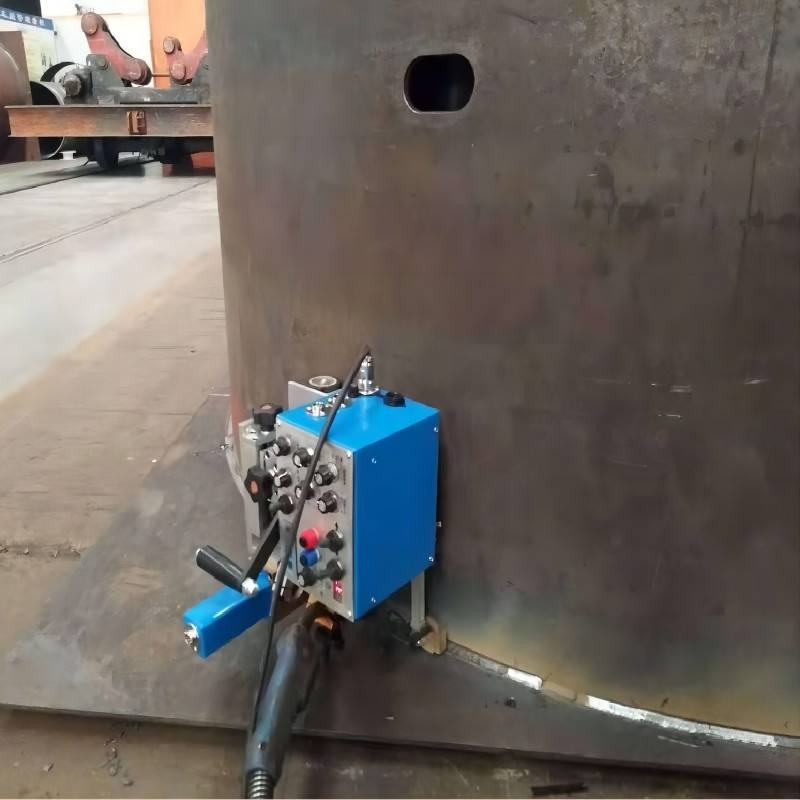
From a mechanical perspective, these machines are designed with a low center of gravity and high-torque stepper motors. The drive system must overcome the friction of the magnetic pull while providing smooth, jitter-free movement at speeds as low as 100mm per minute or as high as 1000mm per minute. In LNG projects, where plate thickness can vary significantly, the crawler’s ability to maintain its path along the curved shell plates without slipping is the foundation of a high-quality fillet weld. The stability provided by magnetic adhesion also allows for the use of multi-torch configurations, effectively doubling the deposition rate without doubling the footprint of the equipment.
Offline Programming: Bridging the Gap Between CAD and Construction
While industrial robots are common in factory settings, their use in the field for LNG tanks is often hindered by the sheer size of the workpieces and the lack of precision in site-wide tolerances. This is where offline programming (OLP) for mechanized crawlers becomes a force multiplier. OLP allows engineers to simulate the welding sequence based on the tank’s digital twin or CAD model before the machine ever touches the steel.
Instead of a technician spending hours on-site manually “teaching” the machine every corner and curve, the OLP system generates a data packet containing travel speeds, oscillation widths, and dwell times tailored to the specific plate geometry. This data is uploaded to the crawler’s PLC (Programmable Logic Controller) via a ruggedized interface. This approach ensures that the welding parameters are optimized for heat management—essential for maintaining the toughness of 9% nickel steel—while maximizing the duty cycle of the machine. The operator’s role shifts from a manual welder to a systems monitor, overseeing the execution of a pre-validated digital weld procedure.
Fillet Weld Optimization: Parameters and Metallurgy
The fillet welds in LNG tanks are often subject to rigorous non-destructive testing (NDT), including vacuum box testing and ultrasonic inspection. To pass these tests on the first attempt, the machine must control the weld bead profile with extreme accuracy. A mechanized system allows for the precise synchronization of wire feed speed and travel speed, ensuring that the fillet leg length meets the design specification without over-welding. Over-welding is not just a waste of consumables; in LNG projects, it introduces unnecessary heat into the plates, which can degrade the cryogenic properties of the base metal.
The fillet weld automation system utilizes specialized sensors to track the joint in real-time. Even with Offline Programming, minor variations in plate fit-up occur. The machine’s integrated seam tracking system compensates for these deviations by making micro-adjustments to the torch position. This hybrid approach—combining the pre-planned path from OLP with real-time tactile or inductive tracking—guarantees that the arc remains centered in the root of the joint. For multi-pass fillet welds, the machine can be programmed to shift its offset automatically for each layer, creating a uniform stack of beads that ensures maximum throat thickness and structural integrity.
Enhancing Deposition Rates and Operational Efficiency
Efficiency in LNG construction is measured by the “arc-on” time. Manual welding typically sees a duty cycle of 30-40% due to welder fatigue and the need for frequent stops to reposition. Mechanized magnetic crawlers can achieve duty cycles exceeding 70-80%. Because the machine does not suffer from fatigue and can handle larger spools of wire (up to 25kg), the number of stops and starts is drastically reduced. In welding, every start and stop is a potential defect location; therefore, longer continuous runs inherently improve the quality of the tank shell.
Furthermore, the use of offline programming enables “just-in-time” welding. As soon as a section of the tank is tacked into place, the welding machine can be deployed with the correct parameters already loaded. This reduces the bottleneck at the inspection phase, as the consistency of the mechanized welds allows for a more predictable NDT schedule. Industrial engineers can forecast completion dates with much higher accuracy when the welding variables are controlled by a digital system rather than the variable performance of a manual workforce.
Site Safety and Risk Mitigation
The safety profile of an LNG construction site is improved when mechanized welding is prioritized. By utilizing magnetic crawlers, the need for extensive scaffolding is reduced, as the machine can operate in positions that would be precarious for a manual welder. Operators can remain at a safe distance from the welding fumes and the intense UV radiation of the arc, controlling the process through a remote pendant. This ergonomic advantage leads to fewer workplace injuries and allows for continuous operation even in the high-temperature environments often found at LNG project sites in tropical or desert regions.
In summary, the integration of magnetic crawler stability with offline programming represents the pinnacle of fillet weld automation for the LNG sector. By focusing on mechanized precision and digital workflow integration, industrial engineers can meet the dual demands of high-speed construction and uncompromising cryogenic safety standards. The transition from manual artistry to engineered mechanized processes is no longer an option but a requirement for the next generation of global energy infrastructure.
-


LT240S tube laser cutting machine
-
LT120S tube laser cutting machine
-
Sale

Tank Fillet Welding Machine
Original price was: $1,000.00.$900.00Current price is: $900.00. -
Sale

MAK100 tube laser cutting machine
Original price was: $5,500.00.$5,000.00Current price is: $5,000.00. -

portable plasma air cutting machine
$1,200.00 -

2in1 fiber laser cutting machine
-

Air cooling Laser welding machine
-

HF h beam laser cutting machine
-

LT240 laser cutting machine
-

Laser welding machine
-


Cobotic Welding Station
-

Gantry welding robot solution
-

Tracked Wheeled AGV Welding robot
-

LFH6020 Fiber laser cutting machine
-
LFP6020
-

robotic welidng machine
