Optimization of Wind Tower Longitudinal and Circumferential Joins
In the industrial production of wind towers, the efficiency of Fillet Welding at the base flange and internal stiffeners determines the overall throughput of the assembly line. Wind towers consist of large-diameter cylindrical sections that require high-integrity welds to withstand cyclical aerodynamic loads. Traditional manual welding methods often result in inconsistent bead profiles and excessive heat input, which can lead to metallurgical deformation. The adoption of a specialized fillet welding machine designed for heavy-duty tank applications addresses these variables by providing a mechanized platform for continuous deposition.
The engineering objective in wind tower fabrication is to maximize the deposition rate while minimizing the volume of filler metal. Standard fillet geometries often lead to over-welding, increasing both material costs and labor hours. By utilizing mechanized crawlers, engineers can achieve precise torch positioning, ensuring that the weld throat thickness meets structural specifications without unnecessary reinforcement.
Mechanical Dynamics of the Magnetic Crawler
The core component of a field-stable welding system is the magnetic crawler. Unlike track-based systems that require time-consuming setup and rigging, a magnetic crawler utilizes high-intensity permanent magnets to adhere directly to the steel surface of the wind tower section. This adhesion is critical for maintaining a constant distance between the welding torch and the workpiece, especially when navigating the curved surfaces of large-diameter shells.
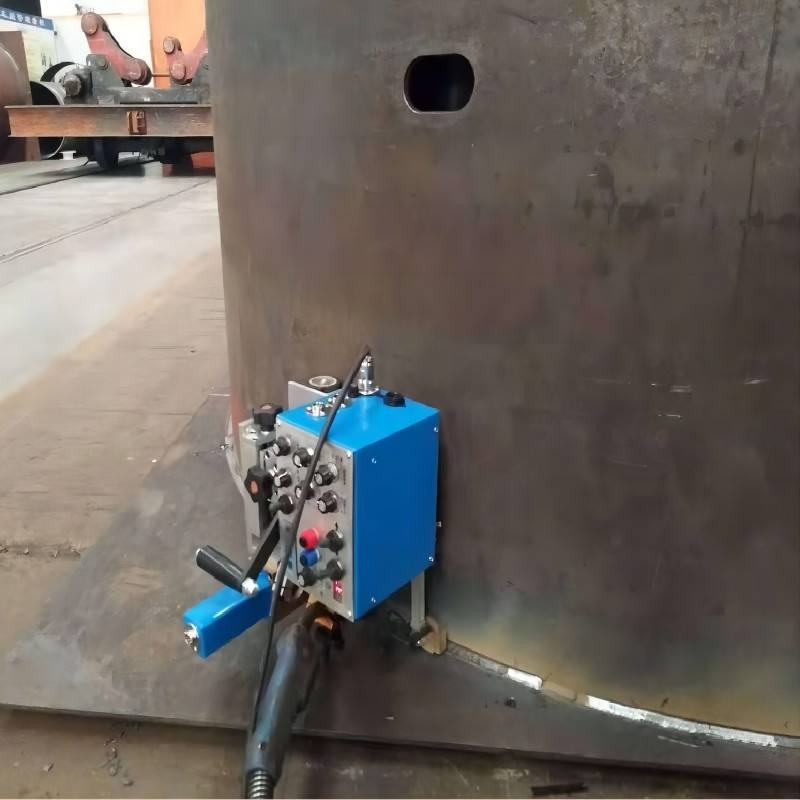
From an industrial engineering perspective, the traction system must provide high torque at low speeds to ensure a uniform travel rate. Any fluctuation in travel speed directly impacts the heat input per unit length (kJ/mm), which affects the grain structure of the heat-affected zone (HAZ). Modern crawlers incorporate four-wheel drive systems with heat-resistant silicone or rubber-coated wheels to prevent slippage on smooth or primed surfaces. The integration of an integrated encoder allows for real-time feedback, maintaining a constant velocity even when moving vertically or in overhead positions during field construction.
Implementation of Narrow Gap Welding Techniques
Narrow gap welding is a process optimization strategy that reduces the groove angle of the weld preparation. In wind tower fabrication, this is particularly effective for thick-walled sections where a standard V-groove would require significant amounts of wire and shielding gas. By narrowing the gap, the total volume of the weld metal is reduced by up to 40% in some applications.
To execute narrow gap fillet welds effectively, the welding machine must be capable of precise oscillation and deep penetration. The use of Flux-Cored Arc Welding (FCAW) or Gas Metal Arc Welding (GMAW) in a narrow gap configuration requires specialized gas nozzles that can reach deep into the joint without compromising gas shielding. The mechanized crawler ensures the torch remains centered in the narrow groove, preventing sidewall lack-of-fusion defects that are common in manual narrow gap attempts. This precision is vital for the wind tower fabrication process, where ultrasonic testing (UT) and radiographic testing (RT) standards are stringent.
Field Construction Stability and Environmental Adaptation
Field construction presents challenges that are not found in controlled shop environments. Wind towers are often assembled in areas with high wind speeds and varying ambient temperatures. A portable Tank Fillet Welding Machine must be ruggedized to withstand these conditions. The stability of the machine is not just about its grip on the tower, but also its resistance to vibration and external mechanical interference.
The weight distribution of the crawler is engineered to keep the center of gravity low, preventing the unit from tipping when the torch arm is fully extended. Furthermore, the control systems are often housed in weather-sealed enclosures to prevent moisture and dust ingress. In the field, the stability of the arc is maintained through sophisticated power source communication, but the physical stability of the machine on the steel shell is what allows for the deposition of multi-pass welds without the need for constant recalibration by the operator.
Thermal Management and Structural Integrity
One of the primary concerns in welding large steel structures is the management of thermal distortion. Excessive heat can cause the cylindrical sections of the wind tower to lose their roundness, making the fit-up of subsequent sections difficult. Mechanized narrow gap welding minimizes the total heat input because the process is faster and requires fewer passes to fill the joint.
By controlling the interpass temperature through regulated travel speeds, the magnetic crawler helps maintain the mechanical properties of the base metal. Industrial engineers monitor the cooling rate (t8/5 time) to ensure that the martensitic transformation does not result in brittleness. The consistency of the mechanized approach ensures that the thermal profile is predictable across the entire circumference of the tower, allowing for more accurate post-weld inspections and a higher pass rate for quality audits.
Throughput Analysis and Economic Impact
The transition from manual or semi-automatic welding to a fully mechanized magnetic crawler system represents a significant capital expenditure that is justified by the increase in duty cycle. A manual welder may have a duty cycle of 20-30% due to fatigue and the need for frequent repositioning. In contrast, a mechanized crawler can operate at a duty cycle exceeding 70%, stopping only for wire spool changes or repositioning between major sections.
When calculating the Return on Investment (ROI), engineers consider the reduction in filler metal mass, the decrease in grinding and post-weld cleanup, and the elimination of scaffolding in many scenarios. Because the crawler “climbs” the structure, the need for extensive work platforms is reduced, enhancing site safety and lowering indirect costs. In the context of global wind energy expansion, the ability to rapidly deploy stable, high-quality welding units in the field is a competitive advantage for fabricators.
Conclusion
The integration of magnetic crawler-based welding machines into wind tower production represents a mature technological solution for modern infrastructure challenges. By focusing on the mechanical stability of the platform and the efficiency of the narrow gap process, fabricators can achieve high-deposition rates without sacrificing the metallurgical quality of the fillet welds. As tower heights increase and plate thicknesses grow, the reliance on stable, mechanized field construction tools will only become more critical for the industrial engineering community.
-


LT240S tube laser cutting machine
-
LT120S tube laser cutting machine
-
Sale

Tank Fillet Welding Machine
Original price was: $1,000.00.$900.00Current price is: $900.00. -
Sale

MAK100 tube laser cutting machine
Original price was: $5,500.00.$5,000.00Current price is: $5,000.00. -

portable plasma air cutting machine
$1,200.00 -

2in1 fiber laser cutting machine
-

Air cooling Laser welding machine
-

HF h beam laser cutting machine
-

LT240 laser cutting machine
-

Laser welding machine
-


Cobotic Welding Station
-

Gantry welding robot solution
-

Tracked Wheeled AGV Welding robot
-

LFH6020 Fiber laser cutting machine
-
LFP6020
-

robotic welidng machine
