Technical Optimization of Wind Tower Base Fillet Welds
In the heavy fabrication industry, specifically concerning wind tower production, the integrity of the fillet welds connecting the base flange to the main shell section is paramount. These structures must withstand multi-axial fatigue loading over a 25-year lifecycle. Industrial engineering standards dictate a shift toward narrow gap Fillet Welding to minimize the volume of filler metal required while ensuring deep root penetration. Traditional welding methods often result in excessive overweld, which increases consumable costs and thermal distortion. By utilizing specialized Tank Fillet Welding Machines, engineers can precisely control the arc voltage and travel speed to maintain a consistent throat thickness across the entire circumference of the tower section.
Mechanical Architecture of Magnetic Crawler Systems
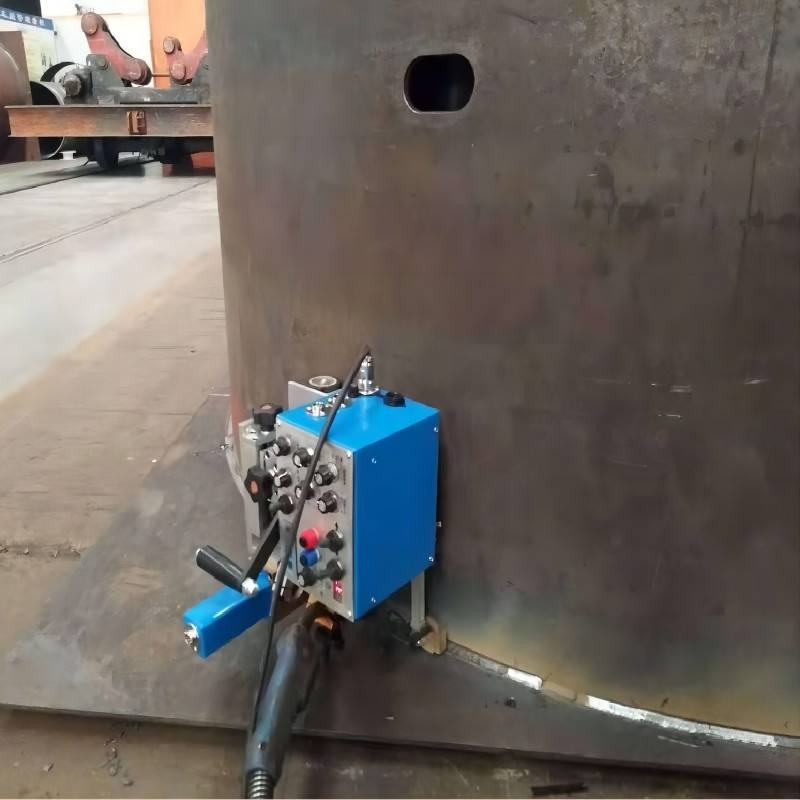
The primary challenge in field construction for wind towers is maintaining stability on curved, vertical, or overhead surfaces. The magnetic crawler welding carriage solves this by utilizing high-flux permanent magnets or switchable electromagnets integrated into the drive chassis. This magnetic adhesion generates sufficient friction to prevent slippage on the steel surface, even when the machine is carrying the weight of the welding torch, wire feeder, and flux recovery hoses. Unlike track-based systems that require time-consuming setup and rail mounting, the trackless magnetic crawler follows the joint geometry directly, reducing the non-productive time associated with machine positioning.
The drive system typically employs a four-wheel independent drive configuration with heat-resistant silicone or specialized rubber coatings. This ensures that the machine can traverse over minor surface irregularities or weld spatter without losing alignment. For wind tower applications, where the plate thickness can exceed 50mm, the stability of the crawler allows for the use of heavy-duty Submerged Arc Welding (SAW) or Gas Metal Arc Welding (GMAW) torches without mechanical vibration affecting the bead morphology.
Narrow Gap Parameters and Heat Input Management
Narrow gap techniques in fillet welding focus on reducing the included angle of the joint or optimizing the torch position to reach the root of the fillet with minimal passes. In wind tower fabrication, this is achieved by adjusting the torch angle relative to the vertical web and the horizontal flange. The welding machine provides fine-tuned oscillation controls, allowing the operator to bridge the gap effectively while maintaining a stable molten pool. Control of the heat-affected zone (HAZ) is a critical metric for industrial engineers; by increasing travel speed through automation, the total energy input per unit length is reduced, which preserves the metallurgical properties of the high-strength low-alloy (HSLA) steels typically used in tower construction.
Specific parameters for a narrow gap fillet weld in this context often involve a current range of 450A to 650A for SAW processes. The magnetic crawler ensures that the contact tip-to-work distance (CTWD) remains constant, which is essential for maintaining arc stability and preventing porosity. By automating the travel, the machine eliminates the variability of manual welding, resulting in a 98% pass rate for ultrasonic and radiographic testing.
Field Construction Stability and Environmental Resilience
Wind tower sections are frequently assembled in coastal or high-wind environments where traditional shielding gas coverage can be compromised. The design of wind tower fabrication crawlers often incorporates integrated wind shields or utilizes the Submerged Arc process, where the granulated flux provides a physical barrier against atmospheric contamination. The mechanical stability of the magnetic crawler is tested against the gravity-induced torque generated when the machine moves along the internal circumference of the tower. High-torque stepper motors provide the necessary power to maintain a constant velocity, which is critical for uniform weld penetration.
Furthermore, the integration of a flux recovery system on the crawler allows for the continuous recycling of unused granulates. This is not merely an environmental consideration but an economic one, as it reduces material waste and keeps the work area clear of debris that could interfere with the crawler’s drive wheels. The closed-loop control system of the machine monitors the load on the motors, providing real-time feedback to the operator if the machine encounters resistance, thereby preventing weld defects caused by inconsistent travel.
Enhancing Deposition Rates with Multi-Pass Logic
While the goal is to minimize the number of passes through narrow gap design, large-scale fillet welds in base sections still require multiple layers to reach the specified leg length. The tank fillet welding machine is programmed with offset memory, allowing it to execute subsequent passes with precise positioning relative to the first bead. This level of repeatability is unattainable through manual methods. By optimizing the deposition rate—often reaching 15kg/h or more in SAW configurations—the cycle time for a single tower section is reduced by approximately 40% compared to semi-automated hand-held operations.
Quality Assurance and Industrial Standards
The implementation of submerged arc welding efficiency via magnetic crawlers aligns with international standards such as AWS D1.1 and ISO 5817. The machine’s ability to log data, including voltage, amperage, and travel speed, provides a digital record of the weld procedure specification (WPS) compliance. This data is essential for the structural health monitoring of the wind tower, as any deviation in the welding parameters could lead to premature fatigue cracking. By removing the human element from the primary travel and oscillation functions, the industrial engineer ensures that the structural integrity of the base joint is governed by calibrated mechanical precision rather than variable operator skill.
In summary, the transition to magnetic crawler-based narrow gap welding represents a significant advancement in the efficiency of wind tower assembly. The focus on mechanical adherence, precision motion control, and optimized thermal management allows for the production of high-quality fillet welds that meet the rigorous demands of the renewable energy sector. By prioritizing these automated systems, fabrication facilities can increase their throughput while maintaining the highest levels of safety and weld reliability in field-based construction environments.
-


LT240S tube laser cutting machine
-
LT120S tube laser cutting machine
-
Sale

Tank Fillet Welding Machine
Original price was: $1,000.00.$900.00Current price is: $900.00. -
Sale

MAK100 tube laser cutting machine
Original price was: $5,500.00.$5,000.00Current price is: $5,000.00. -

portable plasma air cutting machine
$1,200.00 -

2in1 fiber laser cutting machine
-

Air cooling Laser welding machine
-

HF h beam laser cutting machine
-

LT240 laser cutting machine
-

Laser welding machine
-


Cobotic Welding Station
-

Gantry welding robot solution
-

Tracked Wheeled AGV Welding robot
-

LFH6020 Fiber laser cutting machine
-
LFP6020
-

robotic welidng machine
