Optimizing Wind Tower Integrity via Mechanized Narrow Gap Fillet Welding
In the current landscape of renewable energy infrastructure, Wind Tower Fabrication demands an unprecedented level of structural consistency and throughput efficiency. As tower heights increase and plate thicknesses exceed 50mm, traditional manual welding processes reach their limits regarding deposition rates and ergonomic sustainability. The transition to mechanized Tank Fillet Welding Machines, specifically those utilizing narrow gap configurations and magnetic crawler stability, represents a critical shift in industrial engineering strategy. This shift is not merely about speed; it is about the precise control of the heat-affected zone (HAZ) and the reduction of total weld metal volume.
The Mechanics of Narrow Gap Geometry in Fillet Joints
Narrow gap welding (NGW) is traditionally associated with butt joints, yet its application in fillet welding for large-diameter tanks and wind tower flanges provides significant economic advantages. In standard fillet applications, the volume of the weld increases quadratically with the leg length. By utilizing a Narrow Gap Welding technique, the joint preparation is modified to allow for a deeper, slimmer weld profile with a reduced bevel angle. This geometry minimizes the number of passes required to achieve the necessary throat thickness.
From an industrial engineering perspective, the reduction in groove volume translates directly to lower consumables cost. However, the technical challenge lies in ensuring root penetration. A specialized tank fillet machine must maintain a consistent arc position within a tight space. This requires a mechanized torch oscillation system that can provide side-wall fusion without excessive heat build-up, which would otherwise compromise the metallurgical properties of the high-strength low-alloy (HSLA) steels typically used in wind tower sections.
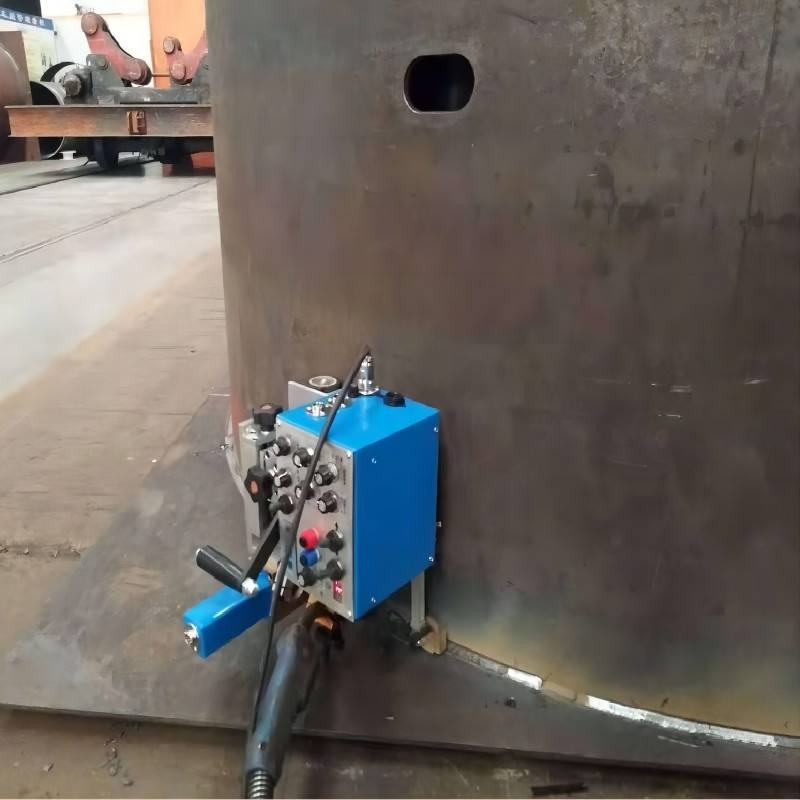
Magnetic Crawler Systems: Stability in Field Construction
Wind tower fabrication often occurs in large-scale assembly shops or on-site field environments where floor space is at a premium and workpiece positioning is fixed. Unlike shop-based rotators that turn the workpiece, a Magnetic Crawler moves the welding head around the stationary tower section. The stability of this crawler is the pivot point of the entire operation. These machines utilize high-power permanent magnets or switchable electromagnets to adhere to the curved surface of the tower shell.
Adhesion Physics and Surface Traction
The reliability of the crawler depends on the magnetic flux density and the friction coefficient of the drive wheels. In field construction, towers are often exposed to varying environmental conditions, including humidity and surface oxidation. A robust magnetic carriage must provide enough pull-off force to carry the weight of the wire feeder, the torch, and the cable harness, even when operating in a vertical or overhead orientation. Industrial engineers must specify crawlers with a safety factor of at least 3:1 regarding magnetic adhesion to prevent equipment detachment during critical welding sequences.
Consistency Through Mechanized Travel
Manual welding is subject to operator fatigue, which manifests as variations in travel speed and torch angle. A mechanized crawler eliminates these variables. By setting a precise travel speed (typically measured in mm/min), the heat input is held constant. In wind tower fabrication, maintaining a low and steady heat input is vital for preserving the toughness of the grain structure. The crawler’s ability to maintain a steady velocity ensures that the bead morphology remains uniform, which is a prerequisite for passing rigorous ultrasonic or radiographic testing.
Submerged Arc and Gas-Shielded Process Integration
While various welding processes can be mounted on a magnetic crawler, Submerged Arc Welding (SAW) remains the preferred choice for heavy-duty tank fillet applications due to its high deposition rates and excellent slag detachability. When configured for narrow gap applications, SAW provides a deep-penetrating arc that is shielded by a layer of granular flux. This flux not only protects the puddle from atmospheric contamination but also acts as a thermal insulator, slowing the cooling rate and reducing the risk of hydrogen-induced cracking.
Management of Flux and Slag
In a vertical or circumferential fillet weld, flux management becomes a logistical hurdle. Industrial engineering solutions involve integrated flux recovery systems that follow the crawler. These systems use vacuum pressure to reclaim unused flux, recirculating it back to the hopper. For the narrow gap profile, the slag must be formulated for easy detachment; if slag becomes trapped in the tight confines of the groove, it leads to inclusions that require costly rework. Choosing the correct flux-wire combination is as critical as the mechanical hardware of the machine itself.
Alternative: Gas Metal Arc Welding (GMAW)
For thinner sections or internal stiffeners where SAW flux management is impractical, gas-shielded processes are employed. In these scenarios, the magnetic crawler must be equipped with sophisticated gas shielding shrouds to prevent turbulence. The narrow gap approach in GMAW requires a pulse-spray transfer mode to minimize spatter and ensure side-wall wetting. The machine’s control interface must allow the operator to fine-tune voltage and wire feed speed in real-time to compensate for fit-up variations common in large-scale fabrications.
Operational Efficiency and ROI Analysis
The implementation of a tank fillet welding machine is a capital-intensive decision that must be justified through a return on investment (ROI) analysis. The primary drivers of ROI in this context are duty cycle improvements and the reduction of repair rates. A manual welder may have a duty cycle (arc-on time) of 20-30% due to the need for repositioning and cleaning. A mechanized magnetic crawler can reach duty cycles of 70-80%.
Reduction in Total Weld Volume
By narrowing the gap, the volume of deposited metal can be reduced by 30% to 50% depending on the plate thickness. For a standard wind tower containing several hundred meters of fillet welds, the savings in wire and flux are substantial. Furthermore, fewer passes mean less time spent on inter-pass cleaning and less total heat input into the structure, which reduces the risk of longitudinal distortion. Engineers can calculate the “break-even” point by comparing the cost of the mechanized system against the labor hours saved and the reduction in consumable overhead.
Stability and Safety in the Work Environment
Safety is a non-negotiable metric in industrial engineering. Mechanizing the welding process removes the operator from the immediate vicinity of the arc and the associated fumes. By using a remote-control pendant, the technician can monitor the weld from a distance, reducing exposure to ultraviolet radiation and respiratory hazards. The stability provided by the magnetic crawler also eliminates the need for complex scaffolding or temporary tack-welded tracks, further streamlining the job site and reducing the risk of falls or structural damage to the tower shell.
Conclusion: The Future of Heavy-Duty Fabrication
The integration of narrow gap technology with magnetic crawler mobility represents the current peak of efficiency for wind tower tank fillet welding. By focusing on mechanical stability and optimized joint geometry, manufacturers can achieve the high-quality standards required for the energy sector while significantly lowering production costs. As the industry moves toward even larger turbine designs, the reliance on mechanized, stable, and high-deposition welding systems will only increase. The industrial engineer’s role is to ensure that these systems are calibrated for the specific metallurgical and geometric demands of the project, ensuring long-term structural reliability in the field.
-


LT240S tube laser cutting machine
-
LT120S tube laser cutting machine
-
Sale

Tank Fillet Welding Machine
Original price was: $1,000.00.$900.00Current price is: $900.00. -
Sale

MAK100 tube laser cutting machine
Original price was: $5,500.00.$5,000.00Current price is: $5,000.00. -

portable plasma air cutting machine
$1,200.00 -

2in1 fiber laser cutting machine
-

Air cooling Laser welding machine
-

HF h beam laser cutting machine
-

LT240 laser cutting machine
-

Laser welding machine
-


Cobotic Welding Station
-

Gantry welding robot solution
-

Tracked Wheeled AGV Welding robot
-

LFH6020 Fiber laser cutting machine
-
LFP6020
-

robotic welidng machine
