Mechanical Engineering Specifications for Tank Fillet Welding
In the fabrication of utility-scale wind towers, the structural integrity of the base and flange connections is paramount. The industry is shifting away from manual processes toward narrow gap welding to address the challenges of thick-plate joining. For wind tower sections, which often exceed 50mm in thickness at the base, traditional fillet welding requires excessive consumables and multi-pass layering that increases the risk of thermal distortion.
Industrial engineers must prioritize the magnetic crawler as the primary delivery system for the welding torch. Unlike fixed-track systems, a magnetic crawler utilizes high-strength neodymium permanent magnets or switchable electromagnets to adhere directly to the tank surface. This provides a stable platform that compensates for the curvature of the tower sections while maintaining a consistent contact-tip-to-work distance. This stability is critical when executing narrow gap procedures where the tolerances for wire positioning are measured in millimeters.
Stability Factors in Field Construction Environments
On-site fabrication presents environmental variables that are absent in a controlled shop floor. Wind gusts, humidity, and uneven ground surfaces can compromise the arc stability and gas shielding of conventional welding setups. The design of a modern Tank Fillet Welding Machine incorporates a four-wheel drive system with high-friction silicone or rubberized coatings over the magnetic cores to prevent slippage on primed or oxidized steel surfaces.
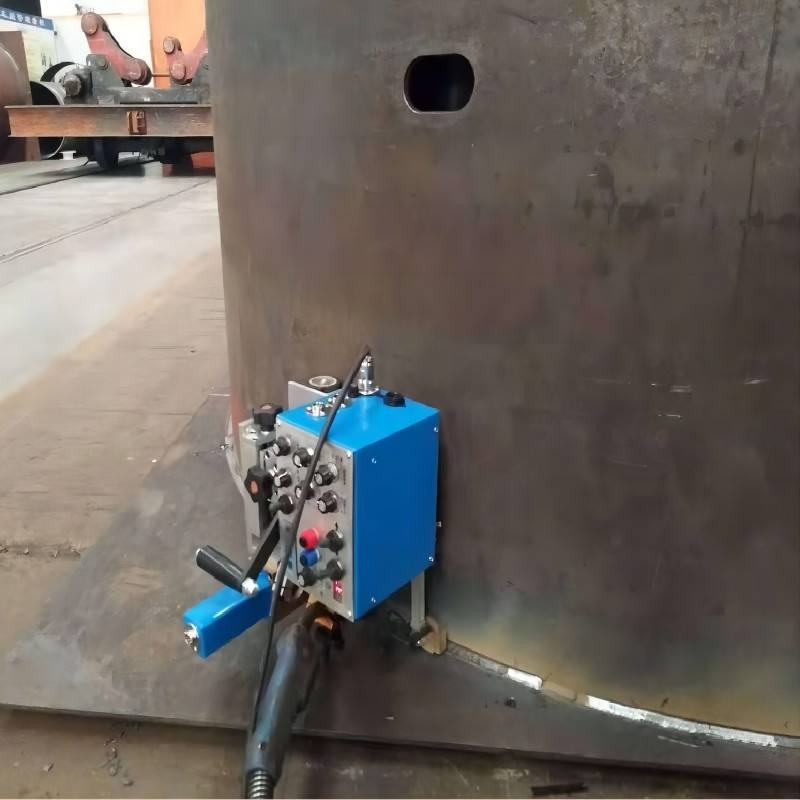
The mechanical load-bearing capacity of these crawlers allows for the integration of heavy-duty wire feeders and flux recovery systems (in the case of Submerged Arc Welding) directly on the carriage. By decentralizing the power source and the wire spool, the system reduces the drag on the torch, which is a common cause of weld bead irregularity. For wind tower sections, the crawler must maintain a constant travel speed, typically ranging from 150 to 600 mm/min, depending on the wire diameter and deposition requirements.
Narrow Gap Geometry and Consumable Efficiency
The primary objective of wind tower fabrication using narrow gap techniques is the reduction of the total weld metal volume. Conventional fillet welds on thick flanges require a large throat thickness, leading to a wide bevel preparation. In contrast, narrow gap configurations utilize a restricted groove angle, often between 1 and 5 degrees, or a square butt preparation with a specific root gap.
From an engineering standpoint, reducing the groove volume translates directly to lower heat input per meter of weld. This is vital for maintaining the grain structure of the steel and minimizing the Heat Affected Zone (HAZ). The crawler’s ability to execute precise, oscillating movements within a narrow channel ensures side-wall fusion without the need for excessive weaving. This precision reduces the total number of passes required to fill the joint, effectively doubling the throughput of a single fabrication station.
Optimizing Deposition Rates via Automated Tractors
Deposition rate is the metric by which industrial efficiency is measured in the wind energy sector. By utilizing a magnetic crawler, engineers can employ larger diameter wires (up to 4.0mm in SAW or 1.6mm in GMAW/FCAW) that would be impossible to control manually. The automated tractor provides the necessary torque to pull the heavy umbilical cables required for high-amperage applications.
To maximize the duty cycle, the system should feature an integrated cooling loop for the torch and a robust wire-straightening mechanism. Wire cast and helix can cause the arc to wander within a narrow gap, leading to lack of fusion. A mechanical straightener ensures that the wire exits the contact tip with zero deviation, maintaining the arc at the exact center of the root gap. This level of control allows for a consistent penetration profile, which is verified through ultrasonic or radiographic testing during quality assurance phases.
Thermal Management and Structural Integrity
In thick-wall tank construction, residual stress is a significant concern. The sequential cooling of multiple weld passes can lead to “bowing” of the tower sections or misalignment of the flanges. The narrow gap approach minimizes the volume of molten metal cooling at any given time. The magnetic crawler contributes to thermal management by allowing for “tandem” or “twin-wire” configurations.
In a tandem setup, two independent arcs are maintained in the same weld pool. The lead wire provides deep penetration, while the trail wire smoothes the bead profile and manages the cooling rate. This configuration, when mounted on a stable magnetic tractor, ensures that the heat is distributed more evenly across the joint. The crawler’s constant velocity prevents localized overheating, which is essential when working with high-strength low-alloy (HSLA) steels commonly found in wind tower specifications.
Operational Logistics and Ergonomics
Deploying automated welding machines in field conditions requires a focus on setup time and portability. A crawler system must be light enough for a two-person team to position on the tank wall, yet powerful enough to remain stationary when the power is cut. Most industrial designs utilize “fail-safe” permanent magnets that require a mechanical lever to disengage, ensuring the machine does not fall in the event of an electrical failure.
The interface for the operator should be simplified to focus on travel speed, voltage, and wire feed speed. In the context of wind tower fabrication, the repeatability of the process is more important than the versatility of the machine. Once the parameters for a specific tower diameter and plate thickness are established, the crawler can be programmed to execute the same weld profile across hundreds of sections, ensuring a uniform fleet of towers with documented weld quality.
Maintenance and Longitudinal Reliability
The harsh environment of a construction yard—characterized by abrasive dust, metallic particles, and varying temperatures—demands a ruggedized machine design. The drive gears of the crawler should be sealed and lubricated for life, and the magnetic wheels must be cleaned regularly to prevent the accumulation of metal filings that could mar the workpiece surface.
By implementing a rigorous preventative maintenance schedule, industrial engineers can ensure that the welding uptime remains above 85%. This reliability is the cornerstone of meeting the aggressive production timelines associated with large-scale wind farm developments. The shift toward magnetic crawler-based narrow gap welding is not merely a technical preference; it is an economic necessity for the scalable production of renewable energy infrastructure.
-


LT240S tube laser cutting machine
-
LT120S tube laser cutting machine
-
Sale

Tank Fillet Welding Machine
Original price was: $1,000.00.$900.00Current price is: $900.00. -
Sale

MAK100 tube laser cutting machine
Original price was: $5,500.00.$5,000.00Current price is: $5,000.00. -

portable plasma air cutting machine
$1,200.00 -

2in1 fiber laser cutting machine
-

Air cooling Laser welding machine
-

HF h beam laser cutting machine
-

LT240 laser cutting machine
-

Laser welding machine
-


Cobotic Welding Station
-

Gantry welding robot solution
-

Tracked Wheeled AGV Welding robot
-

LFH6020 Fiber laser cutting machine
-
LFP6020
-

robotic welidng machine
