Optimizing Shipbuilding Through Specialized Tank Fillet Welding
In the heavy industrial landscape of shipbuilding, the integrity of tank structures—ranging from fuel oil tanks to ballast compartments—is paramount. These structures require extensive linear and circumferential fillet welds that must withstand immense hydrostatic pressure and corrosive environments. The transition from manual welding to automated fillet welding machine systems is not merely a matter of speed; it is a strategic engineering decision to standardize quality and manage the mechanical properties of the heat-affected zone (HAZ).
Mechanical Architecture of Magnetic Crawler Systems
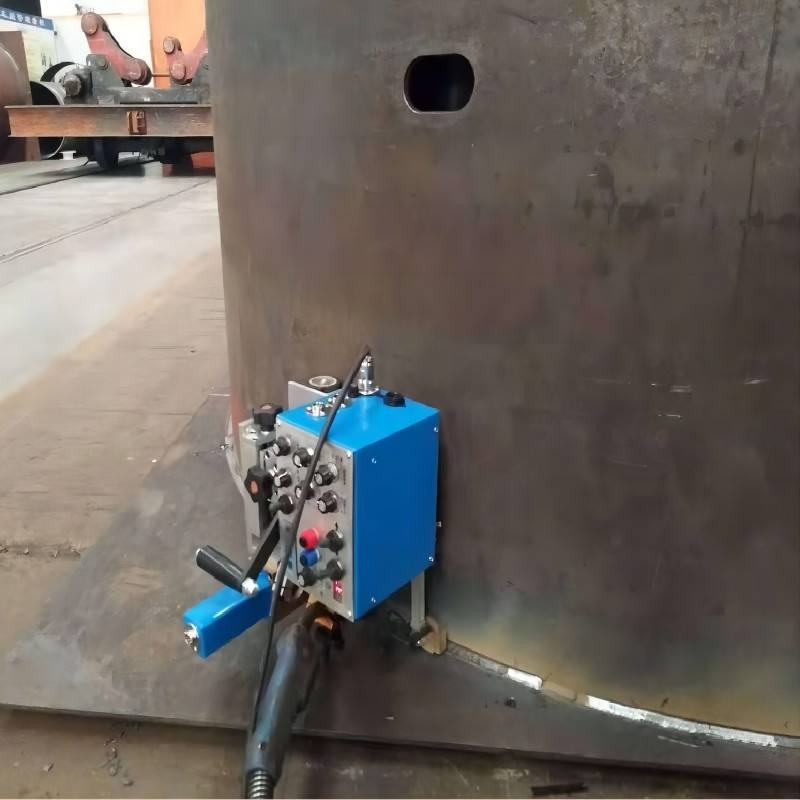
The primary challenge in shipyard field construction is the lack of fixed positioning. Unlike shop environments where workpieces can be rotated, tank construction occurs in situ. This necessitates a magnetic crawler capable of navigating vertical and overhead planes with absolute precision. The mechanical grip is achieved through high-intensity permanent magnets or switchable magnetic bases integrated into the carriage chassis. This design ensures that the welding torch maintains a constant distance from the joint, regardless of surface irregularities or gravitational pull.
From an industrial engineering perspective, the stability of the crawler is the foundation of weld consistency. By utilizing a four-wheel drive system with high-friction heat-resistant rollers, the machine compensates for the “crabbing” effect often seen in non-magnetic carriages. The synchronization of the drive motors allows for a uniform travel speed, which is critical for maintaining the specific weld bead profile required in narrow gap applications.
The Engineering Logic of Narrow Gap Fillet Welding
Narrow gap welding (NGW) is often associated with butt joints, but its application in fillet welding within tanks provides significant volumetric efficiency. By reducing the included angle of the joint preparation or utilizing specialized torch geometries to reach deep into tight corners, the volume of weld metal required is drastically reduced. A narrow gap welding approach minimizes the number of passes needed to achieve the required throat thickness.
Reducing the weld metal volume leads to several downstream advantages:
1. Decreased total heat input, which limits angular distortion in thin-walled tank partitions.
2. Lower consumption of flux-cored or solid welding wires, directly impacting the Bill of Materials (BOM) costs.
3. Shorter arc-on time per meter of weld, increasing the overall duty cycle of the welding operation.
Arc Stability and Torch Oscillation Parameters
In narrow gap configurations, the risk of sidewall lack of fusion is a primary concern. To mitigate this, the Tank Fillet Welding Machine incorporates mechanical oscillation. Unlike complex digital systems, industrial-grade crawlers use ruggedized linear or pendulum oscillators. These units allow the operator to set a specific width and dwell time at the weld toes, ensuring that the arc effectively “washes” against the vertical and horizontal members of the tank joint.
The integration of an auto-stop limit switch and an integrated torch track adjustment allows the system to handle the long continuous runs typical of longitudinal bulkheads. By maintaining a tight arc gap through mechanical sensing arms, the machine negates the fluctuations in voltage that would otherwise occur due to operator fatigue in manual processes.
Heat Input Management in Field Construction
Shipbuilding steel, particularly high-tensile grades, is sensitive to the cooling rate post-welding. Excessive heat input can lead to grain coarsening, reducing the impact toughness of the joint. The automated crawler provides a controlled travel speed that manual welders cannot consistently replicate over an eight-hour shift. This precision allows engineers to calculate and adhere to strict interpass temperature requirements, ensuring the mechanical properties of the tank remain within the classification society’s standards.
Field Stability and Environmental Adaptability
The shipyard environment is characterized by humidity, dust, and fluctuating temperatures. A tank fillet welding machine designed for this sector must eschew delicate electronics in favor of robust, IP-rated components. The stability of the magnetic crawler is tested not just by the weight it carries, but by its ability to remain clamped to the workpiece during the vibration of nearby grinding or chipping operations.
Modern crawlers utilize a low-center-of-gravity design to prevent tipping when navigating curved sections of the bilge or tank corners. The inclusion of a manual clutch allows for rapid repositioning, which is essential for maintaining a high “arc-on” ratio. By streamlining the setup time—typically requiring only the placement of the crawler on the plate and the alignment of the torch—the industrial engineer can significantly reduce non-productive labor hours.
Economic Impact and Productivity Metrics
When analyzing the Return on Investment (ROI) for automated tank welding systems, the focus is on deposition rates and rework reduction. In manual fillet welding, the defect rate—primarily due to porosity or slag inclusions at start-stop points—can range from 3% to 5%. An automated magnetic crawler reduces start-stops by 80% on long seams, effectively bringing the repair rate down to less than 1%.
Furthermore, the deposition rate of a machine-guided FCAW (Flux-Cored Arc Welding) process is significantly higher than manual SMAW (Shielded Metal Arc Welding). While a manual welder might achieve 2-3 kg/h, a crawler-mounted system can comfortably maintain 5-6 kg/h depending on the power source capacity. Over the course of a large-scale tanker or container ship project involving several kilometers of tank fillets, these gains represent thousands of saved man-hours.
Conclusion: The Path to Structural Reliability
The implementation of narrow gap fillet welding machines via magnetic crawlers represents a pragmatic leap in shipbuilding technology. By focusing on the mechanical fundamentals of stability, travel consistency, and optimized joint geometry, shipyards can achieve a level of structural reliability that manual processes cannot match. This approach does not seek to replace the skill of the welder but rather to provide a high-performance tool that handles the repetitive, physically demanding tasks of tank construction with mathematical precision. As the industry moves toward larger vessels and more stringent safety regulations, the role of specialized field-stable welding automation becomes an indispensable component of modern maritime engineering.
-


LT240S tube laser cutting machine
-
LT120S tube laser cutting machine
-
Sale

Tank Fillet Welding Machine
Original price was: $1,000.00.$900.00Current price is: $900.00. -
Sale

MAK100 tube laser cutting machine
Original price was: $5,500.00.$5,000.00Current price is: $5,000.00. -

portable plasma air cutting machine
$1,200.00 -

2in1 fiber laser cutting machine
-

Air cooling Laser welding machine
-

HF h beam laser cutting machine
-

LT240 laser cutting machine
-

Laser welding machine
-


Cobotic Welding Station
-

Gantry welding robot solution
-

Tracked Wheeled AGV Welding robot
-

LFH6020 Fiber laser cutting machine
-
LFP6020
-

robotic welidng machine
