Standardizing Tank Fillet Welding in Shipbuilding Operations
In the heavy industrial landscape of shipbuilding, the efficiency of tank construction—specifically ballast tanks, fuel oil tanks, and cargo holds—is a primary determinant of the overall production schedule. The structural integrity of these compartments relies heavily on the quality of fillet welds joining bulkheads to deck plates and longitudinal stiffeners. Traditional manual welding in these confined and often vertical environments presents challenges in consistency and ergonomics. The transition to tank fillet welding systems using mechanized carriages allows for a more controlled heat input and a higher duty cycle compared to manual operations.
Industrial engineers focus on reducing the “arc-off” time. In ship hull construction, the environment is characterized by long, repetitive seams that demand high-quality fusion across varied plate thicknesses. A mechanized approach ensures that the travel speed remains constant, which is nearly impossible for a manual welder to maintain over a 20-meter seam. This consistency directly impacts the weld bead profile and reduces the likelihood of undercut or overlap, which are common points of fatigue failure in marine structures.
Mechanics of the Magnetic Crawler System
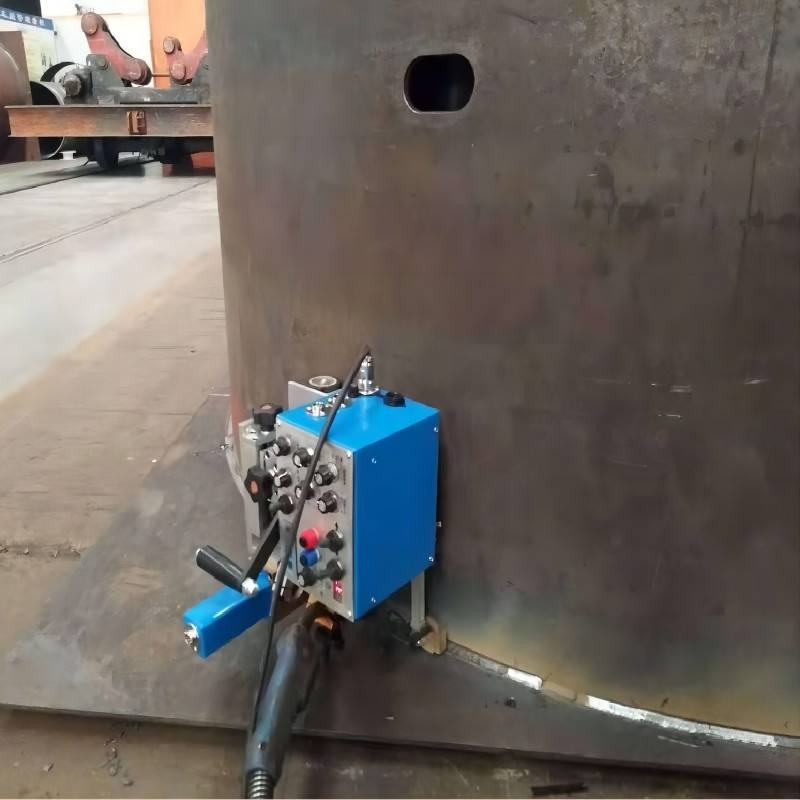
The core of a field-stable welding unit is the magnetic crawler. Unlike rail-mounted systems that require extensive setup time and tack-welding of tracks, a magnetic crawler utilizes high-strength permanent magnets or switchable magnetic wheels to adhere directly to the ferromagnetic hull plates. This design allows the machine to operate on vertical surfaces and even slightly inclined overhead sections without slipping.
Drive Force and Surface Adhesion
for Shipbuilding applications, the crawler must exert enough pulling force to drag the welding lead, gas hose, and control cables, which can exceed 30 kilograms in a deep-tank environment. The traction system is typically an all-wheel drive configuration with heat-resistant silicone or rubber-coated wheels to prevent marring the primer coating while maintaining a high coefficient of friction. The stability of the crawler is essential for maintaining the torch-to-work distance, which directly influences arc voltage and penetration depth.
Tracking and Guidance Mechanisms
While the machine is mechanized, its path must be precisely aligned with the joint. Guide rollers or specialized tracking sensors (tactile or inductive) follow the vertical bulkhead or the stiffener edge. This mechanical guidance ensures the arc remains centered in the joint. In the context of narrow gap welding, even a one-millimeter deviation can result in lack of sidewall fusion, making the rigidity of the crawler’s torch arm a critical engineering specification.
Narrow Gap Welding Methodology for Tank Fillets
The application of narrow gap techniques in fillet welding is an optimization strategy aimed at reducing the volume of weld metal deposited. In thick-plate shipbuilding, traditional wide-angle grooves or oversized fillet legs increase the total heat input, leading to greater angular distortion and residual stress. By narrowing the gap or optimizing the torch angle to achieve deeper penetration with a smaller leg length, engineers can achieve the same structural strength with less material.
Metallurgical Advantages of Controlled Heat Input
Narrow gap configurations typically involve a tighter torch oscillation or a steady stringer bead. This focus on weld penetration control ensures that the root of the fillet is fully consumed. Lowering the total volume of deposited metal reduces the heat-affected zone (HAZ), which preserves the mechanical properties of the high-tensile steel commonly used in ship hulls. Reduced heat also minimizes the risk of plate buckling, which otherwise requires expensive post-weld straightening.
Consumable Management and Shielding Gas Stability
In field construction, wind speeds inside a partially completed hull can disrupt shielding gas coverage. Mechanized narrow gap machines are often equipped with specialized gas shrouds or “skirts” that travel with the torch. This maintains a stable laminar flow of Argon/CO2 mixtures, preventing porosity. Furthermore, using large-diameter wire spools mounted directly on the carriage or fed through a high-torque wire feeder ensures continuous operation without the frequent stops associated with manual stick electrode changes.
Field Construction Stability and Environmental Resilience
A welding machine designed for a shipyard must be “hardened” for the environment. This means the electronic components must be sealed against metallic dust (grinding dust) and moisture. The stability of the machine is not just about its grip on the wall; it is about its ability to handle voltage fluctuations common in shipyard power grids and its physical resilience against the rough handling inherent in field construction.
Power Source Integration
The mechanized crawler is usually paired with an inverter-based power source capable of pulse-GMAW (Gas Metal Arc Welding). Pulse settings are particularly effective for vertical-up fillets, as they allow for a cooler weld pool that solidifies quickly, preventing “sagging” of the weld metal. The integration between the crawler’s travel speed and the power source’s wire feed speed is crucial for maintaining a uniform weld cross-section.
Operational Safety and Ergonomics
By delegating the primary welding task to a magnetic crawler, the operator is moved away from the immediate plume of welding fumes. This is a significant factor in the confined spaces of ship tanks. The operator’s role shifts to that of a technician, monitoring the arc parameters from a distance and making minor adjustments to the oscillation width or travel speed via a remote control pendant. This shift reduces operator fatigue and increases the total “arc-on” time per shift.
Economic Analysis of Mechanized Fillet Welding
From an industrial engineering perspective, the transition to mechanized tank welding is justified by the reduction in “man-hours per meter.” Manual fillet welding in a tank might reach speeds of 15 to 25 centimeters per minute, whereas a mechanized tractor can consistently operate at 40 to 60 centimeters per minute with a 100% duty cycle.
Reduction in Secondary Operations
Manual welds often require significant grinding to meet the aesthetic and structural requirements of marine classification societies (such as ABS or DNV). The mechanized bead is inherently smoother, with uniform ripples and a consistent toe line. This eliminates approximately 70% of the post-weld grinding and cleanup work. When multiplied by the thousands of meters of fillet welds in a VLCC (Very Large Crude Carrier) or a container ship, the cost savings are substantial.
ROI and Tool Longevity
The initial investment in a high-quality magnetic crawler and narrow gap torch setup is higher than manual equipment. However, the return on investment (ROI) is typically realized within the first six months of a major hull assembly project. The longevity of these machines is ensured by using high-grade aluminum housings, stainless steel fasteners, and replaceable wear parts for the drive system.
Conclusion
Optimizing tank fillet welding through mechanized magnetic crawlers represents a necessary evolution in shipbuilding. By focusing on narrow gap techniques and field stability, shipyards can achieve a higher level of precision and structural integrity. The removal of manual variability, combined with the mechanical grip of magnetic drive systems, ensures that even the most challenging tank environments can be welded with efficiency and safety. As vessel designs continue to scale in size and complexity, the reliance on these stable, mechanized systems will only increase to meet the rigorous demands of modern maritime engineering.
-


LT240S tube laser cutting machine
-
LT120S tube laser cutting machine
-
Sale

Tank Fillet Welding Machine
Original price was: $1,000.00.$900.00Current price is: $900.00. -
Sale

MAK100 tube laser cutting machine
Original price was: $5,500.00.$5,000.00Current price is: $5,000.00. -

portable plasma air cutting machine
$1,200.00 -

2in1 fiber laser cutting machine
-

Air cooling Laser welding machine
-

HF h beam laser cutting machine
-

LT240 laser cutting machine
-

Laser welding machine
-


Cobotic Welding Station
-

Gantry welding robot solution
-

Tracked Wheeled AGV Welding robot
-

LFH6020 Fiber laser cutting machine
-
LFP6020
-

robotic welidng machine
