Optimizing Shipbuilding Throughput with Tank Fillet Welding Systems
In the heavy industrial landscape of shipbuilding, the fabrication of storage tanks, fuel bunkers, and double-bottom sections represents a significant portion of total man-hours. The traditional approach to fillet welding in these confined and often vertical environments relied heavily on manual labor, which introduces variables in weld quality and consistency. To achieve the rigorous standards required for maritime classification societies, industrial engineers have shifted focus toward narrow gap welding systems integrated into specialized carriage units. These machines are designed to navigate the internal and external radii of tank shells while maintaining a precise arc strike and consistent travel speed.
The core objective of implementing a mechanized Tank Fillet Welding Machine is to maximize the deposition rate while minimizing the heat-affected zone (HAZ). In shipbuilding, where high-tensile steel is standard, controlling thermal input is critical to preventing plate distortion and maintaining the structural integrity of the hull and bulkheads. By utilizing a mechanized crawler, the process moves from a stochastic manual operation to a controlled, repeatable industrial process.
Mechanical Design and Magnetic Crawler Stability
A primary challenge in shipyard tank construction is the presence of vertical and overhead planes. The magnetic crawler welder addresses this by utilizing high-intensity permanent magnets or electromagnets integrated into the drive wheels or the chassis. This adhesion force ensures that the welding carriage remains locked to the work surface even when traversing vertical seams or curved shell plates.
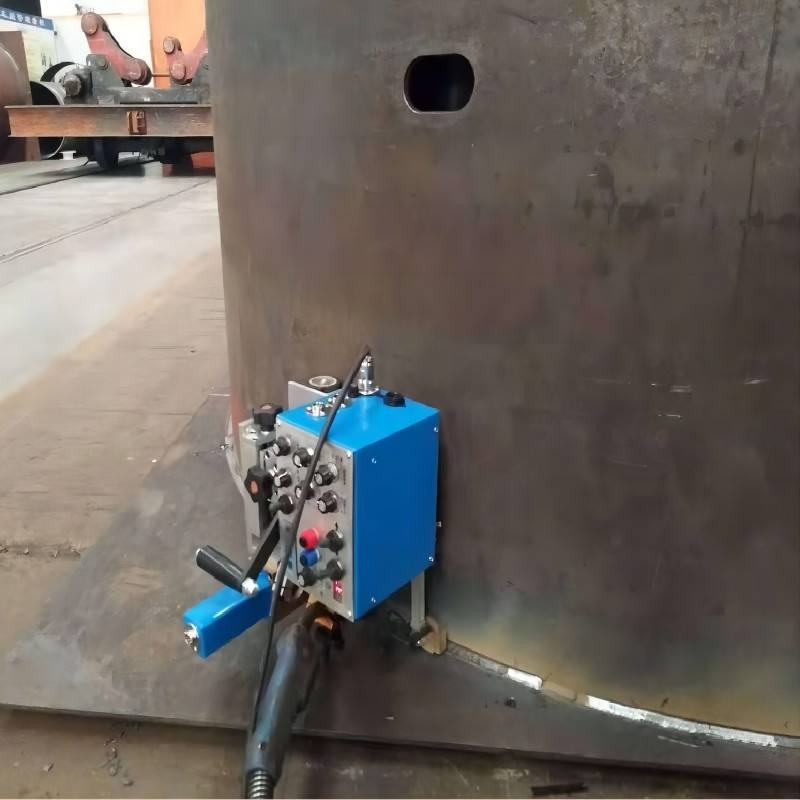
Adhesion Force and Surface Contact
From an engineering perspective, the traction system must balance magnetic pull with motor torque. If the magnetic force is too high, the motor may stall or consume excessive power; if too low, the carriage slips, leading to weld defects such as porosity or irregular bead profiles. Modern systems utilize 4-wheel drive configurations with independent suspension to account for surface irregularities, such as mill scale, tack welds, or slight plate misalignments. This mechanical stability is the foundation of high-quality fillet welds in field conditions.
Oscillation and Torch Control
The welding head on these machines is typically equipped with a motorized oscillator. In narrow gap applications, the torch must move with micron-level precision to ensure side-wall fusion. Unlike standard wide-groove welding, narrow gap technology requires the arc to stay centered while oscillating slightly to tie into both the vertical shell and the horizontal floor or bulkhead. This reduces the volume of weld metal required, leading to a direct reduction in consumable costs and arc-on time.
Narrow Gap Methodology in Fillet Joint Optimization
The transition to tank fillet welding machine technology is often driven by the need to reduce the “V” or “J” groove angle. In thick-plate shipbuilding, a standard fillet weld might require multiple passes with a large volume of filler material. Narrow gap techniques allow for a tighter root opening and a steeper groove angle, often ranging between 5 to 10 degrees.
Reduction in Filler Metal Volume
The mathematical advantage of narrow gap welding is found in the cross-sectional area of the weld joint. By narrowing the gap, the volume of the weld deposit is reduced by as much as 30-50% compared to conventional submerged arc or flux-cored arc welding. This reduction does not merely save on wire costs; it minimizes the total energy input into the plate. Lower energy input translates to less shrinkage and angular distortion, which is a major concern when assembling large-scale maritime tanks where tolerances are tight.
Multi-Pass Consistency
Industrial engineers specify these machines to handle multi-pass sequences automatically. The carriage can be programmed to perform a root pass with specific voltage and wire feed speed parameters, followed by multiple fill and cap passes. Because the machine maintains a constant distance from the joint (via contact tip to work distance sensors), the electrical stick-out remains uniform. This uniformity is nearly impossible to maintain manually over a 20-meter tank circumference, making mechanization essential for large-scale projects.
Field Construction Stability and Environmental Management
Shipyards are not controlled laboratory environments. Field construction involves wind, varying ambient temperatures, and humidity. A robust tank fillet welding machine must be designed with “field-hardening” in mind. This includes shielded electronics, weather-resistant drive motors, and integrated gas shielding manifolds that protect the weld pool from atmospheric contamination.
Wind Resistance and Gas Shielding
In narrow gap applications, the shielding gas must reach the bottom of a deep, tight groove. Standard nozzles often fail in windy shipyard conditions. Mechanized crawlers use specialized gas cups and sometimes secondary “trailing” shields to ensure the molten pool is protected until it solidifies. The stability of the crawler allows for the use of higher gas flow rates without the turbulence that manual shaking might cause.
Power Source Integration
The machine acts as the interface between the power source and the workpiece. Industrial engineers prioritize inverter-based power sources that can communicate with the crawler’s control unit. This allows for real-time adjustments to the shipbuilding welding automation cycle. If the crawler detects a change in travel resistance, it can theoretically signal the controller to maintain the weld bead’s consistent morphology by adjusting wire feed speed or travel velocity.
Efficiency Metrics and Duty Cycle Improvements
The primary KPI (Key Performance Indicator) for an industrial engineer in a shipyard is the “arc-on time.” Manual welders typically have a duty cycle of 25-35% due to fatigue, repositioning, and helmet adjustments. A magnetic crawler tank welder can achieve duty cycles exceeding 70%.
Throughput Calculations
Consider a standard 50,000 DWT tanker’s fuel oil tank. The total linear meters of fillet welding can be astronomical. By increasing the travel speed and duty cycle through mechanization, the schedule for tank completion can be compressed by weeks. Furthermore, the reduction in post-weld grinding and rework due to the clean, spatter-free finish of a mechanized narrow gap process further optimizes the production flow.
Labor Allocation
Mechanization does not eliminate the need for skilled personnel; rather, it shifts the welder’s role to that of a system operator. One operator can often manage two or even three crawlers simultaneously on long, straight runs. This force-multiplication is vital in regions facing a shortage of certified high-pressure welders. The operator focuses on setup, parameter monitoring, and quality assurance, while the machine handles the repetitive, physically taxing labor of maintaining the arc.
Technical Specifications for Industrial Implementation
When selecting a system for Shipbuilding, certain technical parameters are non-negotiable. The machine must support wire diameters typically ranging from 1.2mm to 1.6mm, common in heavy-duty FCAW (Flux-Cored Arc Welding). Travel speeds should be adjustable from 50mm/min to 1000mm/min to accommodate various plate thicknesses and weld sizes. Finally, the vertical load capacity of the magnets must exceed the total weight of the carriage, wire spool, and torch assembly by a factor of at least 2:1 to ensure a safety margin during operation.
In conclusion, the integration of narrow gap tank fillet welding machines into shipyard workflows represents a pragmatic engineering solution to the challenges of modern maritime construction. By focusing on mechanical adhesion stability, optimized joint geometry, and increased duty cycles, shipbuilders can achieve superior structural integrity and operational efficiency without the need for overly complex or delicate non-contact systems. The magnetic crawler remains the workhorse of the field, providing the necessary stability to deliver high-integrity welds in the most demanding environments.
-


LT240S tube laser cutting machine
-
LT120S tube laser cutting machine
-
Sale

Tank Fillet Welding Machine
Original price was: $1,000.00.$900.00Current price is: $900.00. -
Sale

MAK100 tube laser cutting machine
Original price was: $5,500.00.$5,000.00Current price is: $5,000.00. -

portable plasma air cutting machine
$1,200.00 -

2in1 fiber laser cutting machine
-

Air cooling Laser welding machine
-

HF h beam laser cutting machine
-

LT240 laser cutting machine
-

Laser welding machine
-


Cobotic Welding Station
-

Gantry welding robot solution
-

Tracked Wheeled AGV Welding robot
-

LFH6020 Fiber laser cutting machine
-
LFP6020
-

robotic welidng machine
