Engineering Analysis of Tank Fillet Welding in Shipbuilding
In the maritime construction sector, the integrity of storage tanks and structural compartments is a primary determinant of a vessel’s lifespan and safety profile. Industrial engineers face the persistent challenge of managing massive weld volumes while maintaining stringent quality standards in often unfavorable field conditions. The transition from manual stick welding to semi-automated Tank Fillet Welding Machine systems has become a logistical necessity to meet production deadlines and reduce material waste.
Unlike workshop-based fabrication, shipbuilding occurs in environments characterized by fluctuating humidity, restricted spaces, and the inherent instability of large steel plates. The focus of modern process optimization lies in the deployment of portable, high-traction units that can navigate these surfaces while executing high-precision narrow gap welds. This engineering approach prioritizes mechanical reliability and weld bead consistency over the high-cost, high-maintenance complexity of digital robotics.
The Role of Magnetic Crawler Systems in Field Stability
The cornerstone of a stable tank fillet welding operation is the carriage movement. In vertical and horizontal-vertical (2F) positions, gravity acts as a constant force trying to displace the welding torch from the intended path. A magnetic crawler provides the necessary adhesive force to maintain contact with the hull or bulkhead, ensuring that the arc length remains constant throughout the entire length of the joint.
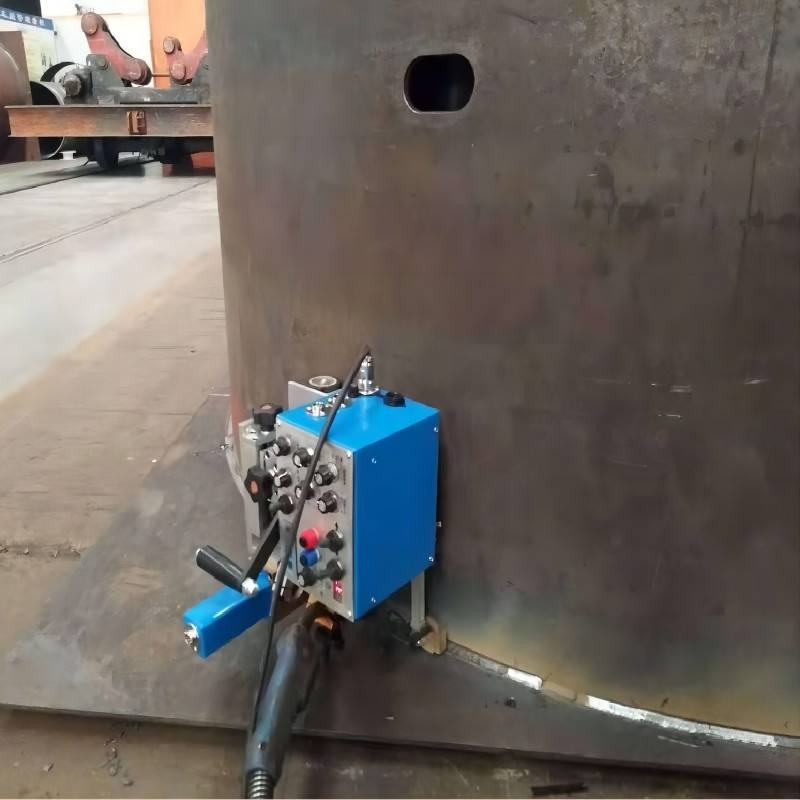
These crawlers utilize high-flux permanent magnets or electromagnets integrated into the drive wheels or the chassis. From an industrial engineering perspective, the choice of magnetic traction reduces the need for expensive guiding tracks or scaffolding. By locking the machine to the workpiece, the system compensates for surface irregularities such as mill scale or minor plate warping. The stability provided by magnetic adhesion allows for higher travel speeds without sacrificing the penetration depth required for heavy-gauge maritime steel.
Narrow Gap Methodology for Fillet Welds
The implementation of narrow gap welding within the context of tank fabrication is primarily driven by the need to reduce the total volume of weld metal deposited. In traditional fillet welding, large leg lengths often lead to excessive heat input, which results in angular distortion and increased internal stresses. By narrowing the groove angle or optimizing the fillet profile to a specific throat thickness through precision torch positioning, engineers can significantly decrease wire consumption and gas usage.
Narrow gap techniques in shipyard environments require the welding machine to maintain a very tight tolerance on the oscillation width and dwell time at the edges of the weld pool. The automated tank fillet machine manages these parameters through localized control units that adjust the wire feed speed and voltage in real-time, compensating for the thermal sink effect of the thick ship plates. This results in a refined grain structure within the weld metal and a reduced Heat Affected Zone (HAZ), which is critical for tanks carrying corrosive or cryogenic cargoes.
Mechanical Traction and Drive Consistency
A critical failure point in field welding is inconsistent travel speed, which leads to “humping” or lack of fusion. Industrial-grade tank welding machines utilize four-wheel drive systems with high-torque DC motors to ensure uniform motion. The friction coefficient between the crawler’s wheels and the steel plate is maximized through specialized rubber or serrated metallic treads, depending on whether the plate is primed or bare steel.
The drive system must be robust enough to pull the weight of the umbilical—the bundle containing the gas hose, power cables, and wire liner—which can be substantial in deep-tank applications. To mitigate the drag of the umbilical, engineers often design the crawler with a low center of gravity and integrated strain relief. This ensures that the external load does not cause the carriage to “crab” or deviate from the fillet line, which would otherwise require manual intervention and grinding.
Process Optimization for High Deposition Rates
In the context of shipbuilding throughput, the deposition rate is a Key Performance Indicator (KPI). Using Shipbuilding grade flux-cored wires (FCAW) or metal-cored wires (MCAW) in combination with a magnetic crawler allows for a continuous duty cycle that manual operators cannot replicate. While a manual welder might maintain a 25-30% arc-on time due to fatigue and the need for repositioning, a magnetic crawler system can achieve upwards of 70-80% arc-on time.
Furthermore, the narrow gap configuration allows for multi-pass welding with minimal inter-pass cleaning. Because the machine provides a consistent bead profile, the risk of slag inclusions is minimized. The industrial engineer can thus calculate precise production schedules based on linear meters per hour, facilitating more accurate project management and labor allocation. This predictability is vital when coordinating the construction of complex structures like double-bottom tanks or wing tanks.
Field Construction Stability and Environmental Adaptability
Shipyard conditions are rarely “clean room” environments. Equipment must be engineered for IP54 or higher ratings to withstand dust, moisture, and metallic particles. The stability of the welding arc is maintained through heavy-duty shielding gas shrouds that are designed to resist the drafts common in open-air docks. The tank fillet welding machine is often equipped with integrated wind shields or flexible curtains that travel with the carriage.
Operational stability also refers to the electrical consistency. In large-scale field construction, voltage drops across long primary cables can be a significant issue. The control systems in modern magnetic crawlers are designed to sense the arc voltage at the wire feeder rather than the power source, allowing the machine to automatically compensate for fluctuations. This ensures that the penetration profile remains uniform even when the power source is located 50 meters away from the actual welding site.
Quality Control and NDT Compliance
Final inspection of tank fillet welds usually involves Visual Testing (VT) and Magnetic Particle Inspection (MPI) or Ultrasonic Testing (UT). The use of automated narrow gap machines significantly reduces the incidence of undercut and porosity. By maintaining a constant torch angle—typically 45 degrees to the web and flange—the machine ensures that the weld throat is sufficient to meet class society requirements (such as ABS or DNV).
The consistency of the mechanized process simplifies the Non-Destructive Testing (NDT) phase. When a machine is calibrated correctly, the likelihood of systematic defects is low, allowing for “spot check” auditing rather than the 100% inspection often required for manual welds in critical areas. This reduction in the NDT bottleneck further accelerates the vessel’s movement through the various stages of the slipway or dry dock.
Conclusion: The Economic and Structural Impact
The deployment of magnetic crawler-based tank fillet welding machines represents a pragmatic peak in industrial engineering for the shipbuilding industry. By focusing on mechanical stability and narrow gap efficiency, yards can achieve high-integrity welds that meet the grueling demands of maritime service. These systems provide a balance between technological sophistication and field-ready durability, ensuring that the primary objective—building safe, efficient, and durable vessels—is met without the unnecessary complexity of non-specialized automation. The result is a streamlined production flow, reduced material overhead, and superior structural reliability across the entire hull and tank assembly.
-


LT240S tube laser cutting machine
-
LT120S tube laser cutting machine
-
Sale

Tank Fillet Welding Machine
Original price was: $1,000.00.$900.00Current price is: $900.00. -
Sale

MAK100 tube laser cutting machine
Original price was: $5,500.00.$5,000.00Current price is: $5,000.00. -

portable plasma air cutting machine
$1,200.00 -

2in1 fiber laser cutting machine
-

Air cooling Laser welding machine
-

HF h beam laser cutting machine
-

LT240 laser cutting machine
-

Laser welding machine
-


Cobotic Welding Station
-

Gantry welding robot solution
-

Tracked Wheeled AGV Welding robot
-

LFH6020 Fiber laser cutting machine
-
LFP6020
-

robotic welidng machine
