Optimizing Tank Fillet Welding in Construction Machinery Fabrication
In the heavy construction machinery sector, the structural integrity of fluid tanks, hydraulic reservoirs, and fuel storage units is paramount. These components are subjected to high-frequency vibrations and cyclic loading, necessitating fillet welds of exceptional quality. Traditional manual welding often falls short in consistency, especially during large-scale field construction. The transition toward mechanized systems, specifically the Magnetic Crawler, addresses these challenges by providing a stable platform for Narrow Gap Welding in fillet configurations.
Industrial engineers prioritize process control and repeatability. When fabricating large-scale tanks for excavators or cranes, the geometry of the fillet joint presents specific challenges regarding torch positioning and heat distribution. Mechanized narrow gap systems allow for a significant reduction in the groove angle—or in the case of fillets, a tighter control over the leg length and throat thickness—leading to reduced filler metal consumption and faster cycle times.
The Mechanics of the Magnetic Crawler System
Field construction stability is often compromised by uneven surfaces, wind, and the sheer scale of the workpieces. A magnetic crawler serves as the foundational transport mechanism for the welding head. Utilizing high-strength permanent magnets or switchable electromagnets, these carriages adhere directly to the carbon steel plates of the tank. This eliminates the need for expensive and time-consuming guide rails.
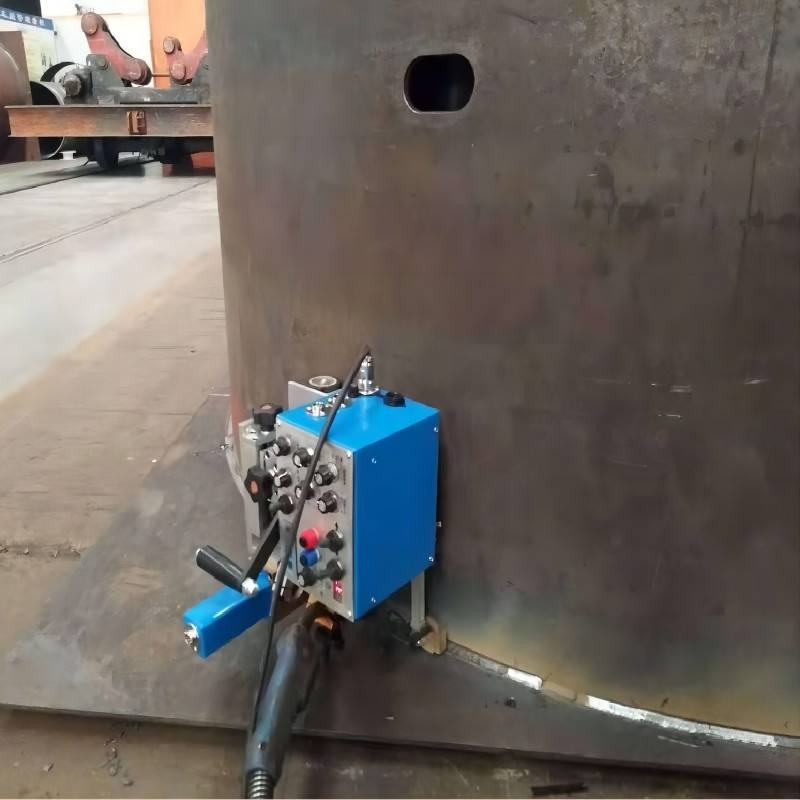
The stability provided by the magnetic grip ensures that the welding arc maintains a constant distance from the joint, even when traversing vertical or curved surfaces. for Construction Machinery tanks, which often feature radius corners and long longitudinal seams, the crawler’s ability to maintain a consistent Field Construction Stability is vital. The motorized drive system provides a steady travel speed, which is a critical variable in calculating the heat input and ensuring the metallurgical properties of the weld remain within specification.
Narrow Gap Techniques for Fillet Joint Integrity
While narrow gap welding is traditionally associated with butt joints in heavy-walled pressure vessels, its application in tank fillet welding offers distinct advantages for heavy machinery. By narrowing the effective arc zone and optimizing the wire aiming point, engineers can achieve deep penetration at the root of the fillet. This is essential for components that must withstand the hydraulic pressures common in construction equipment.
The Narrow Gap Welding approach focuses on minimizing the volume of the weld pool. This reduction in molten metal volume directly correlates to lower residual stresses and reduced transverse shrinkage. In the context of tank fabrication, where distortion can lead to alignment issues with hydraulic ports and mounting brackets, controlling shrinkage through narrow gap parameters is a major process improvement. The use of specialized gas-shielded metal arc welding (GMAW) or flux-cored arc welding (FCAW) torches with slim profiles allows the arc to reach into tight geometries without sacrificing gas coverage.
Advanced Motion Control and Oscillation
To ensure side-wall fusion in a narrow gap fillet, the mechanized crawler often incorporates a micro-oscillation unit. This unit moves the welding wire back and forth across the joint interface. Unlike manual weaving, which is subject to human error and fatigue, mechanized oscillation is precise to the millimeter. This ensures that the weld bead ties in perfectly to both the vertical and horizontal members of the tank assembly.
Engineers can program the dwell time on each side of the fillet, ensuring that the “cold” corners of the joint receive sufficient heat to prevent lack-of-fusion defects. This level of control is particularly beneficial when working with high-strength low-alloy (HSLA) steels frequently used in the construction machinery industry to reduce vehicle weight without sacrificing durability.
Enhancing Field Construction Stability
Working in a field environment introduces variables that are absent in a controlled factory floor. Wind gusts can disrupt shielding gas, and temperature fluctuations can affect the ductility of the base metal. The mechanized tank fillet welder addresses these issues through integrated shielding shrouds and robust wire-feed mechanisms. The magnetic crawler’s low center of gravity and high tractive force ensure that it does not slip or vibrate during the welding process, which would otherwise cause arc instability.
Furthermore, the portability of these units allows for rapid deployment across different sections of a large construction site. Instead of moving the massive tank components to a stationary welding station, the machine is brought to the workpiece. This “point-of-need” fabrication strategy reduces material handling costs and minimizes the risk of damage to partially completed structures.
Technical Specifications and Parameter Optimization
From an industrial engineering perspective, the success of a tank fillet welding operation is measured by the Fillet Weld Integrity and the deposition rate. By utilizing 1.2mm or 1.6mm solid or metal-cored wires, the narrow gap system can operate at high current densities. The mechanized crawler allows for travel speeds that are 2-3 times faster than manual welding while maintaining a higher duty cycle.
Key parameters for optimization include:
1. Voltage and Amperage Synchronization
The system must balance the penetration depth with the risk of undercut. In narrow gap fillet welding, a spray transfer mode is typically preferred to ensure a clean, spatter-free finish that requires minimal post-weld cleaning.
2. Gas Composition
A mixture of Argon and CO2 is standard, but the specific ratio must be tuned to provide the necessary arc stiffness for the narrow gap. The magnetic crawler’s steady movement ensures that the gas lens remains effective over the weld pool at all times.
3. Tracking Accuracy
Modern crawlers utilize tactile or inductive seam tracking to compensate for any deviations in the joint line. Since the narrow gap approach leaves little room for error, the tracking system must be responsive to small changes in plate fit-up, ensuring the arc remains centered in the root.
Economic and Quality Assurance Benefits
The implementation of mechanized fillet welding provides a clear ROI through several channels. First, the reduction in filler metal consumption due to the narrow gap geometry lowers the unit cost per tank. Second, the consistency of the mechanized arc significantly reduces the rate of rework. In manual tank welding, pinhole leaks and slag inclusions are common, often requiring expensive grinding and re-welding. The crawler-based system virtually eliminates these defects by maintaining a constant arc length and travel speed.
Furthermore, the reduction in total heat input preserves the mechanical properties of the base metal. Excessive heat can lead to grain coarsening in the heat-affected zone, making the tank susceptible to fatigue cracking over time. By concentrating the energy in a narrow gap, the thermal profile of the weld is optimized, leading to a more robust final product that meets the rigorous standards of the construction machinery industry.
Conclusion
The integration of magnetic crawler technology with Narrow Gap welding techniques represents a significant leap forward for tank fabrication in the field. By focusing on mechanical stability and precise parameter control, manufacturers can produce high-quality fillet welds that meet the demands of modern construction equipment. This mechanized approach not only enhances the structural integrity of the components but also drives efficiency, safety, and cost-effectiveness in large-scale industrial projects.
-


LT240S tube laser cutting machine
-
LT120S tube laser cutting machine
-
Sale

Tank Fillet Welding Machine
Original price was: $1,000.00.$900.00Current price is: $900.00. -
Sale

MAK100 tube laser cutting machine
Original price was: $5,500.00.$5,000.00Current price is: $5,000.00. -

portable plasma air cutting machine
$1,200.00 -

2in1 fiber laser cutting machine
-

Air cooling Laser welding machine
-

HF h beam laser cutting machine
-

LT240 laser cutting machine
-

Laser welding machine
-


Cobotic Welding Station
-

Gantry welding robot solution
-

Tracked Wheeled AGV Welding robot
-

LFH6020 Fiber laser cutting machine
-
LFP6020
-

robotic welidng machine
