Technical Integration of Magnetic Crawler Systems in Bridge Engineering
In the construction of heavy-duty bridge trusses, the structural integrity of fillet welds is paramount. Traditional manual welding methods often struggle with the sheer scale and consistency required for long-span gusset plates and chord members. The shift toward magnetic crawler welding systems addresses these challenges by providing a stable, mechanized platform that adheres directly to the workpiece. Unlike stationary shop equipment, these machines are designed for the rigors of field construction, where vertical and inclined surfaces are common. The magnetic adhesion ensures that the torch maintains a constant distance and angle, which is critical for achieving deep penetration in fillet joints without the fluctuations inherent in human operation.
Mechanical Stability and Field Adhesion Mechanics
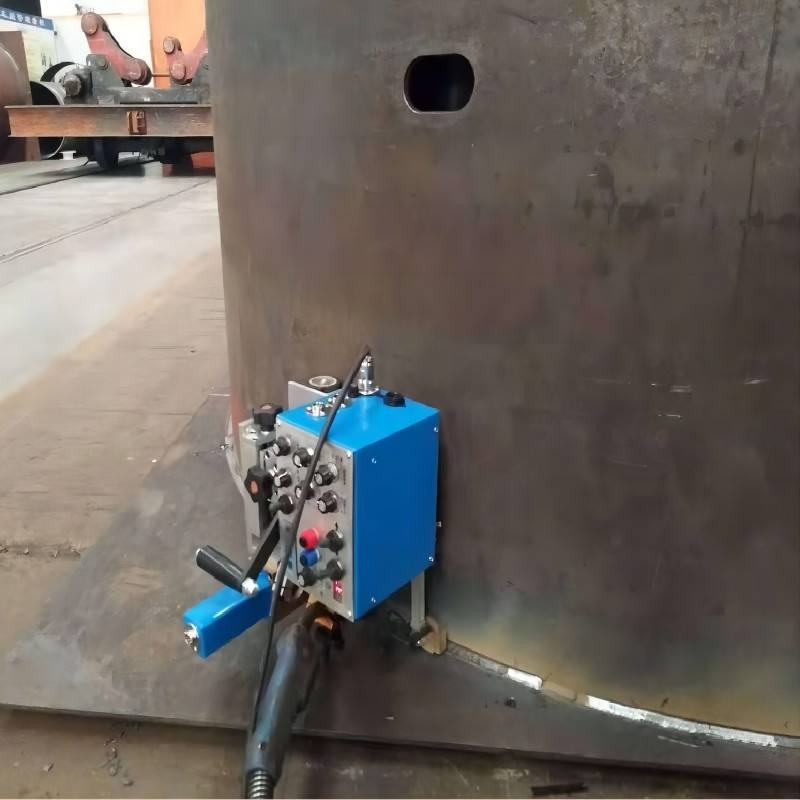
The core of a Tank Fillet Welding Machine is its drive system. for Bridge Trusses, which utilize thick-gauge carbon steel, the crawler must exert sufficient magnetic pull to overcome gravity while carrying the weight of the wire feeder and welding torch. High-strength permanent magnets or switchable electromagnets are integrated into the chassis, providing a traction force that ensures the unit does not slip during vertical climbs. This stability is the foundation of the narrow gap fillet welding process. When the machine moves at a controlled, synchronized speed, the heat input remains uniform across the entire length of the truss section, significantly reducing the risk of burn-through or cold laps.
Optimizing Narrow Gap Configurations for Heavy Plate
Narrow gap welding, traditionally associated with butt joints, has been adapted for fillet applications in bridge trusses to minimize the volume of filler metal required. By reducing the included angle of the weld preparation or utilizing a tighter root opening, engineers can decrease the number of passes needed to achieve the design throat thickness. This optimization leads to several industrial advantages:
- Reduced total heat input, which minimizes the Heat Affected Zone (HAZ).
- Lower consumption of welding consumables (wire and shielding gas).
- Decreased cycle times per joint, increasing overall project throughput.
- Minimal residual stress and angular distortion in the truss assembly.
For bridge trusses where plate thicknesses often exceed 25mm, managing the cooling rate and grain structure is essential for fatigue resistance. The mechanized crawler facilitates a multi-pass approach within the narrow gap, ensuring that each subsequent bead provides a tempering effect on the previous layer, enhancing the fracture toughness of the completed joint.
Electromechanical Parameters and Process Control
Precision in bridge truss construction requires rigorous control over electromechanical parameters. The tank fillet welding machine utilizes a closed-loop feedback system to regulate travel speed, typically ranging from 150 to 600 mm/min depending on the required leg size. The integration of Flux-Cored Arc Welding (FCAW) is preferred in field environments due to its high deposition rate and ability to withstand minor wind interference when compared to gas-metal arc welding. The machine’s control interface allows the operator to pre-set voltage and wire feed speed, ensuring that the arc remains stable within the confined geometry of the narrow gap.
Managing Slag and Interpass Cleaning
One of the primary technical hurdles in mechanized multi-pass welding is slag management. In narrow gap fillet joints, slag entrapment can lead to inclusions that compromise the ultrasonic testing (UT) results. Industrial engineers specify specialized flux formulations that produce “self-peeling” slag. As the magnetic crawler completes a pass, the thermal contraction of the slag allows it to detach from the weld face easily. This mechanical property is vital for continuous operation, as it reduces the downtime required for manual cleaning between passes, further optimizing the labor-to-output ratio on the job site.
Field Construction Stability and Environmental Variables
Field-deployed welding machines must contend with variables that are absent in a controlled factory setting. The magnetic crawler’s design includes ruggedized tracks that can navigate surface irregularities such as mill scale or light oxidation. Furthermore, the stability of the weld penetration is maintained through the use of mechanical sensors or contact guides that track the root of the fillet. These guides ensure that even if the truss member has slight dimensional deviations, the torch remains centered in the narrow gap, preventing asymmetrical weld profiles that could lead to stress concentrations.
Impact on Labor Efficiency and Safety
The implementation of automated crawlers fundamentally changes the labor dynamics of bridge construction. A single technician can oversee multiple machines, shifting the role from manual torch manipulation to process monitoring and quality assurance. This transition not only improves the ergonomic conditions for the workforce by removing them from the immediate vicinity of welding fumes and intense heat but also ensures a level of repeatability that is unattainable through manual means. From an industrial engineering perspective, the reduction in rework—caused by the consistency of the mechanized travel—is the most significant factor in maintaining project timelines and budgets.
Conclusion and Metallurgical Integrity
The synergy between magnetic crawler technology and narrow gap welding techniques represents a significant advancement in bridge truss fabrication. By prioritizing mechanical stability and precise parameter control, these machines deliver high-quality fillet welds that meet the stringent requirements of modern infrastructure. The focus remains on the metallurgical integrity of the joint, where controlled heat input and consistent penetration profiles ensure that the bridge can withstand decades of cyclic loading. As truss designs become more complex and material specifications more demanding, the reliance on stable, mechanized field welding solutions will continue to be a cornerstone of efficient structural engineering.
-


LT240S tube laser cutting machine
-
LT120S tube laser cutting machine
-
Sale

Tank Fillet Welding Machine
Original price was: $1,000.00.$900.00Current price is: $900.00. -
Sale

MAK100 tube laser cutting machine
Original price was: $5,500.00.$5,000.00Current price is: $5,000.00. -

portable plasma air cutting machine
$1,200.00 -

2in1 fiber laser cutting machine
-

Air cooling Laser welding machine
-

HF h beam laser cutting machine
-

LT240 laser cutting machine
-

Laser welding machine
-


Cobotic Welding Station
-

Gantry welding robot solution
-

Tracked Wheeled AGV Welding robot
-

LFH6020 Fiber laser cutting machine
-
LFP6020
-

robotic welidng machine
