Optimization of Bridge Truss Fabrication via Automated Fillet Welding
In the domain of heavy civil infrastructure, the fabrication of bridge trusses demands a rigorous adherence to structural tolerances and weld quality. The traditional reliance on manual shielded metal arc welding (SMAW) or semi-automatic gas metal arc welding (GMAW) often encounters bottlenecks during the assembly of large-scale box girders and truss nodes. As an industrial engineer, the objective is to maximize the duty cycle and deposition rate while minimizing the defect rate. The introduction of the magnetic crawler welding machine provides a specialized solution for these challenges, particularly when dealing with long-stretching fillet welds and the restrictive geometries of narrow gap configurations.
The primary engineering challenge in bridge truss construction is maintaining consistency across thousands of meters of weld beads. These joints are often situated in positions that are ergonomically taxing for human operators, leading to variability in travel speed and torch angle. By transitioning to a mechanized crawler system, the process becomes a controlled mechanical operation where variables such as wire feed speed, voltage, and travel velocity are pre-set and strictly maintained.
Mechanics of the Magnetic Crawler in Field Construction
Field construction environments are inherently unstable compared to controlled shop settings. Factors such as wind, uneven surfaces, and the orientation of the steel members (vertical or overhead) necessitate a robust locomotion system. The Tank Fillet Welding Machine utilizes high-force permanent magnets or electromagnets integrated into its drive wheels or track system. This ensures field construction stability by maintaining a constant perpendicular force against the workpiece.
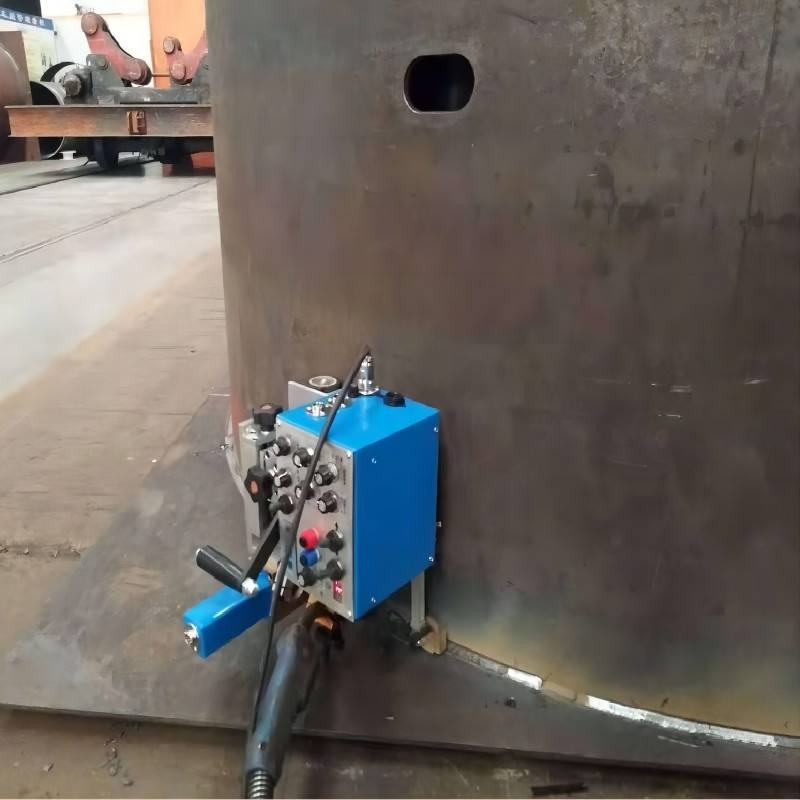
The traction force must be calculated to exceed the combined weight of the carriage, the wire feeder, and the tension of the umbilical cables. for Bridge Trusses, where members are often inclined, the magnetic grip prevents slippage, which is critical for maintaining a uniform weld throat thickness. The design of these crawlers typically incorporates a four-wheel drive system with independent suspension to navigate slight surface irregularities or mill scale commonly found on structural steel.
Addressing Narrow Gap Geometries
Bridge truss nodes frequently involve acute angles and restricted access points where standard welding equipment cannot maneuver. Narrow gap fillet welding techniques integrated into compact crawlers allow for deep penetration in confined spaces. The machine’s torch arm is designed with a low-profile adjustment mechanism, enabling it to reach into the “V” or “L” joints of the truss assembly.
In these narrow configurations, the risk of lack of side-wall fusion is high. To mitigate this, the crawler utilizes a precise oscillation unit. This mechanical weave ensures that the arc dwells sufficiently at the toes of the fillet weld, promoting optimal wetting and reducing the likelihood of undercut. The industrial engineer must calibrate the oscillation width and frequency based on the plate thickness and the specified leg length of the fillet to ensure compliance with AWS D1.5 Bridge Welding Code.
Technological Integration and Duty Cycle Improvements
From a productivity standpoint, the transition from manual to automated fillet welding drastically alters the project timeline. A manual welder typically operates at a 20% to 30% duty cycle due to the need for repositioning, electrode changes, and physical fatigue. In contrast, a magnetic crawler can operate at duty cycles exceeding 70%.
The integration of a continuous wire feed system (GMAW or FCAW) allows for non-stop welding over the entire length of a truss chord. By using large-diameter wire spools mounted either on the carriage or a secondary trolley, the number of starts and stops is significantly reduced. Each start and stop in a weld is a potential point of failure; therefore, reducing these instances directly improves the structural integrity of the bridge truss.
Thermal Management and Heat Input Control
Structural steel used in bridge construction is sensitive to heat input, which can affect the Heat Affected Zone (HAZ) and lead to distortion or reduced toughness. The mechanized travel speed of a tank fillet welding machine provides a uniform heat input profile. Unlike manual welding, where travel speed may fluctuate, the crawler ensures a steady Joules per millimeter (J/mm) ratio.
Industrial engineers utilize the crawler’s digital control interface to lock in parameters that satisfy the Weld Procedure Specification (WPS). This precision is vital when working with high-strength low-alloy (HSLA) steels. By maintaining a constant speed, the cooling rate of the weld metal is stabilized, leading to a more predictable grain structure and mechanical properties in the finished joint.
Stability Factors in Multi-Pass Fillet Welds
For heavy-duty bridge trusses, a single pass is often insufficient to achieve the required fillet size. The bridge truss fabrication process frequently requires multi-pass welding. The magnetic crawler’s ability to track the same path with high repeatability is a significant advantage here. Some units are equipped with guide rollers that track the vertical member of the fillet, ensuring that subsequent layers are deposited with the correct overlap and bead placement.
This mechanical tracking eliminates the “wandering” effect often seen in long manual welds. The result is a clean, ripple-free surface finish that requires minimal post-weld grinding. This reduction in secondary operations is a key metric in lean manufacturing, as it frees up labor for other critical assembly tasks.
Economic Impact and Safety Considerations
The economic justification for deploying magnetic crawlers involves a multi-factor ROI analysis. While the initial capital expenditure for the machine is higher than manual setups, the reduction in man-hours per ton of steel is substantial. Furthermore, the decrease in non-destructive testing (NDT) failures leads to massive savings in rework costs. In bridge construction, repairing a defective internal fillet weld in a box girder is exponentially more expensive than performing it correctly the first time.
Safety is the final, yet perhaps most important, pillar. Automated welding removes the operator from the immediate vicinity of the welding arc and the concentrated fumes. In the context of bridge truss fabrication, where welding often occurs at height or in cramped quarters, the crawler allows the operator to monitor the process from a safer, more ergonomic distance using a remote pendant. This reduces the risk of falls, respiratory issues, and flash burns.
Conclusion
The application of magnetic crawler machines for narrow gap fillet welding represents a necessary evolution in bridge truss fabrication. By prioritizing field construction stability and mechanical precision, these systems address the inherent limitations of manual labor. For the industrial engineer, these tools are not merely equipment but essential components of a high-efficiency production system that ensures the longevity and safety of critical public infrastructure.
-


LT240S tube laser cutting machine
-
LT120S tube laser cutting machine
-
Sale

Tank Fillet Welding Machine
Original price was: $1,000.00.$900.00Current price is: $900.00. -
Sale

MAK100 tube laser cutting machine
Original price was: $5,500.00.$5,000.00Current price is: $5,000.00. -

portable plasma air cutting machine
$1,200.00 -

2in1 fiber laser cutting machine
-

Air cooling Laser welding machine
-

HF h beam laser cutting machine
-

LT240 laser cutting machine
-

Laser welding machine
-


Cobotic Welding Station
-

Gantry welding robot solution
-

Tracked Wheeled AGV Welding robot
-

LFH6020 Fiber laser cutting machine
-
LFP6020
-

robotic welidng machine
