Engineering Standards in Bridge Truss Fillet Welding
Bridge truss fabrication demands rigorous adherence to structural integrity standards, as these components are subject to high fatigue cycles and immense dead loads. Traditionally, the welding of stiffeners and flange-to-web connections relied heavily on manual labor, which introduces variables in weld bead consistency and penetration depth. To mitigate these risks, industrial engineers are increasingly specifying the use of the Magnetic Crawler Welding system. This specialized machinery is designed to traverse the long, linear joints of bridge trusses with a level of precision that manual operators cannot maintain over extended shifts.
The core objective in bridge truss assembly is achieving a high-quality fillet weld that minimizes the Heat Affected Zone (HAZ) while ensuring structural convergence. The introduction of the narrow gap technique into the fillet welding process allows for a significant reduction in the volume of filler metal required. Unlike standard wide-angle grooves, the narrow gap approach utilizes a tighter bevel or a square butt configuration with minimal clearance, necessitating a machine that can provide absolute torch stability and consistent wire positioning.
Mechanical Design and Field Construction Stability
Field construction of bridges presents environmental challenges, including wind, uneven surfaces, and fluctuating temperatures. A standard wheeled carriage often loses traction or veers off track when encountering surface scale or slight inclines. The magnetic crawler addresses this through high-force permanent magnets integrated into the drive system. These magnets provide a constant downforce, effectively “locking” the machine onto the steel substrate. This magnetic adhesion is critical for maintaining a constant distance between the contact tip and the workpiece, which is the primary factor in voltage stability.
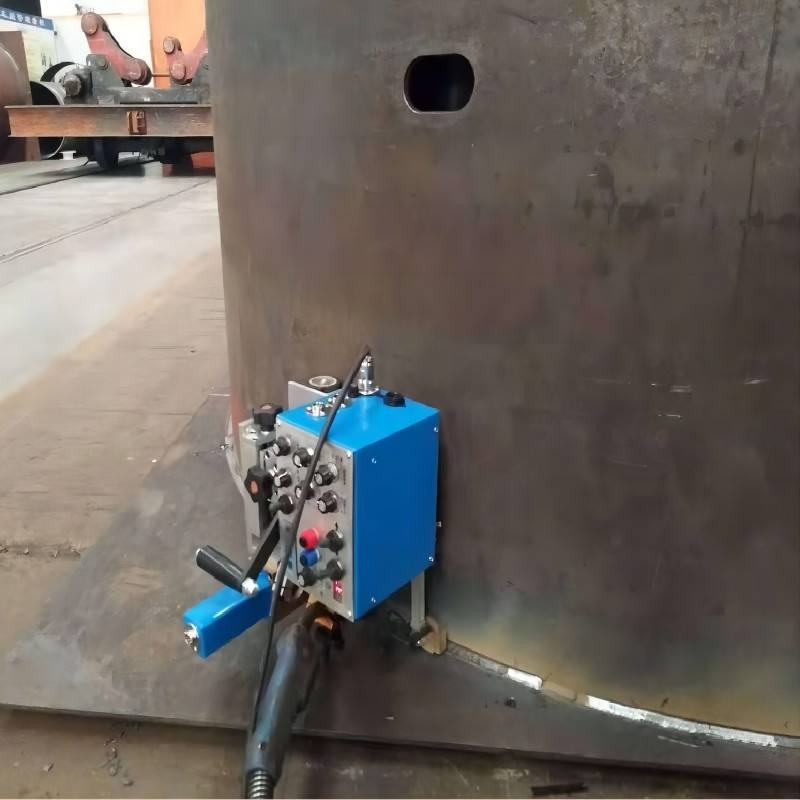
From an engineering standpoint, the stability of the Narrow Gap Technique depends on the machine’s ability to resist external vibrations. In bridge trusses, where long spans of steel can act as resonators for surrounding construction activity, the magnetic crawler’s low center of gravity and high-torque motor drive ensure that the welding arc remains centered in the joint. This eliminates the “arc wander” typically associated with lighter, non-magnetic portable tractors.
Optimizing Fillet Weld Penetration and Geometry
The geometry of a fillet weld in a bridge truss determines its load-bearing capacity. Engineers focus on the “effective throat” of the weld. When employing narrow gap parameters, the Fillet Weld Penetration is enhanced by the concentrated heat input. Because the machine moves at a calibrated, steady travel speed, the energy density is focused directly into the root of the joint. This is particularly advantageous when dealing with thick plate sections common in modern bridge design, where traditional methods might result in lack of fusion at the root.
The magnetic crawler is equipped with fine-tuning adjustment slides for both horizontal and vertical torch positioning. This allows for the “lead-lag” angle of the torch to be set according to the specific metallurgy of the bridge steel, such as HPS 70W (High-Performance Steel). By maintaining a consistent 45-degree angle (or specified offset), the machine ensures that the leg lengths of the fillet are equal, preventing stress concentrations that could lead to premature fatigue cracking.
Technical Advantages of Narrow Gap Parameters
Implementing narrow gap welding via a magnetic crawler offers several quantifiable benefits to the production cycle:
First, the reduction in groove angle leads to a decrease in the number of weld passes required. For a standard 90-degree fillet, the volume of weld metal increases exponentially with the leg size. In a narrow gap configuration, the weld path is optimized to fill the joint with fewer layers, directly reducing the total arc time and consumable costs. This is a vital metric for project managers looking to meet tight bridge commissioning deadlines.
Second, the localized heat input reduces angular distortion. One of the primary headaches in Bridge Truss Fabrications is the “oil-canning” or bowing of web plates due to excessive heat. By using a machine-controlled narrow gap process, the thermal input is restricted to a narrower corridor, preserving the flatness of the plates and reducing the need for post-weld heat straightening.
Operational Efficiency and Duty Cycle
Manual welding is often limited by a 30-40% duty cycle due to operator fatigue and the need for frequent repositioning. A magnetic crawler tank welding machine operates at a duty cycle nearing 80-90%. Once the machine is indexed to the joint and the parameters are set, it can execute continuous welds over the entire length of a truss member, which may span 10 to 20 meters.
This continuous operation not only speeds up the fabrication process but also eliminates the “stop-start” points that are notorious for containing defects like craters, porosity, or cold laps. In the context of bridge engineering, every stop-start is a potential point of failure during ultrasonic or radiographic testing. By automating the travel via a crawler, the number of these vulnerable points is reduced by over 90%.
Adaptability to Complex Truss Configurations
Bridge trusses are rarely simple flat surfaces. They involve gusset plates, stiffeners, and interlocking geometries. The compact footprint of a Tank Fillet Welding Machine allows it to operate in confined spaces where larger gantry systems cannot reach. The magnetic wheels allow the machine to climb vertically or run inverted if necessary, provided the safety tethering protocols are followed.
The control interface on these units is typically ruggedized for field use, allowing operators to adjust wire feed speed and travel speed in real-time. This is essential when the gap in the truss fit-up varies slightly due to fabrication tolerances. The operator can compensate for a slightly wider gap by slowing the travel speed, ensuring the throat thickness remains within specification without stopping the process.
Economic Impact and Quality Assurance
The shift toward magnetic crawler systems in bridge truss construction is driven by the bottom line. While the initial capital expenditure for the machine is higher than a manual power source, the return on investment (ROI) is realized through the reduction of rework. In bridge construction, the cost of grinding out a failed weld and re-welding it in the field can be ten times the cost of the initial weld.
Furthermore, the data logging capabilities of modern crawler systems allow engineers to track the parameters used for every joint. This creates a digital twin of the fabrication process, providing proof of compliance with AWS D1.5 (Bridge Welding Code). When a machine maintains the voltage and amperage within the specified range for 100% of the weld length, the confidence in the structural integrity of the bridge truss is significantly higher than with manual application.
Conclusion of Technical Implementation
The integration of magnetic crawler machines with narrow gap fillet welding represents a peak efficiency state for bridge truss fabrication. By focusing on mechanical stability, consistent travel speeds, and optimized joint geometry, these systems provide a robust solution to the challenges of field construction. The result is a bridge structure with superior fatigue resistance, lower fabrication costs, and a streamlined path to project completion. For the industrial engineer, the choice of a magnetic crawler is not just about automation—it is about controlling the variables of metallurgy and physics in a demanding environment.
-


LT240S tube laser cutting machine
-
LT120S tube laser cutting machine
-
Sale

Tank Fillet Welding Machine
Original price was: $1,000.00.$900.00Current price is: $900.00. -
Sale

MAK100 tube laser cutting machine
Original price was: $5,500.00.$5,000.00Current price is: $5,000.00. -

portable plasma air cutting machine
$1,200.00 -

2in1 fiber laser cutting machine
-

Air cooling Laser welding machine
-

HF h beam laser cutting machine
-

LT240 laser cutting machine
-

Laser welding machine
-


Cobotic Welding Station
-

Gantry welding robot solution
-

Tracked Wheeled AGV Welding robot
-

LFH6020 Fiber laser cutting machine
-
LFP6020
-

robotic welidng machine
