Optimization of Tank Fillet Welding in Field Environments
In the construction of large-scale storage tanks and pressure vessels, the fillet weld joining the tank shell to the bottom plate represents one of the most critical structural junctions. Industrial engineering requirements for these joints prioritize penetration depth, consistent bead geometry, and metallurgical integrity. Manual welding of these long-circumference seams often results in operator fatigue and inconsistent weld profiles, leading to potential points of failure under hydrostatic pressure.
The transition toward Tank Fillet Welding automation using specialized mechanized systems addresses these variables. Unlike stationary factory setups, field construction requires equipment that can handle the irregularities of site-built foundations and atmospheric fluctuations. The use of a mechanized crawler allows for a continuous welding process that maintains a steady travel speed, which is the primary variable in controlling heat input and the resulting Heat Affected Zone (HAZ).
The Role of the Magnetic Crawler in Vertical and Horizontal Stability
The core of field-stable automation is the Magnetic Crawler. These machines utilize high-strength permanent magnets or controlled electromagnets to adhere to the steel shell of the pressure vessel. This adhesion is critical for maintaining the torch’s orientation relative to the joint, especially when the crawler must navigate the slight curvatures of large-diameter tanks.
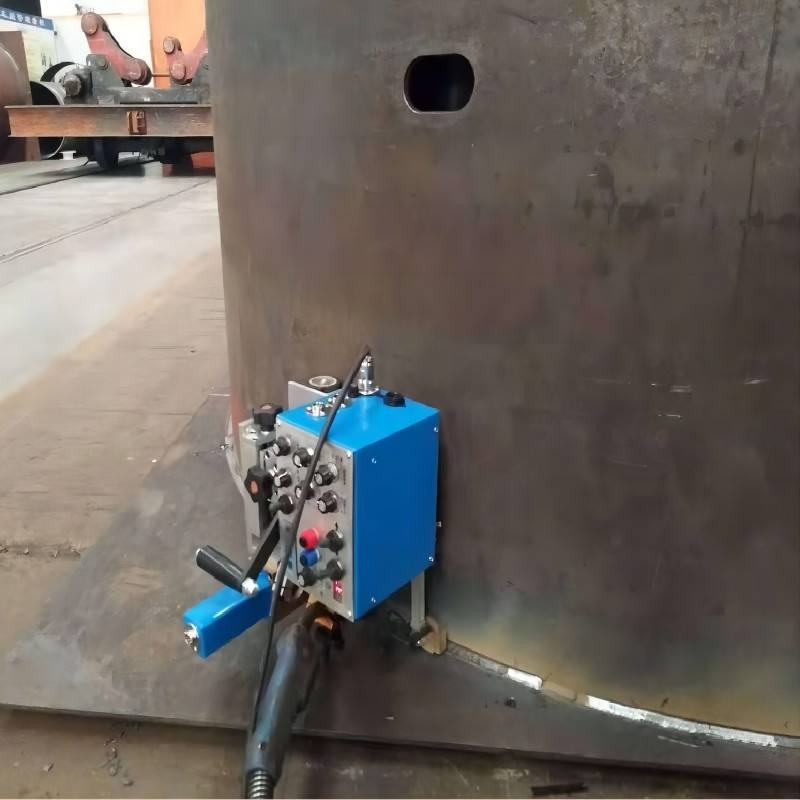
Mechanical Adhesion and Traction Control
Stability in a field environment is often compromised by surface contaminants such as mill scale, light rust, or moisture. A heavy-duty magnetic drive system ensures that the wheels maintain constant traction, preventing the “slippage” that causes irregular bead spacing. By providing a stable platform for the welding torch, the crawler eliminates the oscillations common in manual operation.
Four-Wheel Drive Systems and Surface Clearance
Industrial-grade crawlers are engineered with high-torque motors and a four-wheel-drive configuration. This setup allows the machine to traverse over tack welds and minor surface plate misalignments without deviating from the intended weld path. The low center of gravity ensures that the weight of the wire feeder and cables does not tip the machine or pull the torch out of the root of the fillet.
Integrating Arc Voltage Control (AVC) for Quality Assurance
While travel speed is managed by the crawler’s drive system, the distance between the welding tip and the workpiece—the arc length—must be managed dynamically. This is where Arc Voltage Control (AVC) becomes indispensable. In the context of pressure vessel fabrication, even a millimeter of deviation in the vertical position of the torch can result in undercut or lack of fusion.
The Feedback Loop Mechanism
AVC works by monitoring the voltage across the welding arc in real-time. Since voltage is directly proportional to the arc length in a constant current or controlled-voltage environment, the system can detect changes in the distance between the torch and the weld pool. If the plate ripples or if the crawler encounters a slight incline, the AVC system sends a signal to a motorized vertical slide to raise or lower the torch instantly.
Maintaining Constant Penetration
For fillet welds on pressure vessels, consistent penetration into the root is non-negotiable. AVC ensures that the arc energy remains focused exactly where it is needed. By keeping the arc length constant, the system prevents the fluctuations in current that would otherwise occur, leading to a uniform weld puddle and a bead profile that meets rigorous X-ray and ultrasonic testing standards.
Throughput Efficiency and Weld Deposition Rates
From a production engineering standpoint, the primary objective is to maximize the mass of weld metal deposited per hour without compromising quality. Mechanized tank welding significantly increases the “arc-on” time compared to manual stick (SMAW) or semi-automatic flux-cored (FCAW) welding.
Continuous Feeding and Duty Cycles
Manual welders typically operate at a 30-40% duty cycle due to the need for repositioning and electrode changes. A magnetic crawler system, integrated with a large-capacity wire drum, can operate at duty cycles exceeding 80%. This throughput is vital for meeting the tight deadlines of Pressure Vessel Fabrication projects, where site availability and weather windows are limited.
Reduction in Rework and Grinding
The precision of an AVC-equipped crawler results in a smoother finish that requires minimal post-weld cleaning. In manual welding, the stop-start points are often the sites of porosity or slag inclusions. A mechanized system allows for long, continuous runs—sometimes encompassing the entire circumference of a tank section—thereby reducing the number of tie-ins and the associated risk of defects.
Environmental Adaptability and Field Construction Challenges
Unlike factory-based automation, field welding equipment must be ruggedized for harsh environments. The electronic components of the crawler and the AVC controller are typically housed in IP-rated enclosures to protect against dust, wind-blown sand, and humidity.
Managing Wind and Gas Shielding
In field conditions, wind can easily displace shielding gas, leading to porosity. Mechanized crawlers allow for the attachment of customized gas shrouds or “wind screens” that travel with the torch. This maintains a stable gas envelope around the weld pool, which is much harder to achieve when a manual welder is constantly moving their hand and body.
Power Supply Integration
Industrial tank welding machines are designed to interface with standard CC/CV power sources. The integration allows the crawler to synchronize its movement with the power source’s ramp-up and crater-fill functions. This ensures that the beginning and end of each weld segment are as structurally sound as the middle.
Technical Specification Overview for Industrial Engineers
When specifying a tank fillet welding system, several technical parameters must be evaluated to ensure compatibility with the project’s metallurgy and plate thickness.
Travel Speed Range
Standard systems should offer a range of 100 mm/min to 1000 mm/min. This flexibility allows the engineer to adjust the heat input according to the cooling rate requirements of the specific steel grade used in the vessel.
AVC Sensitivity and Response Time
The response time of the AVC motor should be in the millisecond range. This is necessary to compensate for high-frequency vibrations or rapid changes in plate topography encountered during field assembly.
Magnetic Adhesion Force
For vertical applications, the magnetic pull-off force must be rated at least three times the total weight of the crawler, torch, and lead package to ensure a safety factor against accidental detachment.
Conclusion
The implementation of magnetic crawler systems with Arc Voltage Control represents a pragmatic leap in tank construction technology. By focusing on mechanical stability and arc precision, industrial operations can achieve high-quality fillet welds that satisfy the most stringent pressure vessel codes. The shift from manual labor to mechanized control not only increases the deposition rate but also creates a safer, more predictable construction environment where structural integrity is a result of engineered precision rather than variable human technique.
-


LT240S tube laser cutting machine
-
LT120S tube laser cutting machine
-
Sale

Tank Fillet Welding Machine
Original price was: $1,000.00.$900.00Current price is: $900.00. -
Sale

MAK100 tube laser cutting machine
Original price was: $5,500.00.$5,000.00Current price is: $5,000.00. -

portable plasma air cutting machine
$1,200.00 -

2in1 fiber laser cutting machine
-

Air cooling Laser welding machine
-

HF h beam laser cutting machine
-

LT240 laser cutting machine
-

Laser welding machine
-


Cobotic Welding Station
-

Gantry welding robot solution
-

Tracked Wheeled AGV Welding robot
-

LFH6020 Fiber laser cutting machine
-
LFP6020
-

robotic welidng machine
