Mechanized Fillet Welding in Field Storage Tank Construction
In the construction of upstream and downstream storage assets, specifically those governed by API 650 and API 620 standards, the integrity of the shell-to-bottom weld is paramount. This critical fillet joint bears the hydrostatic load of the stored medium and the structural weight of the shell plates. Traditionally, this process relied on manual or semi-automatic methods which are prone to inconsistencies due to operator fatigue and environmental variables. The introduction of a specialized Tank Fillet Welding Machine has shifted the baseline for field productivity and weld quality.
The primary challenge in field welding is the lack of a controlled environment. Unlike shop fabrication, field assembly involves irregular fit-up gaps, wind interference, and varying plate surface conditions. To maintain a high-quality fillet profile, the welding system must provide mechanical stability and real-time parameter adjustment. This is achieved through the integration of a heavy-duty carriage system designed for continuous operation along the tank’s circumference.
The Role of the Magnetic Crawler in Stability
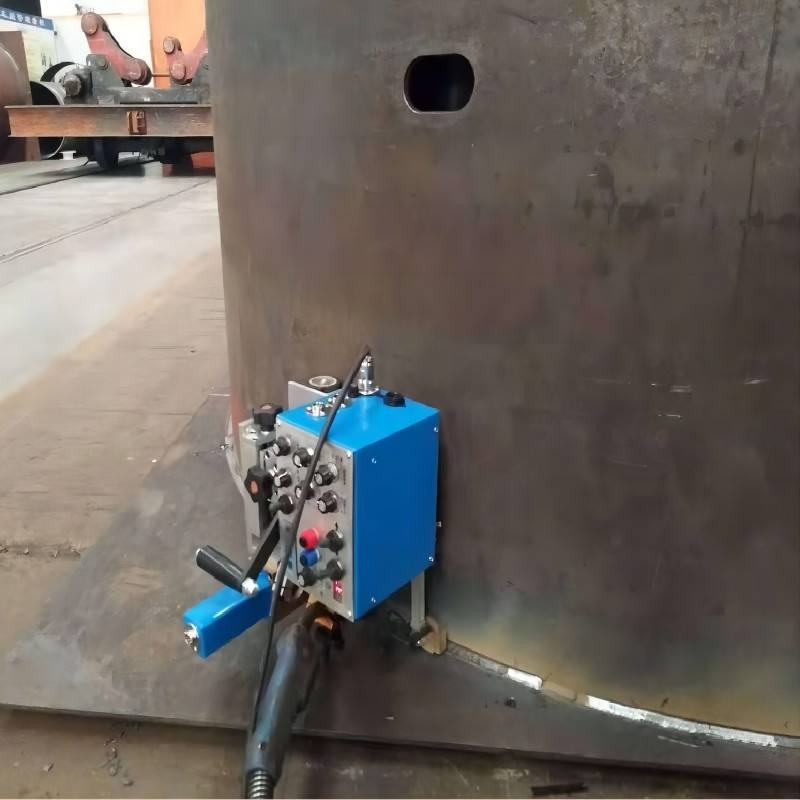
Stability is the foundation of any mechanized welding process. In tank construction, the welding carriage must navigate the curvature of the tank shell while maintaining a precise torch angle relative to the joint. A Magnetic Crawler utilizes high-flux permanent magnets or electromagnets to provide the necessary adhesion force against the vertical shell plate.
Adhesion and Traction Mechanics
The magnetic wheels or tracks serve two functions: they prevent the carriage from drifting away from the joint and ensure consistent travel speeds. In fillet welding, the crawler typically tracks the corner where the vertical shell meets the horizontal bottom plate. The magnetic force must be calibrated to overcome the weight of the welding head, wire feeder, and umbilical cables, while still allowing for smooth motion over surface scale or minor plate misalignments.
Tracking Precision
Mechanical guide rollers usually complement the magnetic drive. These rollers physically reference the vertical shell, ensuring that the torch remains centered in the joint. By utilizing a four-wheel drive configuration with high-torque stepper motors, the system maintains a constant travel speed, which is a vital variable in calculating heat input and ensuring uniform leg length of the fillet weld.
Arc Voltage Control (AVC) Systems
While mechanical tracking manages the X and Y axes, the Z-axis (the distance between the contact tip and the workpiece) is managed by the Arc Voltage Control system. In long-distance fillet welds, the distance between the torch and the weld pool can fluctuate due to plate warping or slight deviations in the crawler’s path.
The Physics of AVC
Arc voltage is directly proportional to the arc length. As the distance increases, the voltage rises; as it decreases, the voltage drops. The AVC system continuously monitors these voltage fluctuations and signals a motorized slide to move the torch up or down to maintain a pre-set voltage. This ensures that the arc remains stable and the penetration profile is consistent throughout the entire circumference of the tank.
Compensating for Field Irregularities
Field-erected tanks often exhibit “waviness” in the bottom plates. Without AVC, a fixed-height torch would either stub the electrode into the puddle or create an excessively long arc, leading to porosity and lack of fusion. The automated response of the AVC system allows the Storage Tank Construction team to achieve shop-quality welds in a field environment, significantly reducing the rate of weld repair and radiographic failure.
Optimizing Deposition Rates and Weld Quality
The transition from manual stick welding (SMAW) to mechanized Gas Metal Arc Welding (GMAW) or Flux-Cored Arc Welding (FCAW) using a crawler significantly increases the deposition rate. However, high-speed welding requires tighter control over parameters that only a mechanized system can provide.
Heat Input Management
Industrial engineers focus on the Cooling Rate (t8/5) to ensure the Heat Affected Zone (HAZ) maintains its mechanical properties. A mechanized fillet welder allows for precise control over the travel speed. By locking in the wire feed speed and voltage through the AVC, the engineer can ensure that the heat input remains within the qualified Welding Procedure Specification (WPS) limits, preventing grain coarsening or hydrogen-induced cracking in high-tensile steel plates.
Consistency of the Fillet Profile
In tank construction, the fillet weld must have a specific leg length and a slightly convex or flat profile. Excessive convexity can create stress concentrations, while undercut at the toe of the weld is a major cause of structural failure. The steady movement of the magnetic crawler, combined with the AVC’s ability to maintain a constant arc plasma column, results in a uniform bead ripple and consistent toe wetting, which are difficult to replicate manually over hundreds of linear meters.
Operational Efficiency in Large Scale Projects
The implementation of a Magnetic Crawler system provides quantifiable improvements in project timelines. A single operator can often manage two machines simultaneously, doubling the output per man-hour. Because the machine does not require frequent stops to change electrodes (as in SMAW), the “arc-on” time is significantly higher.
Reduction in Post-Weld Processing
Mechanized welds produce less spatter and a cleaner finish compared to manual processes. For the tank contractor, this means less time spent on grinding and cleaning before vacuum box testing or dye penetrant inspection. The precision of the AVC also minimizes the risk of over-welding, which reduces filler metal consumption and prevents unnecessary distortion of the bottom plates.
Durability in Harsh Environments
Field welding equipment must withstand dust, heat, and humidity. Modern tank fillet welders are engineered with IP-rated enclosures for the electronic controls and ruggedized motors that can handle the high duty cycles required for 24/7 construction schedules. The integration of quick-release mechanisms for the torch and wire spool allows for rapid setup and teardown, which is essential as the project moves from one tank to the next.
Conclusion: Engineering Reliability
For the industrial engineer, the choice to utilize a mechanized tank fillet welding machine with Arc Voltage Control is a decision based on risk mitigation and process optimization. By removing the variables of manual torch manipulation and replacing them with a stable magnetic crawler and a responsive AVC loop, the construction process becomes a predictable industrial operation rather than a variable craft. This transition is essential for the oil and gas industry, where the structural integrity of storage infrastructure is non-negotiable and the costs of field repairs are prohibitive. The synergy between mechanical adhesion and electronic arc regulation represents the current peak of field-based welding technology for large-scale tank erection.
[END]
-


LT240S tube laser cutting machine
-
LT120S tube laser cutting machine
-
Sale

Tank Fillet Welding Machine
Original price was: $1,000.00.$900.00Current price is: $900.00. -
Sale

MAK100 tube laser cutting machine
Original price was: $5,500.00.$5,000.00Current price is: $5,000.00. -

portable plasma air cutting machine
$1,200.00 -

2in1 fiber laser cutting machine
-

Air cooling Laser welding machine
-

HF h beam laser cutting machine
-

LT240 laser cutting machine
-

Laser welding machine
-


Cobotic Welding Station
-

Gantry welding robot solution
-

Tracked Wheeled AGV Welding robot
-

LFH6020 Fiber laser cutting machine
-
LFP6020
-

robotic welidng machine
