Optimizing Oil and Gas Storage Tank Construction via Automated Fillet Welding
In the industrial landscape of oil and gas storage, the integrity of the fillet welds connecting the tank shell to the bottom plates and the various reinforcing pads is critical. These structures, often built under API 650 or 653 standards, demand rigorous adherence to weld procedures to prevent catastrophic leaks or structural failures. Traditional manual welding in the field presents significant challenges, including operator fatigue, inconsistent travel speeds, and varying arc lengths due to the massive physical scale of the tanks. The shift toward a specialized Tank Fillet Welding Machine represents a move toward standardized mechanical precision in field environments.
Unlike general-purpose welding carriages, a dedicated tank fillet welder must provide high-torque propulsion and extreme stability on vertical or curved surfaces. The mechanical objective is to replace the variable nature of human movement with a constant, repeatable travel speed that synchronizes with the deposition rate of the filler metal. This synchronization ensures that the weld throat thickness remains uniform across hundreds of linear meters of joint length, a feat nearly impossible to achieve manually without significant rework.
The Mechanics of the Magnetic Crawler System
Surface Adhesion and Drive Stability
The core of a field-ready fillet welding machine is its Magnetic Crawler chassis. In oil and gas tank construction, the materials are typically ferromagnetic carbon steels. Utilizing high-strength permanent magnets, the crawler generates a powerful clamping force that allows it to maintain its position on the vertical shell plates or the horizontal floor plates without slipping. This adhesion is critical for maintaining the torch orientation relative to the fillet joint.
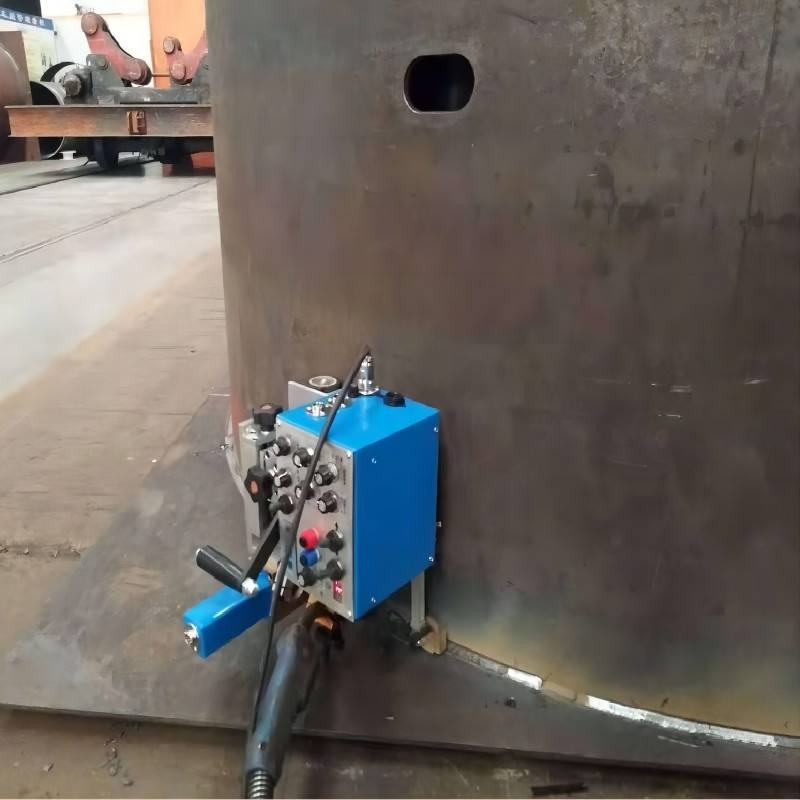
From an engineering perspective, the drive system must account for the friction of the plate surface, which is often coated with primer or affected by environmental moisture. Four-wheel drive systems powered by high-reduction gear motors provide the necessary torque to move the welding torch, wire feeder, and cabling. This mechanical stability is the foundation of Field Construction Stability, ensuring that vibrations or uneven plate transitions do not translate into defects in the weld bead.
Navigation and Tracking Precision
Fillet joints in tank construction are rarely perfectly linear. The crawler must navigate the circumference of the tank while staying locked into the corner of the shell-to-bottom joint. Guide rollers or specialized tracking arms are employed to physically reference the joint, allowing the machine to follow the seam autonomously. This reduces the need for constant operator intervention, allowing one technician to oversee multiple machines, thereby increasing the overall project efficiency and deposition per man-hour.
Arc Voltage Control: The Technical Edge in Weld Consistency
The Fundamentals of AVC in Fillet Joints
Arc Voltage Control (AVC) is a feedback mechanism that monitors the voltage across the welding arc and adjusts the torch height to maintain a pre-set value. In the context of fillet welding, the distance between the contact tip and the workpiece (stick-out) is prone to fluctuation due to plate waviness, tack welds, or slight misalignments in the magnetic crawler’s path. Without AVC, these fluctuations lead to changes in current density and heat input, resulting in inconsistent penetration or undercut.
The AVC system utilizes a high-speed motorized slide that moves the torch toward or away from the joint in real-time. By keeping the arc voltage constant, the machine ensures that the arc length remains uniform. This is particularly vital in Gas Metal Arc Welding (GMAW) or Flux-Cored Arc Welding (FCAW) processes commonly used in tank farms, where the metal transfer mode must remain stable to avoid excessive spatter and ensure fusion at the root of the fillet.
Mitigating Field Irregularities
Field construction is an imperfect environment. Plates may have slight “oil-canning” effects or thermal distortion from previous weld passes. An AVC-equipped machine perceives these variations as changes in voltage. If the torch approaches a high spot on the plate, the voltage drops; the AVC system detects this instantly and retracts the torch to the correct distance. This level of dynamic adjustment ensures that the weld profile meets the structural requirements of the design engineer, regardless of the fit-up tolerances encountered on-site.
Process Efficiency and Deposition Rates
Maximized Duty Cycles
One of the primary metrics for an industrial engineer on a tank project is the duty cycle. Manual welders generally operate at a 30% to 40% duty cycle due to the need for breaks, repositioning, and cleaning. An automated tank fillet welding machine can operate at duty cycles exceeding 80%. As long as the wire spool is loaded and the gas supply is constant, the machine continues its traverse. This leads to a significant reduction in the total construction timeline for a tank farm project.
Heat Input and Metallurgical Integrity
Excessive heat input can lead to a large Heat-Affected Zone (HAZ), which can compromise the fracture toughness of the tank shell. By maintaining a constant travel speed and arc length, the automated machine ensures that the heat input (calculated as Kilojoules per millimeter) remains within the range specified by the Welding Procedure Specification (WPS). This level of control is essential when working with higher-strength steels where over-tempering can occur if the welding pace is too slow or inconsistent.
Overcoming Environmental Challenges
Wind and Shielding Gas Coverage
In field construction, wind is a constant adversary. While the machine handles the mechanical aspect of the weld, it also provides a stable platform for enhanced shielding gas delivery. Most tank fillet welders are fitted with custom shrouds or wind screens that travel with the carriage. This ensures that the shielding gas remains concentrated over the weld pool, preventing porosity and oxidation which are common in manual field welding during gusty conditions.
Operator Safety and Ergonomics
Welding large-diameter tanks often requires working in awkward positions for extended periods. By deploying a magnetic crawler, the operator is removed from the immediate vicinity of the welding fumes and intense UV radiation. The operator transitions from a manual laborer to a system technician, monitoring the arc through a remote pendant. This shift not only improves safety but also reduces the physical toll on the workforce, leading to higher quality output toward the end of a long shift.
Conclusion: The ROI of Automated Fillet Welding
The investment in a tank fillet welding machine with AVC is justified through the drastic reduction in non-destructive testing (NDT) failures. In the oil and gas industry, a single failed weld can require grinding, re-welding, and re-testing, costing thousands of dollars in labor and downtime. By ensuring high-quality, repeatable fillet welds through magnetic tracking and voltage stabilization, contractors can guarantee the structural longevity of the storage assets. The precision of the Arc Voltage Control combined with the ruggedness of the magnetic crawler creates a synergistic effect that elevates field construction to shop-quality standards.
-


LT240S tube laser cutting machine
-
LT120S tube laser cutting machine
-
Sale

Tank Fillet Welding Machine
Original price was: $1,000.00.$900.00Current price is: $900.00. -
Sale

MAK100 tube laser cutting machine
Original price was: $5,500.00.$5,000.00Current price is: $5,000.00. -

portable plasma air cutting machine
$1,200.00 -

2in1 fiber laser cutting machine
-

Air cooling Laser welding machine
-

HF h beam laser cutting machine
-

LT240 laser cutting machine
-

Laser welding machine
-


Cobotic Welding Station
-

Gantry welding robot solution
-

Tracked Wheeled AGV Welding robot
-

LFH6020 Fiber laser cutting machine
-
LFP6020
-

robotic welidng machine
