Precision Large Diameter Tube Laser Cutting for HVAC Duct Production
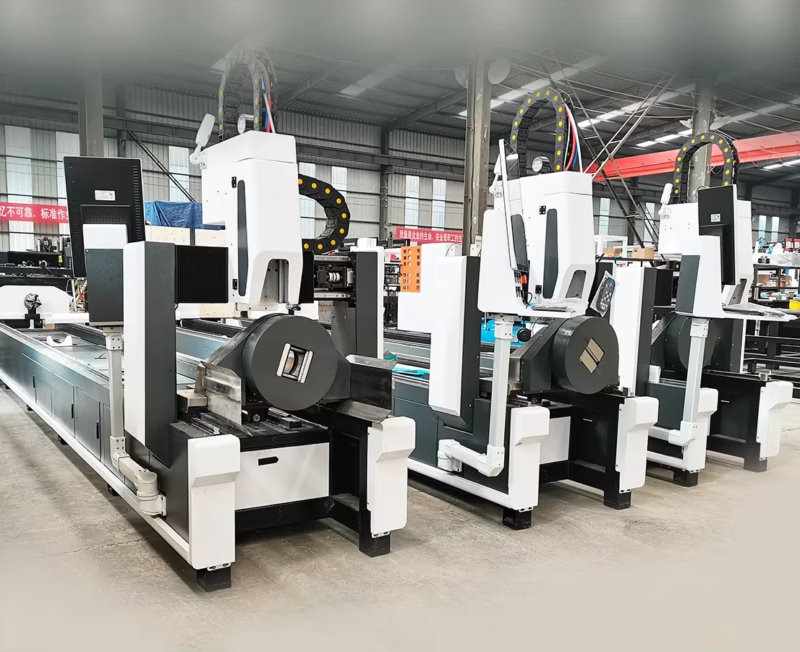
The manufacturing of commercial HVAC ducting requires the processing of large-diameter tubes, often ranging from 150mm to 500mm. Traditional fabrication methods, including manual plasma cutting, bandsawing, and manual layout marking, present significant bottlenecks in terms of throughput and material efficiency. The integration of high-power fiber laser source technology into the production line addresses these inefficiencies by automating the geometry calculation and cutting process.
Industrial HVAC requirements involve complex geometries, specifically regarding intersection holes for branch lines and miter joints for directional changes. Transitioning to an automated laser system equipped with intelligent nesting capabilities allows for a direct conversion of CAD files into machine code, eliminating manual measurement errors and ensuring a tolerance within +/- 0.1mm across large spans.
ROI and Cost Efficiency: Zero-Tailing and Labor Consolidation
The primary cost driver in tube fabrication is material waste. Standard tube laser cutters often leave a “tail” of 15cm to 30cm because the chuck cannot hold the tube close enough to the cutting head at the end of the stock. Advanced large-diameter cutters now utilize Zero-tailing technology. This involves a multi-chuck synchronization system—typically three or four chucks—that passes the material through the cutting zone. By shifting the grip between chucks during the final cut, the machine utilizes the entire length of the tube stock. This saves approximately 10-20cm of material per pipe. In high-volume operations where hundreds of tubes are processed weekly, the cumulative material savings can pay for the machine’s financing costs over a medium-term horizon.
Furthermore, labor substitution is a critical component of the ROI calculation. A manual fabrication workflow for a complex HVAC assembly typically requires a team of three to five workers: one for technical drawing and layout, two for material handling and marking, and two for manual cutting and deburring. A large-diameter tube laser replaces this entire sequence. A single operator can manage the Automatic loading system, monitor the cutting process, and unload finished parts. This consolidation allows manufacturers to reallocate skilled labor to higher-value assembly or installation tasks while maintaining a continuous production cycle.
Market Competitiveness: Lead Time and Complex Intersections
Lead time is the decisive factor in securing HVAC contracts for large-scale infrastructure projects. Manual processing of a batch of complex duct intersections can take up to three working days. An automated laser system reduces this timeframe to approximately three hours. This 90 percent reduction in processing time is achieved through the elimination of set-up changes and the high-speed capability of the laser head.
The Nesting software used in these machines handles high-difficulty intersection cutting with precision. For example, when a 400mm main duct requires a 200mm branch connection at a 45-degree angle, the software automatically calculates the saddle curve and compensates for the tube wall thickness. This ensures a perfect fit for welding, which further reduces assembly time. Because the laser creates a minimal Heat Affected Zone, the structural integrity of galvanized steel is preserved, and the edges remain clean and free of the dross typically associated with plasma cutting.
Technical Comparison Table: Manual vs. Automated Laser
| Metric | Manual Plasma/Sawing | Automated Tube Laser |
|---|---|---|
| Labor Force | 3 – 5 Workers | 1 Operator |
| Material Waste (per pipe) | 150mm – 300mm | 0mm – 20mm |
| Batch Lead Time | 3 Days | 3 Hours |
| Edge Quality | Rough / Slag Present | Finished / Clean |
| Dimensional Accuracy | +/- 2.0mm | +/- 0.1mm |
EHS and Compliance: Operational Safety and Training
Environment, Health, and Safety (EHS) compliance is increasingly scrutinized in industrial environments. Manual sawing and plasma cutting generate significant noise pollution (often exceeding 100 dB) and airborne metallic dust. Modern tube laser cutters are typically fully enclosed or equipped with localized high-efficiency particulate air (HEPA) extraction systems. This setup significantly reduces ambient noise and ensures that respirable dust is captured at the source, protecting the workforce and meeting internal air quality standards.
The demographic shift in the workforce also necessitates equipment that is accessible to younger operators. Traditional tube fabrication requires years of apprenticeship to master manual layout and specialized welding fit-ups. In contrast, the software interface of a modern laser cutter is designed for digital natives. Training for a new operator generally takes only two days. The first day focuses on the safety protocols and loading procedures, while the second day covers the basic operation of the nesting software and file importation. This rapid onboarding reduces the risk associated with skilled labor shortages and ensures that production is not dependent on a single highly specialized individual.
Conclusion on Strategic Implementation
Deploying a large-diameter tube laser for HVAC ducting is a strategic move that addresses the three core pillars of modern manufacturing: cost control, speed to market, and workplace safety. By utilizing zero-tailing technology, companies can immediately reduce their raw material expenditures by 5-10 percent. The ability to cut complex intersections with zero manual layout time allows for a much more aggressive bidding strategy on large-scale projects. Finally, the move toward an enclosed, automated system provides a cleaner, safer work environment and a faster training pathway for the next generation of industrial operators. In a market where margins are tightening, the shift from manual mechanical processing to intelligent laser automation is no longer optional for maintaining a competitive edge.
-


LT240S tube laser cutting machine
-
LT120S tube laser cutting machine
-
Sale

Tank Fillet Welding Machine
Original price was: $1,000.00.$900.00Current price is: $900.00. -
Sale

MAK100 tube laser cutting machine
Original price was: $5,500.00.$5,000.00Current price is: $5,000.00. -

portable plasma air cutting machine
$1,200.00 -

2in1 fiber laser cutting machine
-

Air cooling Laser welding machine
-

HF h beam laser cutting machine
-

LT240 laser cutting machine
-

Laser welding machine
-


Cobotic Welding Station
-

Gantry welding robot solution
-

Tracked Wheeled AGV Welding robot
-

LFH6020 Fiber laser cutting machine
-
LFP6020
-

robotic welidng machine
